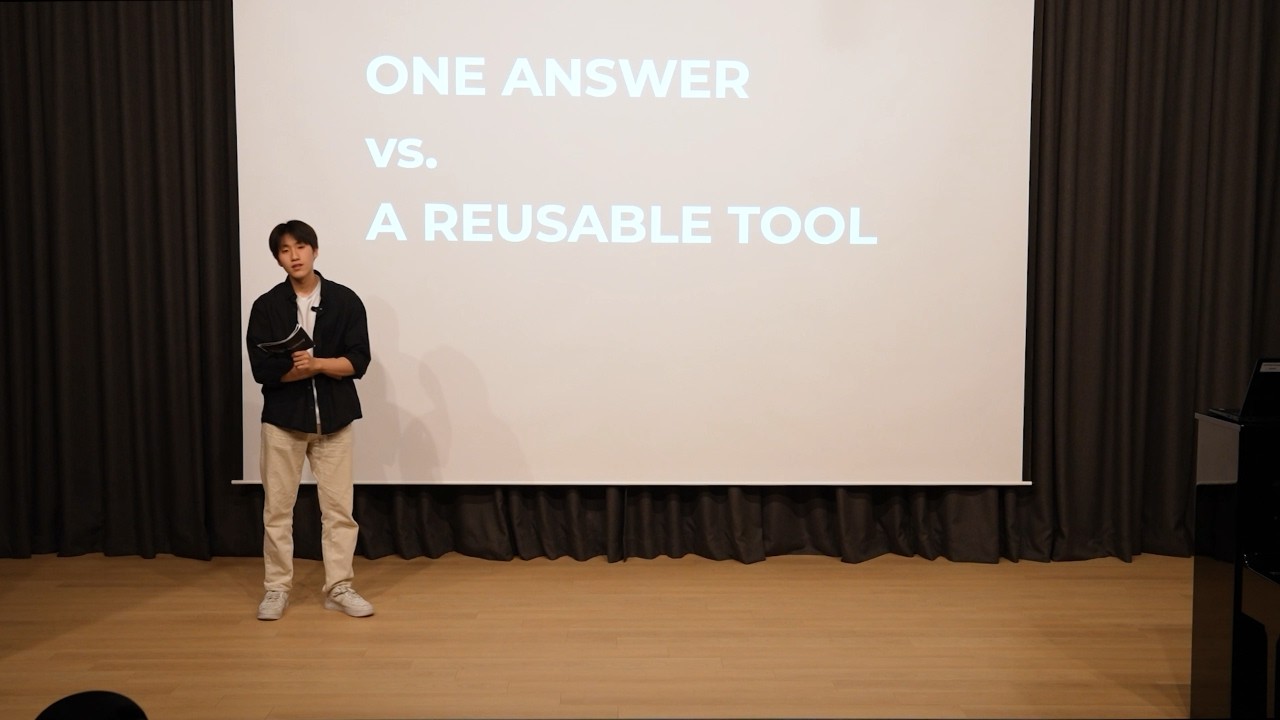
The Last 10 Percent | Yubin Han | TEDxNewton Academy Youth
Keywords
Summary
150 words
Critical Evaluation
Value of the Information & Strength of the Argument
The value of the talk lies in its accessible, first-person perspective on AI-assisted creation. The speaker effectively shifts the debate from ‘who gets credit’ to ‘what constitutes capability’, offering a nuanced view that neither dismisses AI nor overstates it. His argument is built on relatable examples and a logical progression from personal experience to broader educational implications. However, the reasoning is primarily anecdotal; the mention of a study on GPT writing speed lacks specifics (authors, methodology), weakening its evidential weight. The three proposed steps are practical and actionable, giving the talk a prescriptive dimension. Overall, the argumentation is sound but could benefit from more concrete data or references.
Scientific Rigor, Source Quality, Title Accuracy
Scientific rigor is moderate. The talk relies on personal evidence and general observations rather than peer-reviewed sources. The mentioned study is not cited properly, and global statistics are quoted without reference. This does not invalidate the message but limits its scholarly depth. The title ‘The Last 10 Percent’ is accurate and memorable, directly referring to the central concept of human effort after AI output. The content aligns well with the title, as the entire talk builds toward this metaphor. No formal sources are provided besides the generic TEDx link; thus, the foundational supports are anecdotal rather than rigorous. Overall, the title is well-chosen, but the scientific grounding is modest.
232 words
Title / Content Match
The title aptly captures the central theme: the critical effort needed to refine an AI-generated solution from 90% to 100%.
Quality & Reliability
7/10
The talk offers a coherent personal narrative on AI and capability, with some broad claims (e.g., global internet access statistics) but lacks specific citations. The reasoning is logical and relatable, though it relies on anecdotal evidence.
Key Moments
Markers derived by PSI from the transcript: the creator did not define chapters.
- Introduction: speaker admits he barely reads code but built several apps; questions whether AI-generated output counts as his ability.
- Describes using vibe coding and creating a GPA calculator, realizing the output was functional but needed adjustment (y-axis scale).
- Builds a SAT vocabulary site, friend uses it, and reflects on the real usefulness of such tools.
- Discusses the 'last 10%' concept: the iterative process of fixing and improving AI output; emphasizes that this is where learning occurs.
- Proposes three practical steps: write down discomforts, start small, and treat AI output as incomplete; concludes that future competitiveness lies in the last 10%.
Cited Sources
- TEDx Program — Mentioned in the description as the organizing framework for the talk.
Contribution & Novelties
The original contribution of this talk is its personalized framing of AI as a tool that shifts the definition of capability, emphasizing the invisible but critical human effort in refining AI-generated outputs. It introduces the memorable metaphor of the ’last 10%’ to describe the iterative, judgment-heavy work required after initial AI results. While not novel in academic terms, it offers a relatable student perspective that could resonate in educational discussions.
Pour aller plus loin :
- Human-in-the-loop — Relevant to the concept of human oversight and refinement in AI workflows.
- Prompt engineering — Directly connected to the speaker’s use of prompts to generate initial outputs.
- Artificial intelligence — Provides background on AI capabilities and limitations, useful for understanding the context.
119 words
Radar Profile
The profile shows moderate scores across information quantity, quality, and technical depth, with fiabilité in the mid-range. This suggests a talk that is engaging and conceptually sound but lacks empirical grounding and technical complexity, fitting a broadly accessible presentation.