Yapay Zekanın Sınırları | Ahmet Çevik | TEDxBK Ankara Youth
The Limits of Artificial Intelligence | Ahmet Çevik | TEDxBK Ankara Youth
Keywords
Summary
131 words
Critical Evaluation
Value of the Information & Strength of the Argument
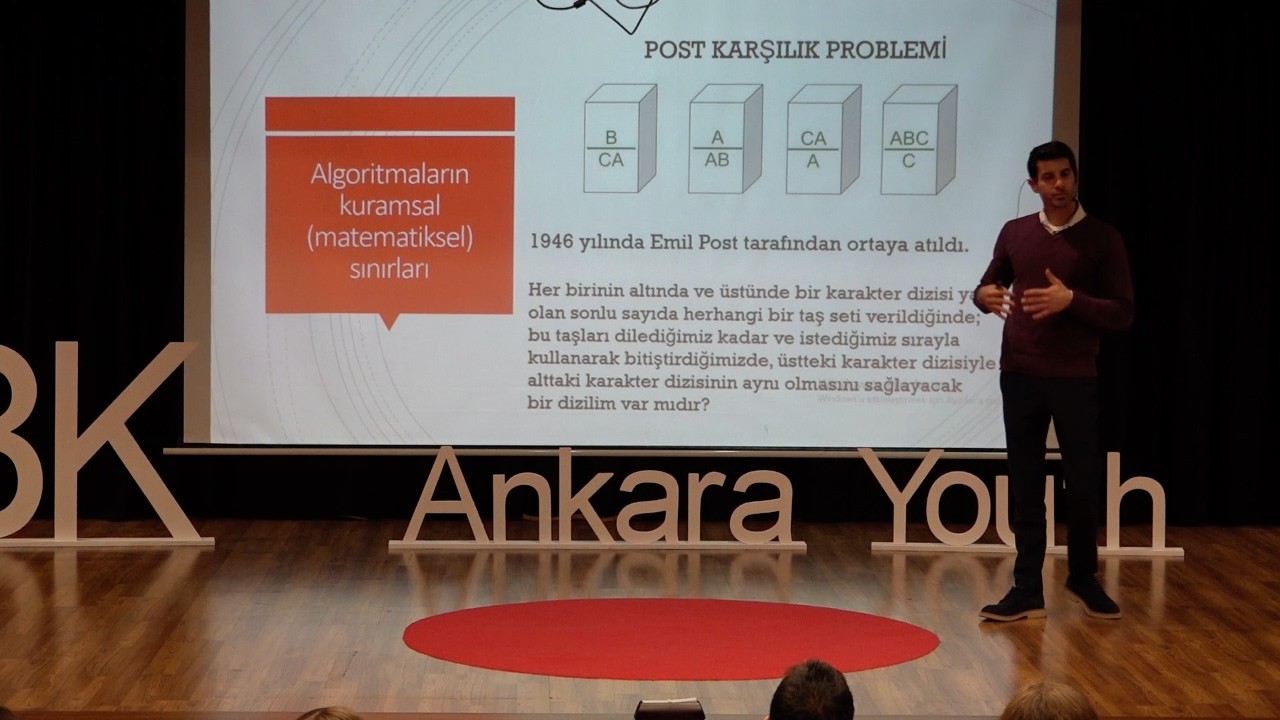
The talk provides a clear and rigorous explanation of theoretical limits of computation, supported by well-chosen examples. The argumentation is logically structured: it first defines algorithmic computation, then demonstrates undecidability via the Post correspondence problem, and finally links these results to AI limits. The speaker’s expertise adds credibility, and the use of visual examples (stone tiles) helps convey abstract concepts effectively. However, the discussion of AI’s practical capabilities is somewhat speculative, and the connection between undecidability and everyday AI might be overstated for a general audience.
Scientific Rigor, Source Quality, Title Accuracy
The content is scientifically accurate, relying on established results from computability theory. The speaker does not cite specific papers but refers to known theorems and problems. The title aligns well with the content, as the talk precisely addresses AI’s limits from a theoretical perspective. The talk is independent of external sources; the only provided link is the general TEDx page, which does not offer deeper references. No comments were provided, so public reception cannot be assessed.
177 words
Title / Content Match
The title accurately reflects the content, which focuses on the theoretical limits of AI as a consequence of algorithmic undecidability.
Quality & Reliability
8/10
The talk is grounded in well-established results from computability theory (Turing machines, undecidability) and presented by an academic with relevant expertise. The reasoning is clear and the examples are accurate, though some simplifications are made for a general audience.
Key Moments
Markers derived by PSI from the transcript: the creator did not define chapters.
- Introduction to impossibility and the importance of knowing what algorithms cannot do.
- Historical examples of algorithms: Euclidean algorithm and Babylonian approximation of √2.
- Alan Turing's formalization of computation via the Turing machine.
- Distinction between unsolved and unsolvable problems; introduction of the Post correspondence problem.
- Illustration of Post correspondence problem with solvable and unsolvable cases.
- Discussion of the halting problem and its significance.
- Implications for AI: theoretical limits vs. practical capabilities, and the role of randomness.
Cited Sources
- TEDx Talks — The official TEDx page providing information about the event format and licensing.
Concurring Sources
- Turing machine — Background on the formal model of computation discussed in the talk.
- Halting problem — One of the key undecidable problems mentioned.
Contribution & Novelties
The talk offers a clear and accessible explanation of why certain problems are beyond algorithmic solution, connecting them directly to AI limits. Its novelty lies in explicitly linking classical undecidability results to contemporary discussions about AI capabilities, making these abstract concepts tangible for a non-specialist audience.
Pour aller plus loin :
- Turing machine — Foundational model of computation introduced by Alan Turing.
- Halting problem — A classic example of an undecidable decision problem.
- Post correspondence problem — The specific undecidable problem used in the talk.
- Computability theory — The branch of mathematics studying what can and cannot be computed.
99 words
Radar Profile
The radar profile shows high scores in quality, technical level, and reliability, with a slightly lower score in quantity due to the limited scope of examples. The overall profile is well-balanced, indicating a focused and credible presentation.