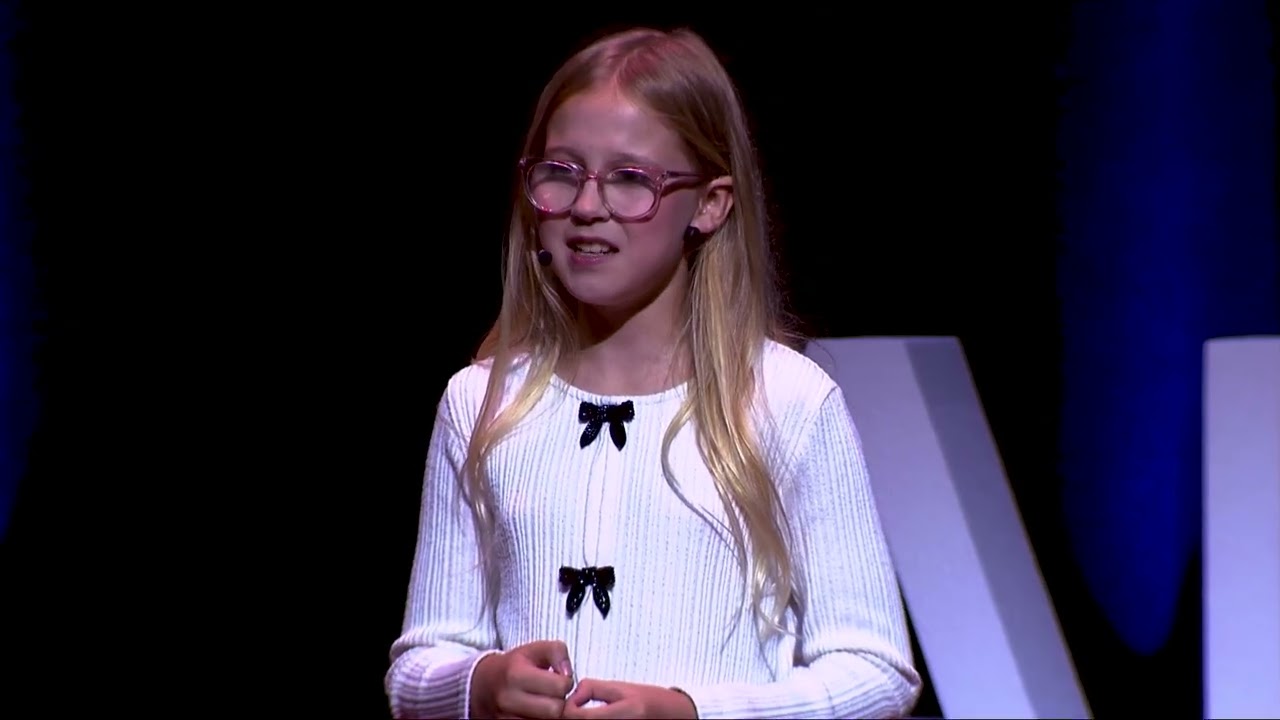
The most powerful brain in the room | Emma Baklanova | TEDxAlpha School Austin Youth
Keywords
Summary
228 words
Critical Evaluation
Value of the Information & Strength of the Argument
The talk’s value lies in its powerful advocacy from a child’s perspective, combining personal anecdotes with simplified scientific references to support its claim. The argumentation is emotionally compelling and uses clear analogies (the candy box) to make complex ideas accessible. However, the scientific evidence is presented without specific citations, and the leap from neuroplasticity to ‘kids are limitless’ oversimplifies the nuance of developmental science. The speaker’s personal achievements are inspiring but do not constitute systematic evidence. The rhetorical structure effectively moves from personal to general, ending with a memorable call to action, which strengthens its persuasive value.
Scientific Rigor, Source Quality, Title Accuracy
Scientific rigor is moderate; the talk correctly references neuroplasticity and the critical period for language learning, but the references are vague (e.g., ‘Dr. Patricia Cole’ without a study, ‘MIT researchers’ without publication). The title ‘The most powerful brain in the room’ is catchy and fits the content, which consistently emphasizes children’s brain potential. The only direct source in the description is the TEDx general page, which does not cite the specific research. The title-contenido alignment is strong, and the overall message is consistent with educational psychology, but the lack of verifiable references and the potential misattribution of names reduce the scientific credibility.
214 words
Title / Content Match
The title accurately reflects the central message about the extraordinary potential of children's brains.
Quality & Reliability
6/10
The talk cites scientific research on neuroplasticity and language learning, but references are vague and some may be misnamed (e.g., 'Dr. Patricia Cole' likely refers to Patricia Kuhl). Core claims align with mainstream science, yet lack of precise citations and oversimplification reduce reliability.
Key Moments
Markers derived by PSI from the transcript: the creator did not define chapters.
- Emma asks adults to recall when their childhood dreams were dismissed.
- Introduction of neuroplasticity and reference to Dr. Patricia Cole's 30-year research.
- MIT study on language learning and the box/candy analogy for brain development.
- Personal achievements: Navy SEAL challenge, cooking for a French chef, starting a macaron business.
- Examples of young inventors: Louis Braille, Gitanjali Rao, and the Popsicle inventor.
- Story about an AI chatbot refusing to help due to age, illustrating systemic age bias.
- Call to action: replace age test with readiness test and say 'How can I support you?'
Cited Sources
- TEDx Talks – Official Page — Referenced in the video description for more information about TEDx events.
Contribution & Novelties
This talk offers a unique, child-led perspective on the psychology of encouragement, merging personal narrative with simplified neuroscience. Its main contribution is the ‘readiness test’ proposal, urging adults to focus on commitment rather than age. However, the scientific content is not new, and the emotional appeal gives it rhetorical force.
Pour aller plus loin :
- Neuroplasticity - Wikipedia — Background on the brain’s ability to reorganize, directly relevant to the talk’s core claim.
- Patricia Kuhl - Wikipedia — The likely researcher referenced as ‘Dr. Patricia Cole’; her work on infant language acquisition supports the critical period argument.
- Growth mindset - Wikipedia — The concept of growth mindset aligns with the talk’s message about encouraging effort and learning.
117 words
Radar Profile
The profile shows moderate scores across information quantity and reliability, with a lower technical level and higher qualitative assessment. This reflects an engaging, accessible talk that prioritizes inspiration over rigorous scientific depth. The strength lies in clear communication and emotional impact, while the weakness is the lack of precise citations.