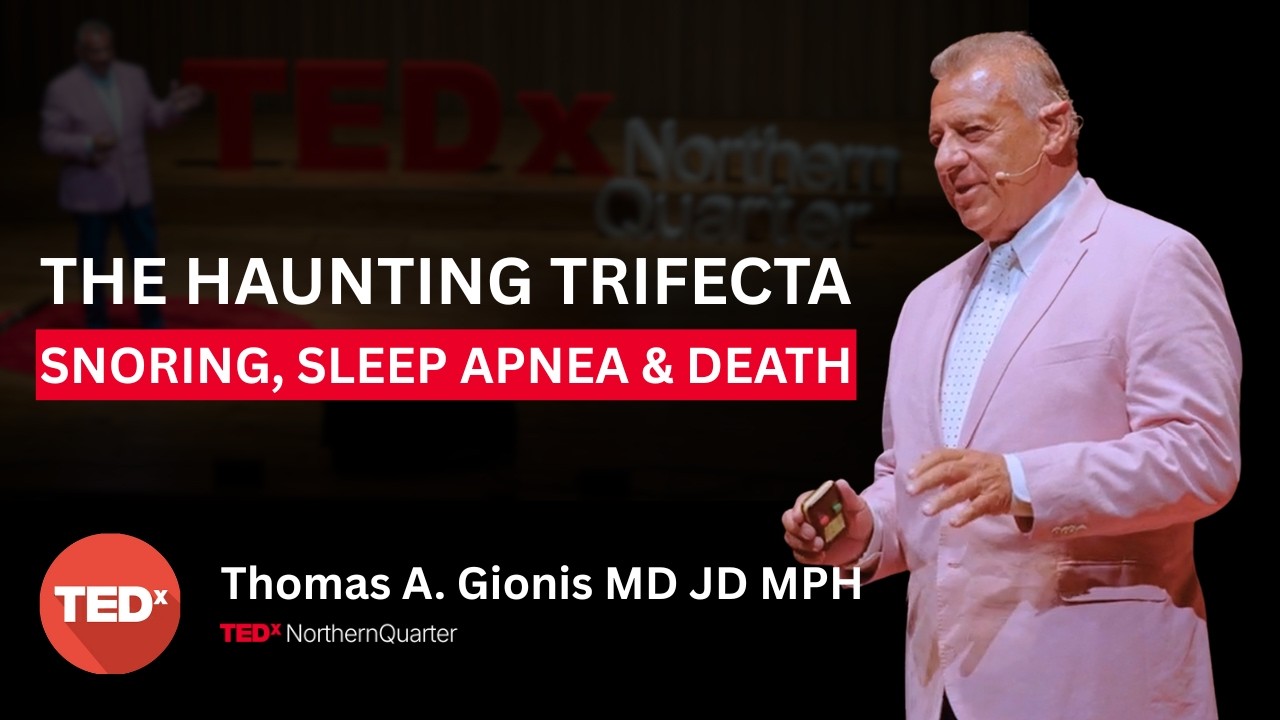
Could your snoring be caused by sleep apnea? | Thomas Gionis | TEDxNorthern Quarter
Keywords
Summary
178 words
Critical Evaluation
Value of the Information & Strength of the Argument
The talk’s value lies in raising awareness for a commonly overlooked condition, using a compelling personal story. The speaker’s 50-year medical experience lends credibility to his descriptions of symptoms and consequences. However, the argumentation is largely anecdotal and lacks systematic literature review. Claims such as ‘300% increase in risk of death’ are presented without citing specific studies, and the effectiveness of didgeridoo and laser therapy is overstated without control-group evidence. The logical flow is clear but relies on emotional appeal and rhetorical questions (‘Do you need to be rescued?’) rather than balanced scientific discourse. The repeated assertion that 85% are unaware is impactful but does not reference a data source.
Scientific Rigor, Source Quality, Title Accuracy
Scientific rigour is limited; the talk cites no primary literature or specific studies. The description mentions the speaker’s credentials, which support his authority, but the content itself lacks footnotes or citations. The title is perfectly matched to the content. The only external link provided is the generic TEDx homepage, offering no direct references. Public comments were not supplied, so no analysis is possible. Overall, the talk is accessible and credible in its general messages but falls short of evidence-based precision.
205 words
Title / Content Match
The title directly addresses the core topic—whether snoring indicates sleep apnea—and the talk consistently stays on theme. It is accurate and inviting.
Quality & Reliability
5/10
The talk combines personal anecdote with medical information. Some statistics are cited without explicit sources, and specific treatment claims (e.g., laser and didgeridoo) are presented as effective without robust clinical evidence. The speaker is an experienced physician, but the content lacks rigorous referencing and contains potentially overblown risk figures.
Key Moments
Markers derived by PSI from the transcript: the creator did not define chapters.
- Introduction: personal story of memory loss due to snoring.
- Show of hands about snoring; discussion of divorce and legal implications.
- Definition of sleep apnea and statistics: 45-60M US, 1B worldwide, 85% undiagnosed.
- Mechanism of airway obstruction and oxygen desaturation.
- Health risks: 180% hypertension, 200% Alzheimer's, 286% death risk.
- Personal blood thickening and memory loss episode.
- Diagnostic methods: finger sensors, sleep lab.
- Treatment options: mouthguards, CPAP, medication, didgeridoo, laser.
- Conclusion: urge to get tested and heed the warning sign.
Cited Sources
- TEDx Talks - General — Description link; general TEDx resource.
Concurring Sources
- Sleep Apnea Information - NIH — Concurs on health risks and prevalence.
Contribution & Novelties
The talk brings a first-person narrative from a medical professional, emphasizing the silent prevalence of sleep apnea and the importance of recognizing snoring as a risk factor. It personalizes the consequences, making the condition tangible. The presentation of non-standard treatments like didgeridoo and laser therapy may introduce viewers to options beyond conventional CPAP, though their scientific basis is not substantiated here.
Pour aller plus loin :
- Sleep apnea - Wikipedia — Overview of types, symptoms, and treatments.
- Obstructive sleep apnea - Mayo Clinic — Clinical description and standard care.
- Sleep Apnea - National Heart, Lung, and Blood Institute — Government resource on diagnosis and management.
- Didgeridoo as adjunctive therapy — A small trial (not cited in the video) suggested improvements; mention without URL to avoid speculation.
126 words
Radar Profile
The profile shows moderate scores across all dimensions, with slightly higher 'quantite' than 'fiabilite' reflecting the abundant but uncited data. The talk is accessible but lacks rigorous sourcing, resulting in balanced but not exceptional performance.