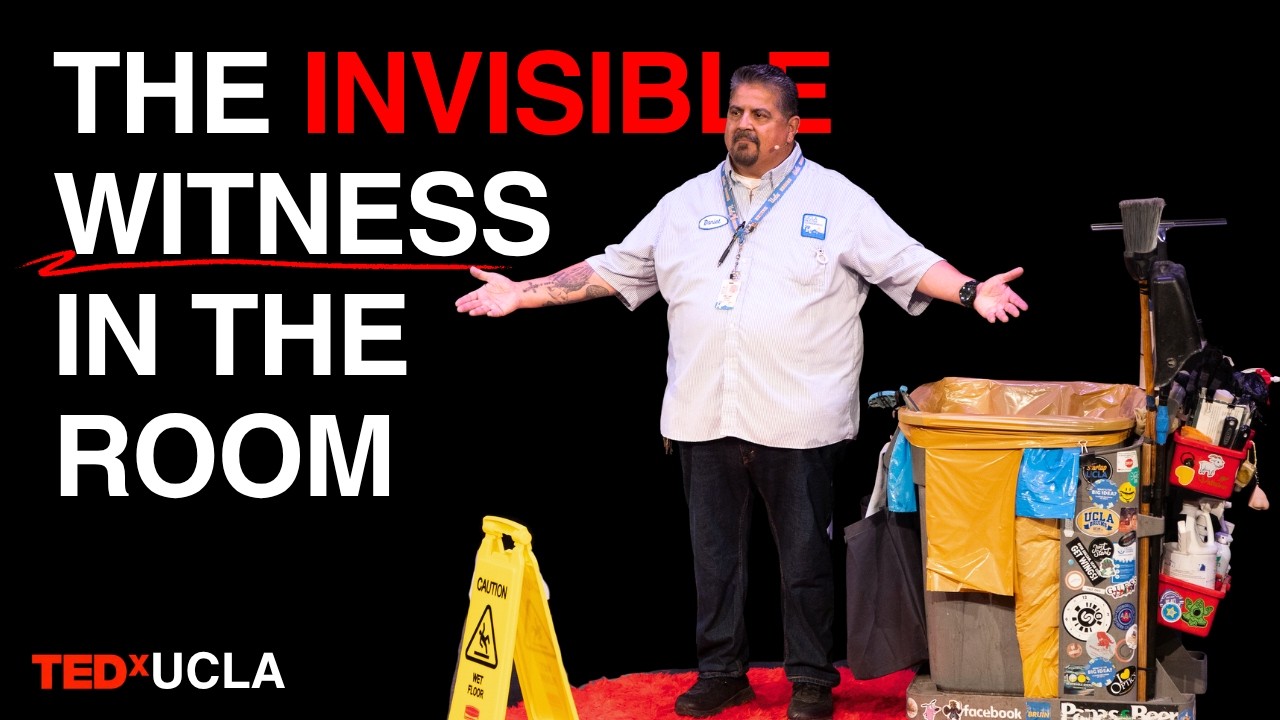
A Janitor’s Philosophy to Work & Life: Put Your Signature On It. | Daniel Estrada | TEDxUCLA
Keywords
Summary
168 words
Critical Evaluation
Value of the Information & Strength of the Argument
The value of this talk lies in its authentic perspective from an often-invisible worker, offering a refreshing counterpoint to conventional success narratives. The core argument—that the way you handle small tasks reflects your overall character and ambition—is both compelling and memorable. The use of personal anecdotes, from the printing trade to the emotional weight of cleaning a suicide scene, lends emotional force to the message. The reasoning is clear and consistent: the principle of ‘signing your name’ bridges professional and personal life, and the call to action is concrete and actionable. However, the argument is purely anecdotal and lacks empirical support or systemic analysis, which limits its scientific rigor but strengthens its appeal as a motivational narrative.
Scientific Rigor, Source Quality, Title Accuracy
The talk does not cite scientific sources, but it references a known YouTube video of Admiral McRaven’s commencement speech, which supports the concept of grit. The only direct source provided in the description is the TEDx platform itself. The title accurately reflects the content: the metaphor of putting your signature on work is central and well-developed. The talk’s structure is logical, moving from personal history, to observations, to a defining tragedy, to practical advice, and finally, to a humorous closing. There are no external URLs in the description to verify, but the talk’s credibility rests on the speaker’s lived experience and the moral weight of his stories. The absence of scientific rigor is compensated by the authenticity and coherence of the message, though it does not meet standards of evidence-based discourse.
263 words
Title / Content Match
The title accurately captures the central metaphor of signing one's work and the broader philosophy of personal responsibility, matching the talk's content.
Quality & Reliability
6/10
The talk is a personal testimony full of authentic anecdotes and reflective insights, but it lacks empirical evidence or systematic analysis. The content is coherent and sincere, yet it remains subjective and not scientifically tested.
Key Moments
Markers derived by PSI from the transcript: the creator did not define chapters.
- Introduction to the printing trade and the rule of signing your name.
- Explanation of the journeyman standard and its application to janitorial work.
- Observations of student behaviors: scooters in elevators, walked-through wet floor signs, and waste.
- Story of Ruben Hardy showing up during a family crisis, illustrating personal signatures.
- Recounting the tragic suicide in a bathroom and the impact on the speaker.
- The central question: 'How are you going to change the world if you can't even flush a toilet?'
- Delivering three pieces of actionable advice: pause, see the person, and do one small thing with intention.
- Closing call to action and humorous reminder to flush toilets.
Cited Sources
- TEDx Talks — The talk was delivered at a TEDx event; the platform is the primary reference for this talk.
Concurring Sources
- Grit (personality trait) — The talk's emphasis on perseverance and discipline aligns with research on grit.
- Personal responsibility — The core message of owning one's actions supports the importance of individual accountability.
Contribution & Novelties
The originality of this talk lies in its inversion of the typical hierarchy: a custodian, often invisible and undervalued, offers a profound philosophy of work and life derived from the mundane. The metaphor of ‘signing your name’ transforms routine tasks into acts of integrity and self-respect, providing a fresh framework for personal responsibility. The talk challenges the separation of small tasks from grand ambitions, suggesting they are the same habit at different scales. It also brings attention to invisible labor, a topic rarely addressed in motivational discourse.
Pour aller plus loin :
- Work ethic — Explores the cultural and psychological dimensions of valuing work, relevant to the talk’s emphasis on diligence.
- Personal responsibility — Discusses the concept of owning one’s actions and choices, central to the speaker’s philosophy.
- Grit (personality trait) — Psychological research on perseverance and passion for long-term goals, echoing the talk’s reference to Admiral McRaven and the notion of showing up consistently.
155 words
Radar Profile
The radar profile shows low scores for quantity of information and technical level, reflecting the talk's non-scientific, personal nature. Quality and reliability are moderate, indicibly due to the authenticity and coherence of the narrative, but the lack of empirical grounding prevents higher ratings.