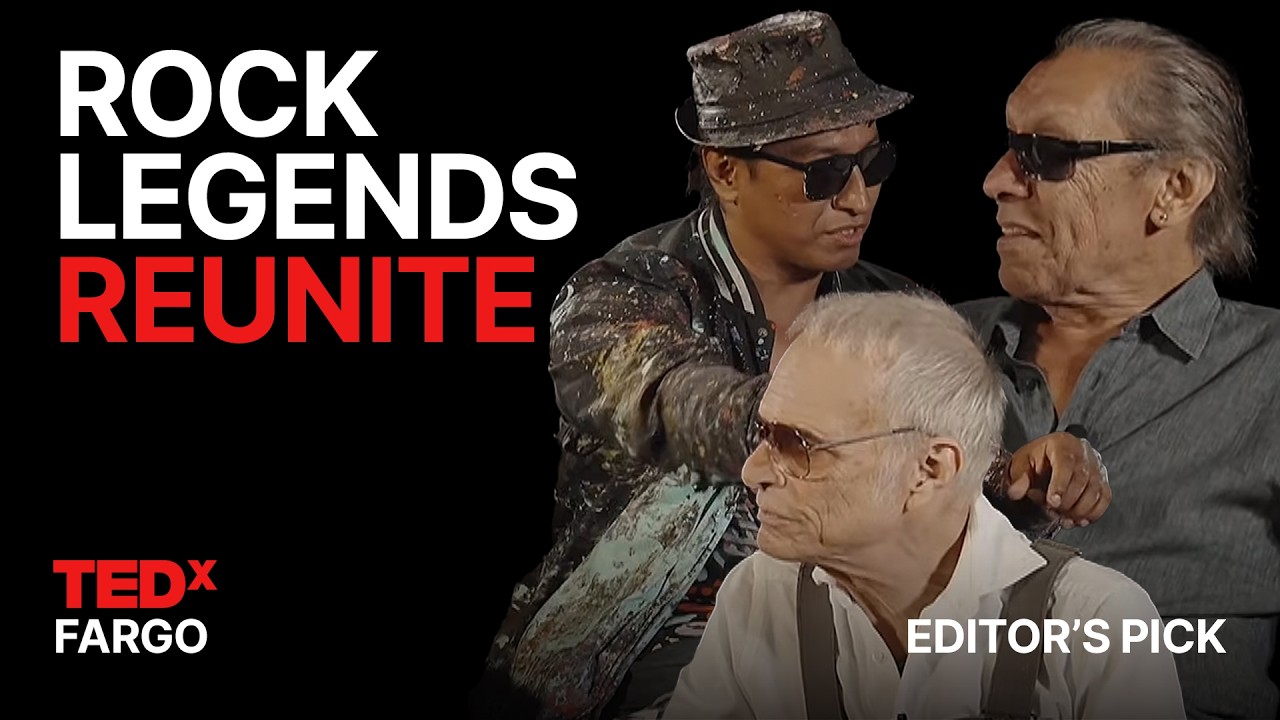
Why great art requires risk | Alex Van Halen, David Lee Roth & Robert Vargas | TEDxFargo
Keywords
Summary
137 words
Critical Evaluation
Value of the Information & Strength of the Argument
The value lies in the firsthand insights from accomplished artists who demonstrate how vulnerability and risk lead to authentic expression. Their argumentation is persuasive through storytelling and concrete examples, such as Vargas’s no-grid approach to murals and Roth’s application of atonal lyrics. They advocate for a process-oriented mindset, valuing rehearsal and iterative creation over polished outcomes. The interplay between their contrasting perspectives—Roth’s flamboyant charisma versus Van Halen’s steady pragmatism—illustrates creative friction as a catalyst for innovation. While not empirically rigorous, the anecdotes are compelling and offer practical wisdom for artistic practice.
Scientific Rigor, Source Quality, Title Accuracy
The scientific rigor is low, as the talk is based on personal experience rather than cited research. No academic sources are referenced; the only provided link is the generic TEDx page. However, the speakers are authoritative in their fields, lending credibility to their artistic expertise. The title is highly appropriate, capturing the core message about risk-taking. The discussion stays on topic, though it occasionally veers into tangential humor. The lack of external sources limits the verifiability of claims, but the experiential nature of the content is acknowledged.
193 words
Title / Content Match
The title accurately reflects the central theme about the necessity of taking risks for creating great art, as discussed throughout the conversation.
Quality & Reliability
6/10
The talk presents experiential wisdom from established artists rather than verifiable scientific data. While the speakers are credible figures, their claims are anecdotal and philosophical, lacking empirical evidence. The content is thought-provoking but not scientifically rigorous.
Key Moments
Markers derived by PSI from the transcript: the creator did not define chapters.
- Introduction and presentation of the mirror painting project.
- Discussion on the importance of homework and breaking rules.
- Robert Vargas describes his immersive world art tour and his practice of painting without preconceptions.
- David Lee Roth shares about Japanese cultural influences and the pentatonic scale.
- Discussion on the alchemy of combining different creative styles and the atom vs. fusion metaphor.
- Van Halen and Roth discuss their early collaborations and the role of family in their music.
- Advice to young creatives: 'Life is short, smoke them if you got them' and 'Learn everything then unlearn it'.
- Closing remarks about being true to your work and the power of laughter.
Cited Sources
- TEDx official page — Provides general information about the TEDx program and this talk.
Contribution & Novelties
The talk offers a rare, candid conversation between iconic figures in rock and visual art, sharing their divergent yet complementary approaches to creativity. It underscores that risk-taking and embracing discomfort are essential for artistic growth. The speakers reveal personal rituals (lucky charms, grounding with walls) and stress the significance of communal engagement. A notable original insight is the metaphor of nuclear fusion for creative collaboration, suggesting that merging distinct styles can exponentially enhance output.
Pour aller plus loin :
- Van Halen — Provides background on the band’s history and musical innovations.
- David Lee Roth — Details Roth’s career and solo work, contextualizing his artistic philosophy.
- Robert Vargas (artist) — Offers information on Vargas’s mural projects and artistic techniques.
118 words
Radar Profile
The profile shows a moderate but balanced distribution across the dimensions, with slightly higher scores in quantity and quality of information, and a lower technical level, reflecting the non-technical, experience-based nature of the discussion.