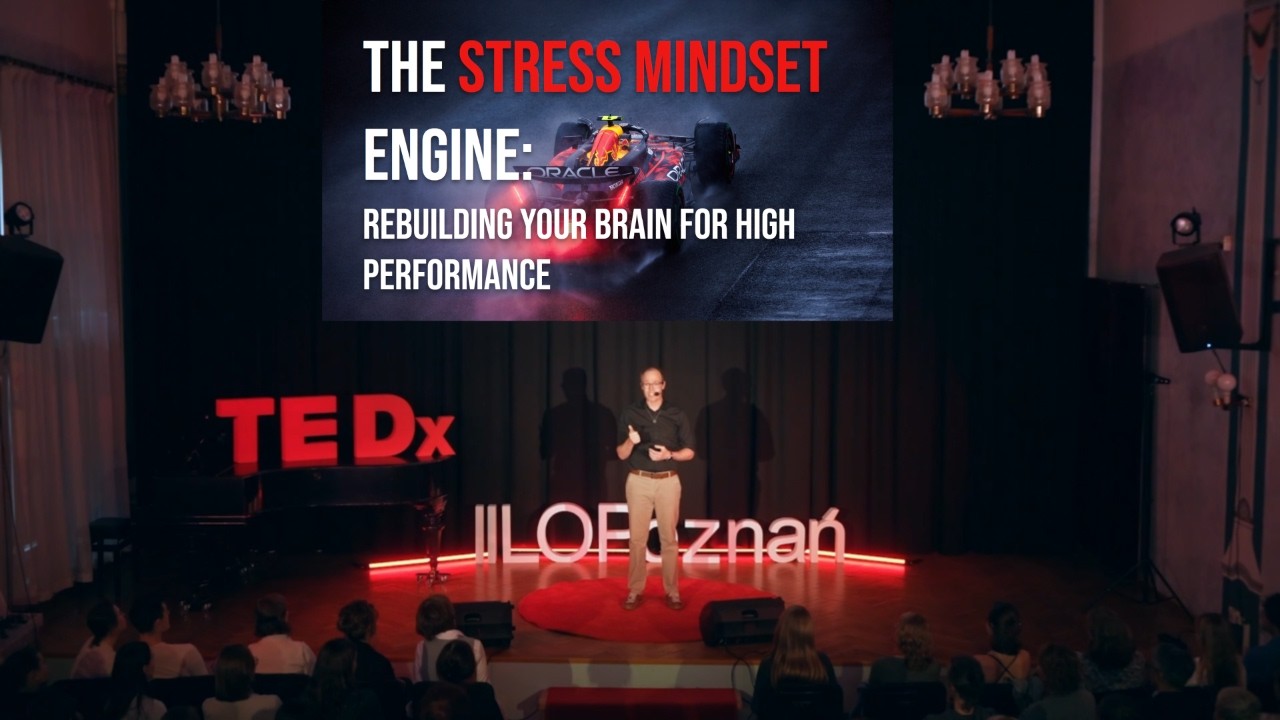
Rebuild for high performance | Bryn Williams | TEDxIILOPoznań
Keywords
Summary
177 words
Critical Evaluation
Value of the Information & Strength of the Argument
The talk provides a clear and engaging synthesis of several well-known studies on stress mindset, making a compelling case for the utility of reappraising stress. The argumentation is structured logically: personal anecdote, research evidence, physiological explanations, and practical application. The speaker effectively uses analogies (armadillo, Formula 1) to make the science accessible, and he cites specific numbers (17%, 12%, 27 seconds) that lend credibility. However, the reliance on a narrow set of studies, some of which are from the same researcher (Jamieson), and the lack of critical comparison with opposing views weakens the depth of the argument. The self-promotion of his YouTube channel within the talk also undermines the perceived impartiality, though it does not directly affect the core message.
Scientific Rigor, Source Quality, Title Accuracy
The talk references legitimate academic sources (Brooks, Crum, Blascovich & Mendes, Jamieson, McGonigal) and describes their methodologies and findings accurately in broad strokes. However, the descriptions are simplified and occasionally imprecise (e.g., the precise percentages and conditions are presented without nuance). The TED note explicitly states the talk falls outside content guidelines, raising concerns about the scientific consensus or the appropriateness of claims. The title ‘Rebuild for high performance’ is somewhat misleading, as the talk does not focus on ‘rebuilding’ but rather on reframing. The description link to TEDx guidelines is not a research source but clarifies the caveat. Overall, the talk is informative but should be treated as a popularization with some limitations in rigor.
251 words
Title / Content Match
The title 'Rebuild for high performance' is catchy but somewhat vague; the talk is primarily about reframing stress as enhancing rather than rebuilding. It is moderately aligned but not perfectly descriptive.
Quality & Reliability
6/10
The talk is grounded in real research (Brooks 2013, Crum et al., Jamieson, Blascovich & Mendes), but it simplifies findings and includes personal interpretation. TED officially flagged it as outside content guidelines, indicating concerns about scientific rigor. Additionally, the speaker promotes his own YouTube channel during the talk, which detracts from objectivity.
Key Moments
Markers derived by PSI from the transcript: the creator did not define chapters.
- Introduction of Alison Wood Brooks's 2013 study on stress reappraisal and the common tendency to relax.
- Discussion of Ali Crum's Navy SEALs study and the stress-is-enhancing mindset's performance benefits.
- Explanation of Blascovich and Mendes's challenge vs. threat model, with analogies to armadillo and Formula 1 modes.
- Jeremy Jamieson's Trier Social Stress Test experiment and the impact on blood vessel responses.
- GRE study results showing real-world improvement from the stress-enhancing mindset.
- Practical advice: learning a key phrase, using mental imagery, and progressive stress exposure.
Cited Sources
- TEDx Content Guidelines — Provided in the video description; indicates that this talk has been flagged as outside standard content guidelines.
- TEDx Official Website — Provided in the video description; general information about TEDx events.
- Alison Wood Brooks (2013) study on excitement reappraisal — Referenced in the talk as the study where saying 'I'm excited' improved performance by 17%.
- Ali Crum, Stanford University, Navy SEALs study (2020) — Referenced in the talk, showing stress-is-enhancing mindset led to 12% longer endurance and faster obstacle course times.
- Blascovich & Mendes biopsychosocial model — Mentioned as the framework for threat vs. challenge responses.
- Jeremy Jamieson, University of Rochester, Trier Social Stress Test and GRE studies — Referenced for experiments on stress mindset and physiological/cognitive performance.
- Kelly McGonigal TED Talk on stress — Mentioned for health benefits of a stress-enhancing mindset.
Contribution & Novelties
The talk’s original contribution lies in its accessible presentation and synthesis of existing research on stress mindset, translating academic findings into actionable advice for a lay audience. It distinguishes itself by combining physiological explanations (total peripheral resistance, challenge response) with practical coaching steps. However, it does not introduce novel research but rather curates and summarizes.
Pour aller plus loin :
- Cognitive reappraisal — Core psychological concept underpinning the stress-is-enhancing mindset.
- Biopsychosocial model — Framework used to explain how psychological states affect physiological responses.
- Trier Social Stress Test — Standardized protocol used in stress research, referenced in the talk.
98 words
Radar Profile
The radar profile shows moderate to high scores in quantity of information and quality of information, with lower scores in technical level and reliability. This indicates the talk is informative and engaging but not deeply technical, and its scientific reliability is diminished by the TED flag and potential oversimplification.