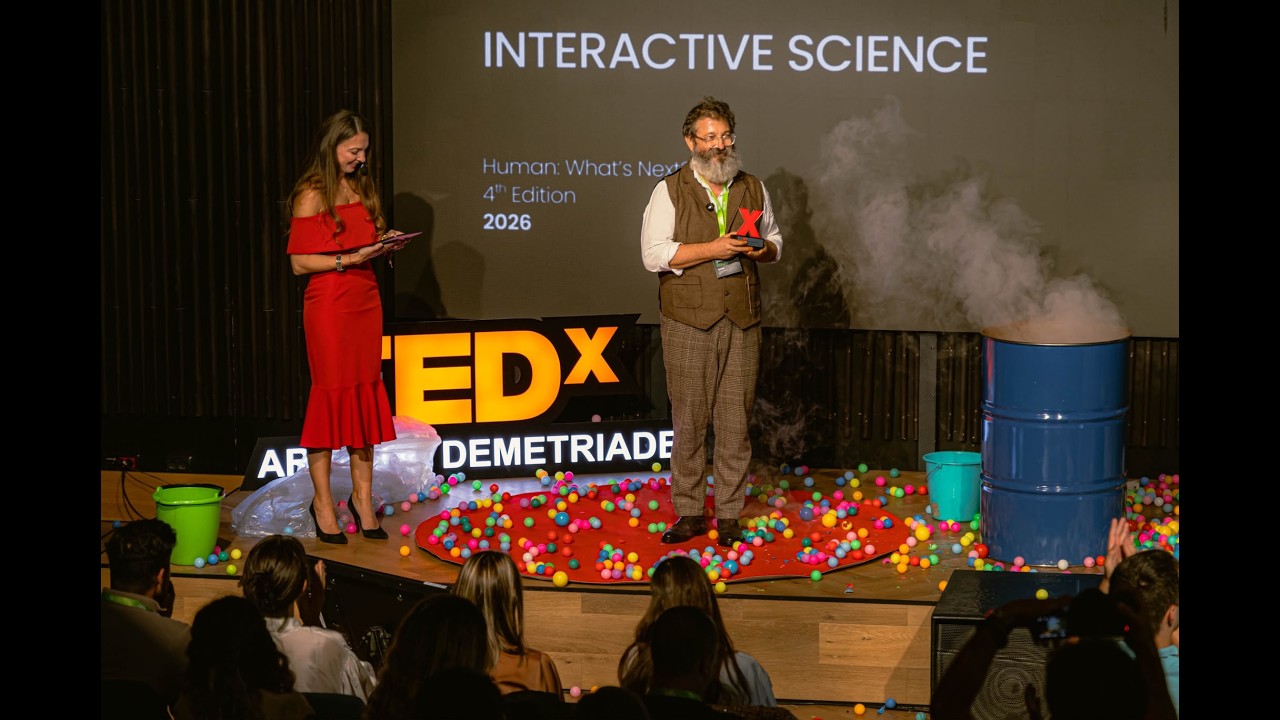
Why Do Children Ask "WHY"? - Let Them Keep Asking | Șerban Borda | TEDxAristide Demetriade Street
Keywords
Summary
192 words
Critical Evaluation
Value of the Information & Strength of the Argument
The value of the information lies in the insightful connection between emotion, curiosity, and learning, illustrated through compelling personal narratives. Borda’s argumentation is coherent and persuasive, supported by clear examples from his work. He effectively shows that education is most powerful when it engages the heart as well as the mind. However, the argument is primarily based on anecdotal evidence and lacks empirical support. The speaker’s perspective as a practitioner adds authenticity but not scientific rigor. The call to make culture more accessible and to foster questioning is admirable, but the reasoning could benefit from references to educational research. Overall, the talk provides a meaningful perspective, but its argumentative strength is limited by the absence of systematic evidence.
Scientific Rigor, Source Quality, Title Accuracy
The talk demonstrates little formal scientific rigor, as it presents no cited studies, data, or structured analysis. The only source mentioned is the TEDx program itself (via the generic link in the description), which does not constitute a substantive reference. The content is based on professional experience and reflections, characteristic of an expert opinion rather than a research presentation. The title and content align well, focusing on children’s curiosity and the importance of fostering it. The speaker’s credibility comes from his hands-on work, but the lack of external sources reduces the overall reliability. There are no comments provided to analyze audience reception.
235 words
Title / Content Match
The title raises a question about children's curiosity; the content effectively addresses it by illustrating how wonder leads to questions, connecting this to education and cultural access.
Quality & Reliability
5/10
The talk is based on personal anecdotes and a personal reflection on education, curiosity, and culture, without citing empirical studies or data. The credibility relies on the speaker's field experience as an actor and science communicator.
Key Moments
Markers derived by PSI from the transcript: the creator did not define chapters.
- Introduction to the concept of 'wow' as a trigger for curiosity and learning
- The story of the family who repeatedly attended the show, illustrating the value of shared emotional experiences
- Encounter with an elderly woman who experienced theatre for the first time, highlighting lack of cultural access
- Reflection on technology's limits in preserving emotion and the need to amplify wisdom
- Call to make education and culture accessible, emphasizing the power of asking questions
Cited Sources
- TEDx Program — Organization and format of the TEDx event where this talk was presented.
Contribution & Novelties
The talk adds a creative perspective on using theatre and science demonstrations to spark curiosity in children, particularly in underserved communities. It advocates for an experiential, emotion-driven approach to education. The originality lies in the combination of artistic performance and scientific experimentation as a pedagogical tool.
Pour aller plus loin :
- Inquiry-based learning — A pedagogical approach centered on questioning exploration, directly relevant to fostering curiosity.
- Experiential learning — Learning through reflection on doing, which supports the talk’s emphasis on hands-on experience.
- Emotion and memory — Research on how emotional experiences enhance retention, underpinning the speaker’s claim that emotion fixes information.
101 words
Radar Profile
The score profile shows a balanced distribution across information quantity and quality, with a technical level lower than the others, reflecting the non-specialist nature of the talk. The reliability score is moderate, aligning with the anecdotal and personal basis of the content.