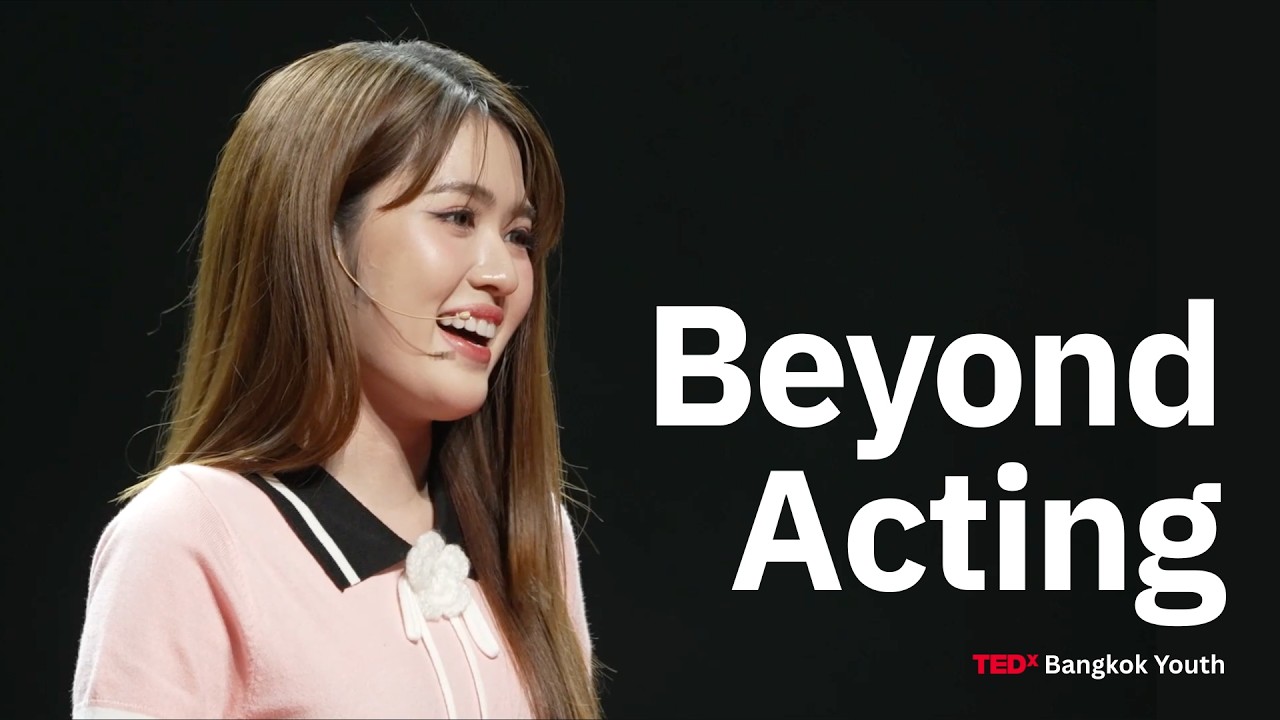
Beyond Acting | อันดา กุลฑีรา ยอดช่าง | TEDxBangkok Youth
Keywords
Summary
177 words
Critical Evaluation
Value of the Information & Strength of the Argument
The talk’s value lies in its authentic personal testimony combined with well-known theoretical references. Unda effectively explains the difference between pretending and deep character immersion, making a credible case for acting as a craft that requires psychological investment. Her argument that acting can both harm and heal is supported by the Heath Ledger anecdote and her own experience, and she strengthens the healing aspect by linking drama therapy to established practices like psychodrama. However, the argumentation is primarily anecdotal and relies on general acceptance of the cited figures rather than systematic evidence. The speaker’s enthusiasm and clear delivery make the case compelling, but the lack of concrete sources for the claims about drama therapy efficacy limits its scientific rigor. Overall, the talk offers insightful reflections on the transformative power of performance, but its reasoning is more exploratory than definitive.
Scientific Rigor, Source Quality, Title Accuracy
The scientific rigor is moderate. The speaker names key figures—Constantin Stanislavski, Lee Strasberg, Jacob Moreno—and mentions drama therapy research, but provides no direct citations or data. The only official source is the generic TEDx link in the description. While the information aligns with common knowledge about method acting and drama therapy, the lack of precise references weakens its scholarly value. The title ‘Beyond Acting’ is apt: it promises a deeper look into the craft and delivers that by covering internal emotional work, psychological risks, and therapeutic applications. The audience reaction (though only 16 views) is not provided in the data, so no comment trends can be analyzed. Overall, the talk is well-structured and faithful to its title, but its source citation is limited.
277 words
Title / Content Match
The title 'Beyond Acting' accurately reflects the content, as the speaker goes beyond the surface of performance to discuss inner processes, method acting risks, and the therapeutic potential of drama, directly addressing the theme.
Quality & Reliability
6/10
The talk is an engaging personal and expert account of acting techniques and their psychological effects, referencing established figures and concepts (Stanislavski, Strasberg, Moreno, drama therapy) without providing primary sources or rigorous scientific citations. The reliability is moderate, adequate for a TEDx talk aimed at general audiences, but lacking depth for scholarly validation.
Key Moments
Markers derived by PSI from the transcript: the creator did not define chapters.
- Unda introduces the idea of escaping reality through acting, sharing that it has been her refuge since childhood.
- She describes her first experience at age 3, simply following directions to smile, and how that led to her passion for acting.
- Explanation of Method Acting, tracing its roots to Constantin Stanislavski and later Lee Strasberg, emphasizing deep character immersion.
- Health Ledger's Joker role is cited as an example of the dangers of method acting, where fusing with the character caused psychological turmoil.
- Unda shares her personal burnout after an intense role, highlighting the need to detach from the character to maintain mental health.
- Introduction to drama therapy (psychodrama), its origins with Jacob Moreno, and its presence in Thailand through institutions like the Rajanukul Institute.
- Closing thoughts: acting as a mirror reflecting life and providing healing for both actors and audiences, inviting a deeper appreciation of performances.
Cited Sources
- TEDx Talks | TED — General reference for the TEDx event format and organizational context, mentioned in the video description.
Concurring Sources
- Stanislavski's system - Wikipedia — Corroborates the video's description of Stanislavski's influence on acting, emphasizing emotional realism and character analysis.
- Method acting - Wikipedia — Supports the video's account of Lee Strasberg's development of Method acting and its psychological intensity.
- Psychodrama - Wikipedia — Confirms Jacob Moreno's creation of psychodrama as a therapeutic approach using role-play, aligning with the video's statements.
Contribution & Novelties
This talk contributes a personal perspective on the intersection of acting and mental health, advocating that actors must consciously manage the boundary between self and character to avoid psychological harm. It also raises awareness of drama therapy as a legitimate therapeutic tool, introducing its historical roots and current applications in Thailand, which is a relatively uncommon topic in public discourse. The novelty lies in bridging the insider experience of a professional actress with the academic field of drama therapy, making the case that acting is not only entertainment but also a form of self-understanding and healing.
Pour aller plus loin :
- Stanislavski’s system — Foundational acting technique that emphasizes emotional realism and psychological depth, directly relevant to the video’s core discussion.
- Method acting — The technique elaborated by Lee Strasberg, central to the video’s analysis of immersive acting and its risks.
- Psychodrama — Jacob Moreno’s therapeutic method that uses role-playing for psychological exploration, a key influence on drama therapy as presented.
- Drama therapy — The clinical application of drama techniques in mental health, which the speaker advocates and illustrates with examples.
181 words
Radar Profile
The radar profile shows a moderate balance: information quantity and quality are fairly high, but technical level is low and reliability is moderate. This suggests a talk that is informative and credible for a general audience but lacks deep technical detail and rigorous citations. The peak on quality indicates good explanation of concepts, while the low technical score reflects its accessibility.