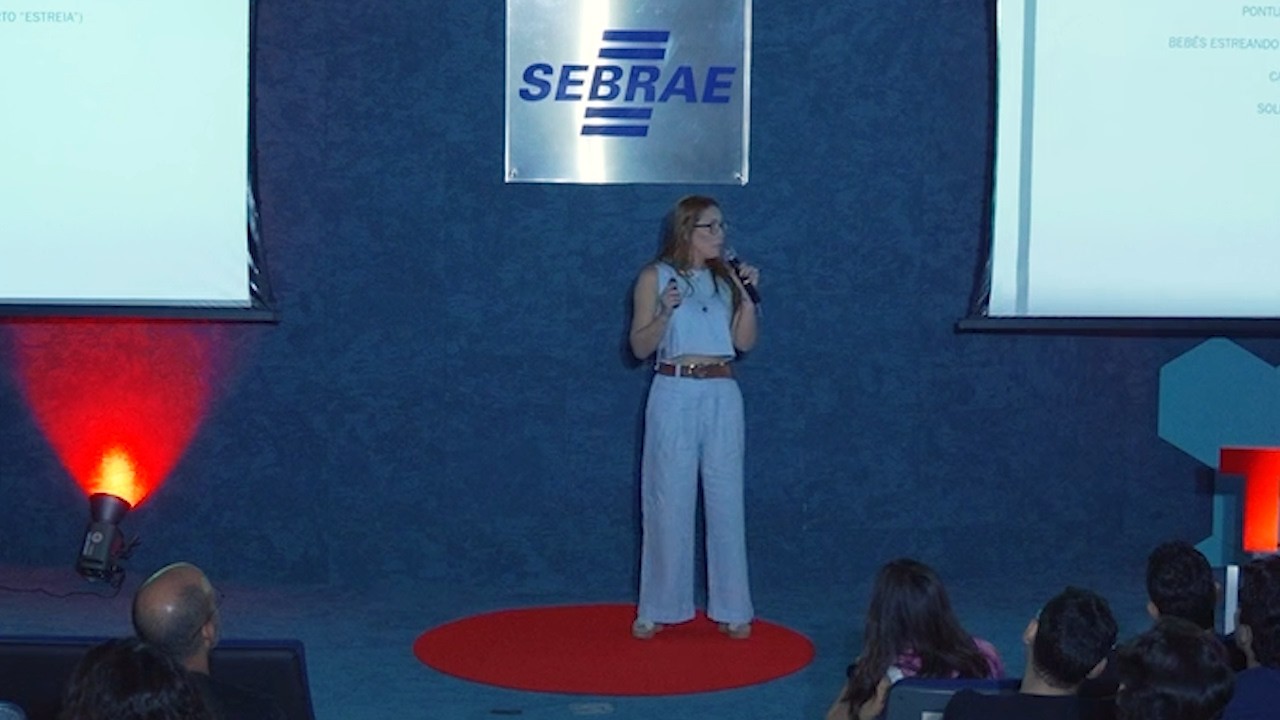
O Poder do Inútil | Aline Lima | TEDxIracema
The Power of the Useless | Aline Lima | TEDxIracema
Keywords
Summary
162 words
Critical Evaluation
Value of the Information & Strength of the Argument
The main value of this talk lies in its accessible and compelling critique of modern performativity, framing it as detrimental to human connection and creativity. The argumentation is structurally coherent, moving from personal observation to a powerful dystopian metaphor to concrete leadership implications. However, the reasoning relies heavily on anecdote, metaphor, and logical analogy rather than empirical or statistical evidence. The speaker’s background as a psychologist and CEO lends practical credibility, yet the arguments are primarily rhetorical appeals that may oversimplify the complex dynamics between productivity and well-being. There is no rigorous framework presented, but the philosophical clarity and the thought-provoking ‘Egosperf’ narrative provide substantial intellectual value for a general audience.
Scientific Rigor, Source Quality, Title Accuracy
Scientific rigor is minimal, as the talk is an opinion piece without academic citations. The only source mentioned (in the description) is the standard TEDx link, which validates the format but not the content. The speaker references Kant’s categorical imperative implicitly through a direct quote, aligning with deontological ethics, but does not provide bibliographic details. The title perfectly matches the content, which is a clear and focused exploration of the value of non-utilitarian activities. No audience comments were provided in this evaluation to analyze public perception.
212 words
Title / Content Match
Exact match. The title 'The Power of the Useless' directly reflects the central thesis that unproductive, unprogrammed activities are essential for connection and innovation.
Quality & Reliability
5/10
The talk is motivational and philosophical rather than scientific. It presents personal observations and a dystopian thought experiment without citing specific studies or data. The speaker draws on psychological and managerial concepts (burnout, leadership) but provides no empirical evidence, making the reliability score low.
Key Moments
Markers derived by PSI from the transcript: the creator did not define chapters.
- Opening call to pause and be present.
- Asking the audience about the last time they did something useless without guilt.
- Describing modern life as 'walking spreadsheets' and constant self-improvement.
- Quoting a principle to treat humanity as an end, not a means.
- Contrasting writing with paper and pen versus current 'empty deliveries'.
- Introduction of the dystopian 'Egosperf' world set in 2142.
- End of the dystopia where people feel relief at not being important.
- Explaining that the useful separates and the useless connects.
- Final call: choose to reinvent rather than repeat.
Cited Sources
- TEDx Talks Channel — Official TEDx event format disclaimer mentioned in the video description. No other specific scientific papers or articles were cited during the talk.
Concurring Sources
- Kant's Moral Philosophy — The speaker explicitly quotes a principle that aligns with the categorical imperative (treating humanity as an end), which is foundational to Kantian ethics, thus providing a solid ethical counterpoint to transactional relationships.
Contribution & Novelties
The talk provides a fresh and vivid metaphor (the Egosperf dystopia) to conceptualize modern performativity and the validation economy. It synthesizes existing critiques of hyper-productivity and burnout in a highly accessible manner, effectively bridging psychological insights with leadership advice. Its originality lies in reframing ‘uselessness’ as a foundational driver of creativity and connection, rather than a luxury, fostering a valuable shift in perspective.
Pour aller plus loin :
- Occupational burnout - Wikipedia — Provides a scientific overview of the burnout phenomenon discussed, offering empirical context to the speaker’s observations.
- Attention economy - Wikipedia — Contextualizes the pressure for constant engagement and validation that the speaker critiques.
- Flow (psychology) - Wikipedia — Connects the speaker’s idea of unprogrammed, playful activity to a state of effortless and productive absorption.
127 words
Radar Profile
The radar profile shows low scores in quantitative information and technical level, reflecting the talk's non-scientific, opinion-based nature focused on personal narratives and societal reflection. Reliability is moderately low, but the quality of information regarding societal insights is relatively higher due to the coherent argumentation and relevance of the topic, indicating a strong conceptual message over empirical support.