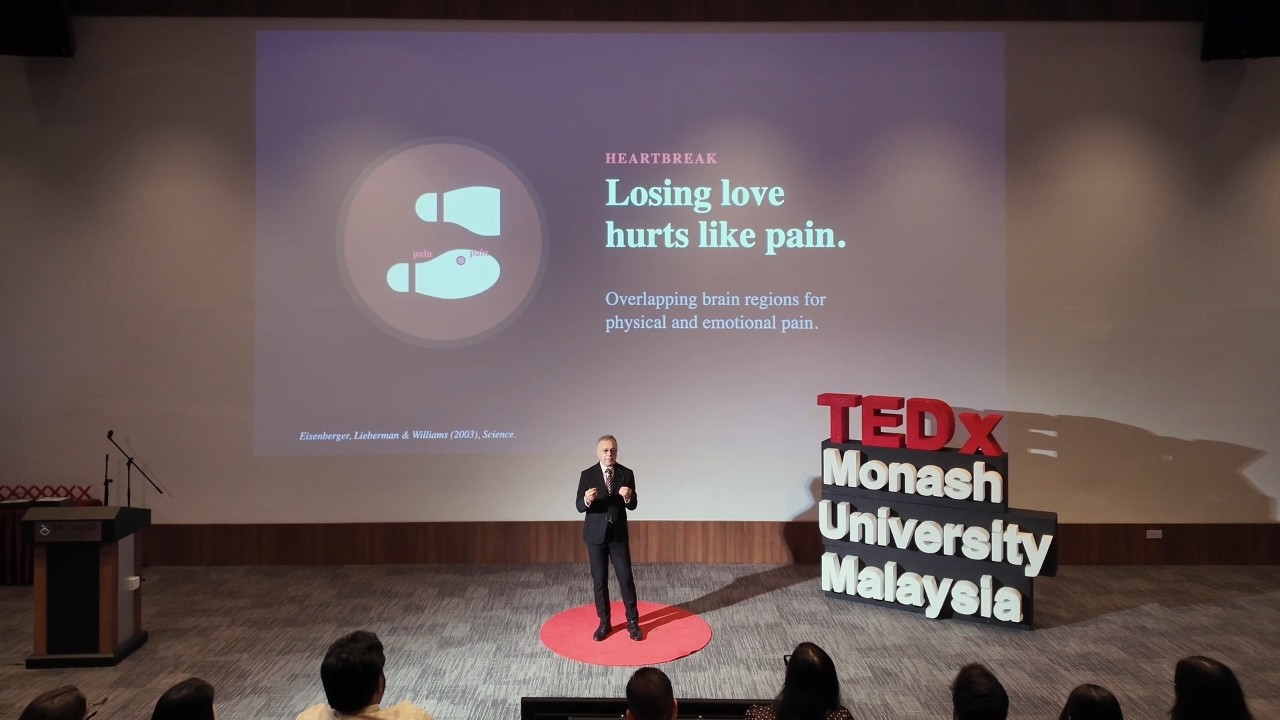
Why Love is Good for Your Brain | Majid Fotuhi | TEDxMonash University Malaysia
Keywords
Summary
207 words
Critical Evaluation
Value of the Information & Strength of the Argument
The value of this talk lies in its synthesis of current neuroscience research on love into accessible terms. It provides concrete examples (fMRI data, animal models) and connects them to real-life experiences, making the science relatable. The argumentation is solid: it builds logically from the neural basis of love to its health benefits, using both empirical studies and personal narratives. However, the talk does not delve deep into methodology or conflicting evidence, so for a specialized audience it may feel oversimplified. Nonetheless, for a general audience, it is persuasive and well-reasoned.
Scientific Rigor, Source Quality, Title Accuracy
The talk demonstrates scientific rigor by citing well-known studies, including Helen Fisher’s fMRI research, prairie vole studies, and the Harvard Study of Adult Development. However, it does not provide specific references or data points within the presentation, so viewers cannot easily verify the claims without external research. The title is fully appropriate: it directly addresses the content and does not exaggerate. The speaker’s credentials add credibility, yet the absence of detailed citations in the talk itself is a minor weakness.
186 words
Title / Content Match
The title accurately reflects the content; the talk explains how love affects brain health and longevity, consistently addressing the claim that love is beneficial for the brain.
Quality & Reliability
8/10
The talk is delivered by a neurologist with credentials from Johns Hopkins and Harvard Medical School. It references well-established studies (Helen Fisher fMRI, prairie voles, Harvard Study of Adult Development) and presents the material clearly without overstatement. Minor limitations: lacks detailed citations in the video itself and oversimplifies some nuances, but overall remains scientifically grounded.
Key Moments
Markers derived by PSI from the transcript: the creator did not define chapters.
- Introduction: 'I love you from the bottom of my heart' – the heart is a muscle, love originates in the brain.
- Brain networks and the role of dopamine in romantic love; mention of Helen Fisher's fMRI study.
- Prairie vole studies: dopamine activation while climbing a fence to reach a partner.
- Emotional loss activates physical pain pathways; personal story of losing a father.
- Case study of an elderly Alzheimer's patient and her devoted husband; Harvard Study of Adult Development.
- Challenge to the audience: call or visit three important people and express love.
Cited Sources
- TEDx Program — The talk was delivered at a TEDx event, independently organized, following the TED conference format.
Concurring Sources
- TEDx Program — The talk is part of TEDx talks, which are known for science communication; the format aligns with presenting evidence-based ideas.
Contribution & Novelties
This talk adds value by translating complex neurobiological findings on love into actionable life advice, emphasizing the health importance of maintaining close relationships. It links the neural mechanisms of love (dopamine, oxytocin) to tangible outcomes like brain health and longevity, based on longitudinal data. The personal stories ground the science, making it memorable for a general audience.
Pour aller plus loin :
- Helen Fisher — Anthropologist whose fMRI research on romantic love is referenced; offers deeper insight into the brain’s reward system.
- Oxytocin — Hormone central to social bonding and attachment, directly relevant to the talk’s theme.
- Harvard Study of Adult Development — 85-year longitudinal study cited as evidence that relationships are key to happiness and health.
117 words
Radar Profile
The radar profile shows strong scores in quality of information and reliability, with moderate scores in technical depth and information quantity. This indicates a talk that is scientifically sound but accessible, balancing substance with engagement.