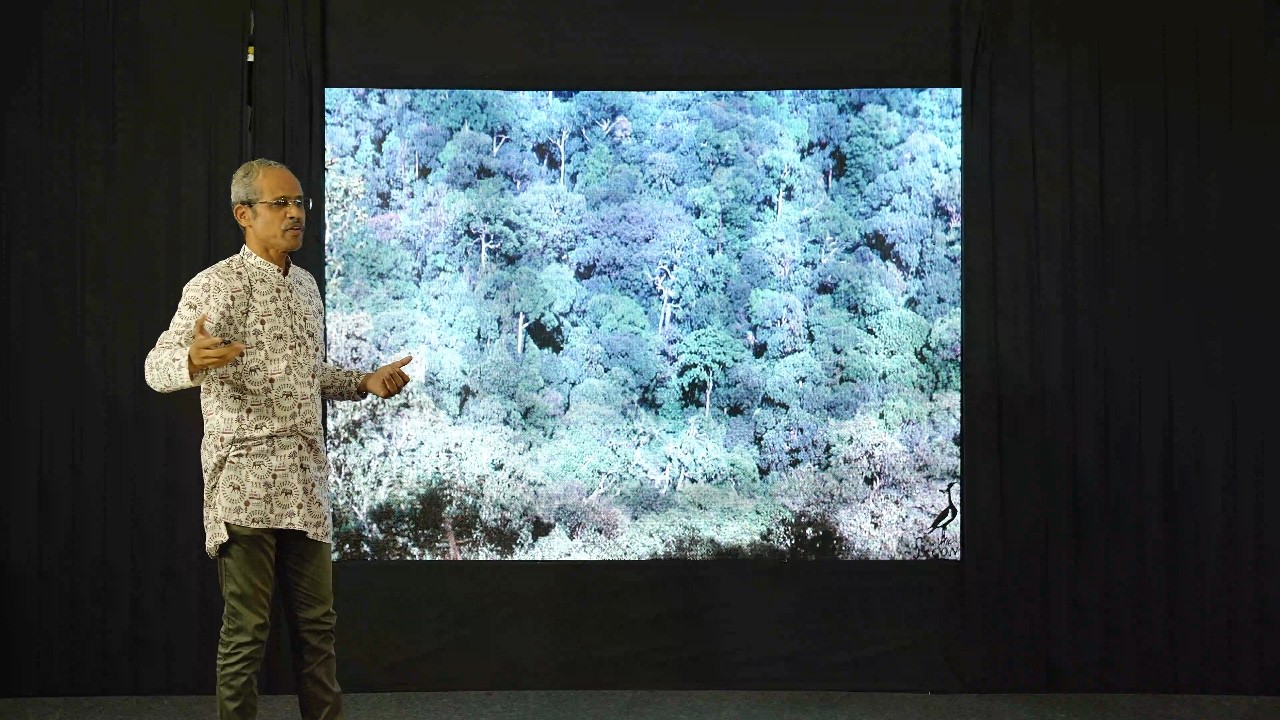
Nature: The Ultimate Source of Inspiration | Dr.Pramod Padmanabhan | TEDxKids Club CBSE School
Keywords
Summary
170 words
Critical Evaluation
Value of the Information & Strength of the Argument
The talk’s core value lies in its authentic testimony from a career scientist who has deeply engaged with Indian ecosystems. The speaker argues that nature is an inexhaustible source of inspiration and personal transformation, supported by his observation that outings in nature have a remarkable effect on children’s behavior and learning. The argumentation is more inspirational than analytical, relying on vivid examples and personal credibility rather than rigorous scientific evidence. He uses specific figures (species counts, migration distances) to ground his claims, but does not cite sources, and some numbers may be approximations. The emotional and motivational framing is powerful, yet it does not offer a structured thesis or counterarguments, making it a compelling but soft scientific contribution.
Scientific Rigor, Source Quality, Title Accuracy
The talk demonstrates strong expertise in ornithology and natural history, but the scientific rigor is limited by the absence of explicit references or data presentation. The speaker uses general statistics and personal anecdotes, which are credible given his position but not verifiable from the video alone. The only provided link is the generic TEDx page, and no specific research papers are mentioned. The title ‘Nature: The Ultimate Source of Inspiration’ is perfectly aligned with the content, as the speaker continuously returns to this central theme.
218 words
Title / Content Match
The title accurately reflects the content: the talk consistently explores nature as a source of inspiration and learning.
Quality & Reliability
7/10
The speaker is a senior scientist with extensive field experience, but the talk relies mostly on personal anecdotes and illustrative numbers without cited scientific publications. The data presented (e.g., species counts) is plausible but not formally sourced.
Key Moments
Markers derived by PSI from the transcript: the creator did not define chapters.
- Introduces himself and his background in Kerala forests.
- Asks the audience to define nature, collecting answers like trees, birds, animals.
- Presents biodiversity statistics: 18,000 flowering plants, 4,500 butterflies, 1,370 birds.
- Shows examples of bird migration: Arctic tern flying 22,000 km and bar-headed geese crossing Everest.
- Discusses murmuration and the mystery of coordinated flight.
- Shares his passion for taking children to forests and the transformative effect on them.
- Closes with a warning about human interference and the rise of AI, urging gratitude for nature.
Cited Sources
- TEDx Program — The talk was delivered at a TEDx event, organized independently under the TEDx license.
Contribution & Novelties
The talk does not present new scientific findings but offers a unique perspective from a veteran scientist on how nature can serve as a catalyst for personal growth and environmental consciousness. Its novelty lies in the emphasis on experiential education and the transformative potential of direct nature exposure, supported by the speaker’s 25 years of leading nature education programs.
Pour aller plus loin :
- Biomimetics — Relevant to the idea of deriving inspiration from nature for design and engineering.
- Bird migration — Discusses the phenomenon the speaker illustrates with the Arctic tern and bar-headed geese.
- Biodiversity hotspot — The Western Ghats, mentioned implicitly, is a major hotspot; this concept supports the speaker’s emphasis on mega-diversity.
- TEDx — Context for the event format used.
123 words
Radar Profile
The radar profile shows moderate scores across quantity, quality, and technical level, with a slightly higher fiabilite_globale. This reflects a talk that is credible and engaging but not deeply rigorous or data-heavy.