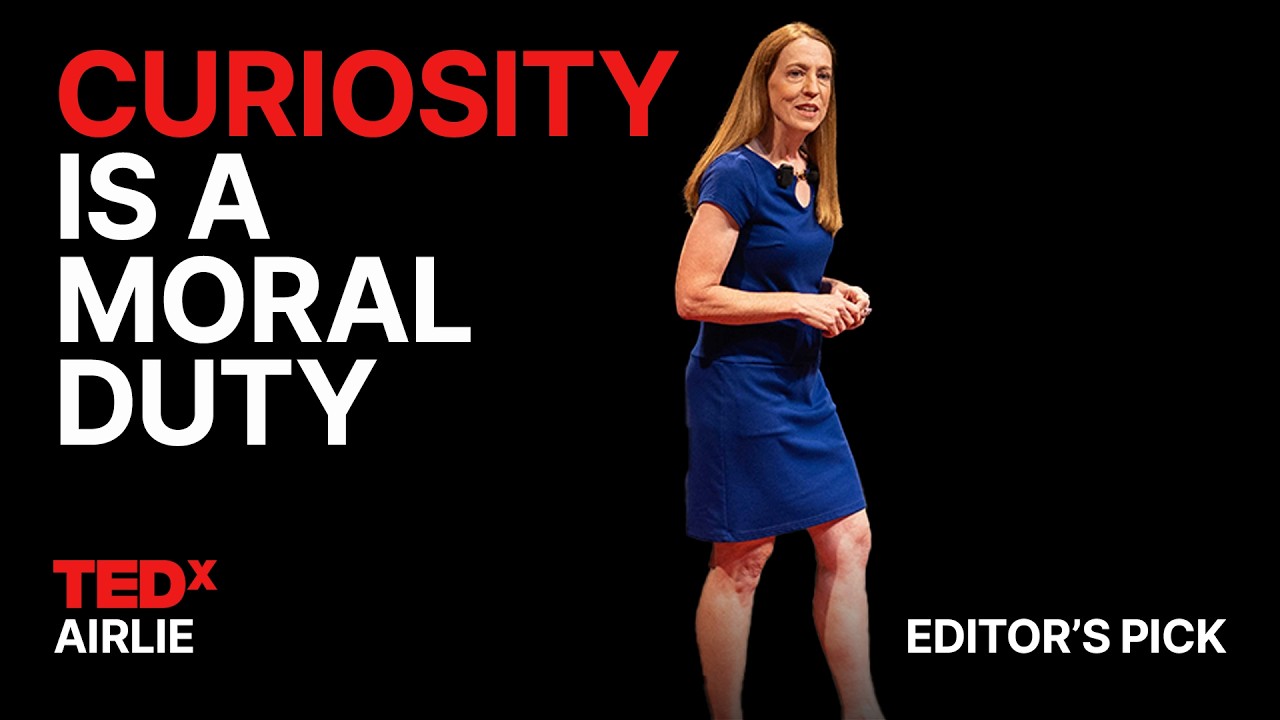
How curiosity saved me from a doomsday cult | Gabrielle Steele | TEDxAirlie
Keywords
Summary
159 words
Critical Evaluation
Value of the Information & Strength of the Argument
The talk’s value lies in its powerful personal testimony, which provides a compelling illustration of how unquestioned beliefs can shape a person’s life. The argument is structured around the idea that curiosity is the antidote to inherited certainty, and Steele supports this with relatable examples and references to psychological research (e.g., the ‘I’m not biased’ bias, the biological need for belonging). The Wizard of Oz analogy is effective in making the abstract concept of inherited narratives tangible. However, the argumentation is largely anecdotal and lacks rigorous scientific backing. The speaker’s claims about curiosity leading to systemic change are supported by the DNA evidence example, but this is presented briefly and without detailed sources. Overall, the talk is persuasive and thought-provoking, but its scientific depth is limited.
Scientific Rigor, Source Quality, Title Accuracy
The talk is a personal narrative rather than a scientific review, so the rigor is moderate. Steele references Don Miguel Ruiz’s ‘The Four Agreements’ and Brené Brown’s work on belonging, but does not provide formal citations. The DNA evidence example is a real-world case, but the statistics (70% of exonerations based on witness identification) are not sourced. The title accurately reflects the content, as the talk is indeed about how curiosity helped the speaker leave a cult. The talk is well-structured and the personal story is compelling, but the lack of verifiable sources limits its scientific credibility.
238 words
Title / Content Match
The title accurately reflects the content: the speaker shares her personal story of leaving a cult and explains how curiosity played a key role.
Quality & Reliability
6/10
Personal testimony with references to psychological concepts (belonging, bias) and a real-world example (DNA exonerations), but no formal citations or data. The speaker's expertise is in exercise physiology, not psychology, and the talk is anecdotal.
Key Moments
Markers derived by PSI from the transcript: the creator did not define chapters.
- Introduction: Speaker shares her background of being in a doomsday cult for 21 years.
- The confession at age 9: 'Because my parents told me' - realizing beliefs are inherited.
- Discussion of Don Miguel Ruiz's 'The Four Agreements' and the 'I'm not biased' bias.
- The Wizard of Oz analogy: Dorothy never questions the narrative and labels the witch as wicked.
- Leaving the cult at 21: the collapse of identity and the beginning of curiosity.
- DNA evidence example: curiosity leading to improved legal procedures.
- Call to action: lean into curiosity in everyday moments to make beliefs your own.
Cited Sources
- TEDx Talks — The talk was given at a TEDx event, and this link provides information about the TEDx program.
Concurring Sources
- The Four Agreements — The speaker references this book to explain inherited beliefs.
- Brené Brown — The speaker cites Brown's work on belonging as a biological need.
Contribution & Novelties
The talk offers a unique personal perspective on the psychological mechanisms of belief formation and the role of curiosity in breaking free from inherited ideologies. It connects personal experience with broader psychological concepts, making it accessible and relatable.
Pour aller plus loin :
- The Four Agreements — A book by Don Miguel Ruiz that discusses limiting beliefs and personal freedom.
- Brené Brown’s research on vulnerability and belonging — Her work explores how vulnerability and belonging shape our lives.
- Innocence Project — An organization that uses DNA evidence to overturn wrongful convictions, relevant to the speaker’s example.
- Confirmation bias — The tendency to search for, interpret, and remember information that confirms one’s preconceptions.
112 words
Radar Profile
The radar profile shows moderate scores across all dimensions, with slightly higher scores in information quality and reliability. This reflects a talk that is engaging and well-argued but lacks deep technical depth and formal citations.