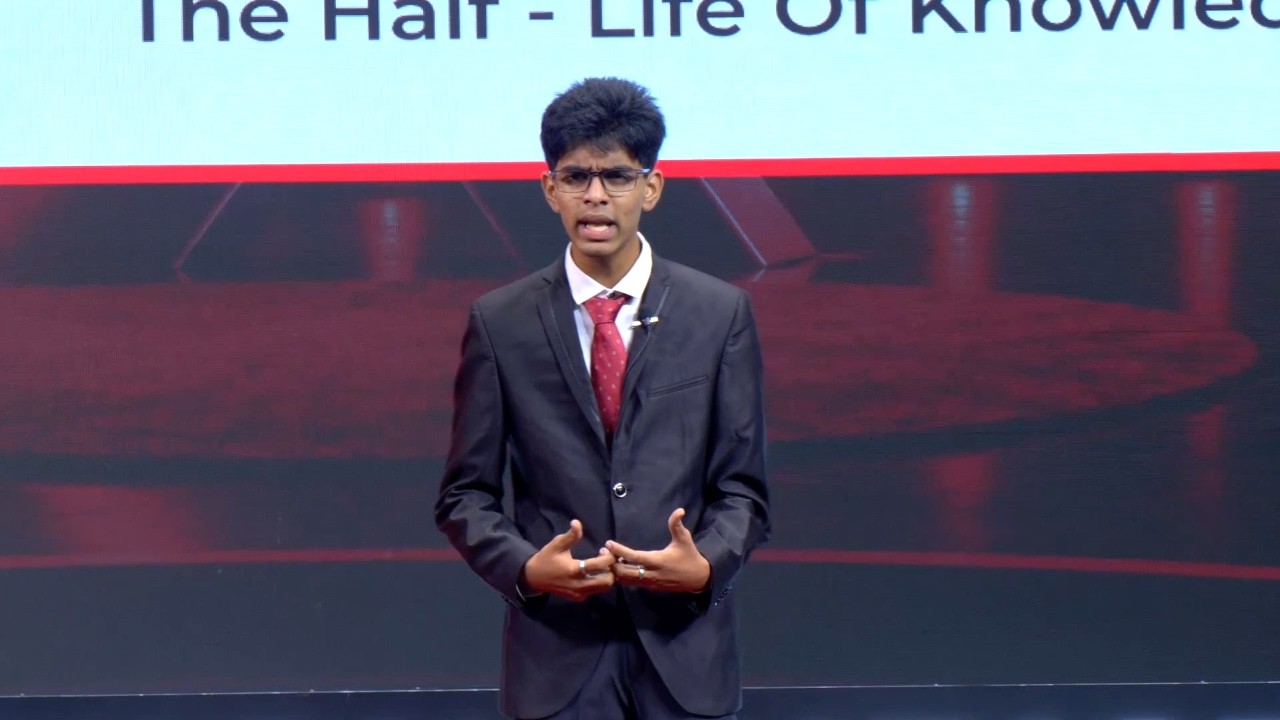
The Half-Life of Knowledge | T Mohammed Arshan | TEDxUnion Christian Public School Youth
Keywords
Summary
180 words
Critical Evaluation
Value of the Information & Strength of the Argument
The talk offers valuable insights into the nature of knowledge and learning, presenting a compelling case for adaptability over static knowledge. The argument is well-structured, using vivid analogies (F1 racing, uranium half-life) to make abstract concepts relatable. Arshan effectively differentiates between mere knowing and true learning, introducing the term ‘metalearning’ and providing practical advice on how to engage with material. However, the reasoning is largely anecdotal and lacks empirical backing; the claims about learning through resistance are plausible but not substantiated with citations. The emotional appeal is strong, but the logical progression from metaphor to prescription is somewhat broad, leaving questions about implementation. Still, the talk succeeds in challenging conventional views and inspiring a growth mindset.
Scientific Rigor, Source Quality, Title Accuracy
The talk references a few well-known facts (Pluto’s reclassification, the concept of half-life from chemistry) but does not cite any scholarly sources. The only external link is to TEDx’s general page, which provides no specific supporting material. The speaker’s credibility as a high school student is limited, though his presentation is polished and coherent. The title accurately reflects the content, and the talk stays on-topic. No comments were provided, so public reception cannot be assessed.
206 words
Title / Content Match
The title accurately captures the central metaphor of knowledge decaying over time, and the talk consistently returns to this theme.
Quality & Reliability
6/10
The talk is well-structured but relies primarily on analogies and personal reflections rather than empirical evidence. The core concepts (half-life, metalearning) are accurately referenced, but the speaker offers no quantitative data or citations, limiting overall reliability.
Key Moments
Markers derived by PSI from the transcript: the creator did not define chapters.
- Introduction with Formula 1 analogy; driver must continuously improve to stay fast.
- Introduces the half-life concept from chemistry and applies it to knowledge; cites Pluto's reclassification in 2006.
- Discusses how education systems assume knowledge stays useful; the problem of outdated knowledge.
- Explains the 'illusion of knowledge'—believing you know something permanently; emphasizes adaptability as key.
- Introduces metalearning (learning how to learn) and its two components: 'how to learn' and 'what to learn'.
- Practical advice: learning involves struggle, not comfort; the example of AI and need for constant updating.
- Final takeaways: embrace 'I don't know', differentiate knowing from learning, and keep updating yourself.
Cited Sources
- TEDx Talks — General TEDx page, referenced as the platform for this talk.
Contribution & Novelties
The talk’s original contribution lies in applying the half-life metaphor from chemistry to knowledge, coining the ‘illusion of knowledge’ and framing metalearning as the essential 21st-century skill. The speaker argues that instead of accumulating facts, individuals must focus on the process of learning, questioning, and adapting. This perspective offers a fresh lens on education and personal development, encouraging a shift from static knowledge to dynamic capability.
Pour aller plus loin :
- Learning to learn — A foundational concept in education that aligns with metalearning, discussing strategies for effective self-directed learning.
- Lifelong learning — The ongoing pursuit of knowledge for personal or professional reasons, directly relevant to the talk’s call for continuous adaptation.
- Dunning–Kruger effect — A cognitive bias illustrating the ‘illusion of knowledge’, where individuals overestimate their competence, tying to the speaker’s warning against complacency.
135 words
Radar Profile
The radar profile shows a balanced but modest performance: quantity and quality of information are moderate, technicality is low, and reliability is moderate. The talk excels in distilling complex ideas into accessible narratives, but lacks depth and empirical grounding, making it more inspirational than rigorous.