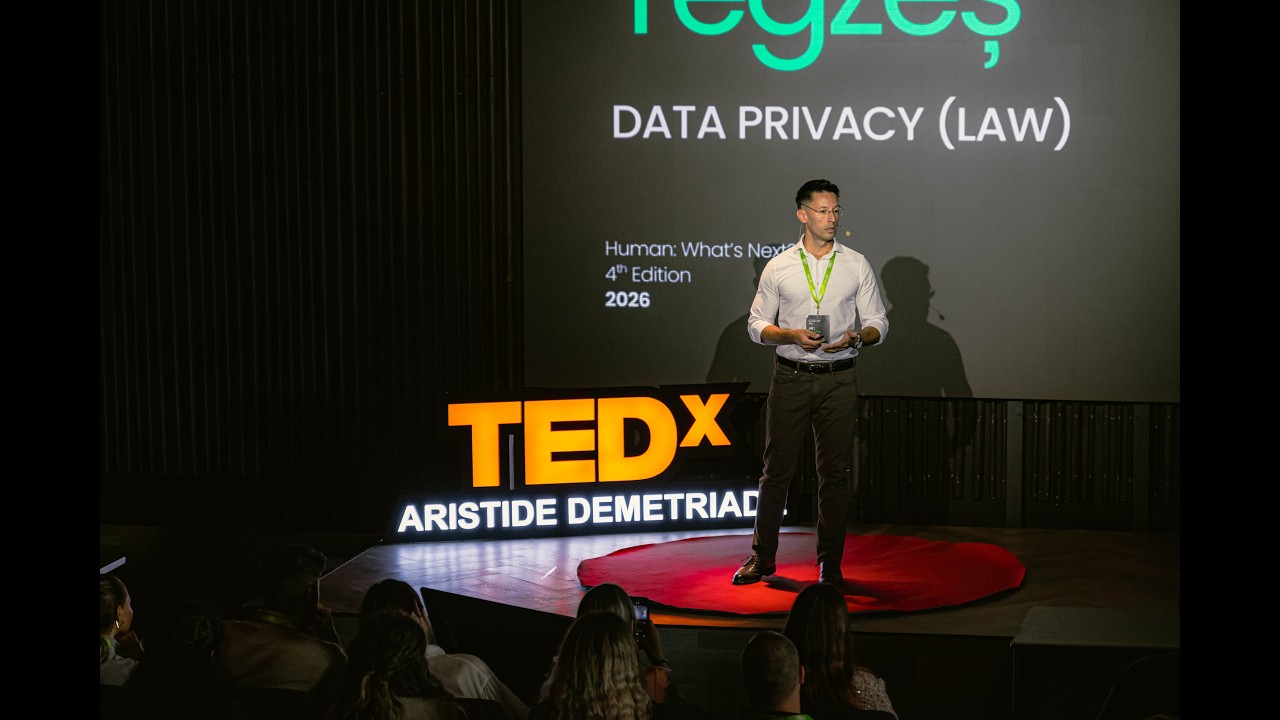
AI, Deepfakes, and Data Privacy in the Digital Age | Alin Tegzeș | TEDxAristide Demetriade Street
Keywords
Summary
198 words
Critical Evaluation
Value of the Information & Strength of the Argument
The talk’s core value lies in raising public awareness about the tangible risks of AI-generated deception and providing simple, actionable strategies for self-protection. The argumentation is effectively structured around two vivid real-world cases that make the threats concrete and emotionally resonant, followed by a practical checklist. The speaker’s background as a lawyer lends authority to discussions of legal gaps and reputation damage. However, the argumentation relies heavily on fear appeal and anecdotal evidence rather than statistical data or peer-reviewed studies, which weakens its scientific rigor. The repeated use of a fictional dialogue with an AI clone is a persuasive stylistic device but does not substitute for systematic evidence. Despite this, the practical advice—such as establishing a private verification password and pausing before responding to urgent requests—is logically sound and easily implementable, giving the talk genuine practical value.
Scientific Rigor, Source Quality, Title Accuracy
The talk is moderately rigorous: it cites two specific incidents (Jennifer DeStefano and Arup) that are consistent with widely reported news stories, and it mentions a study suggesting 300 likes are enough for algorithms to know someone, but provides no references. This lack of citation reduces its scientific credibility. The title accurately matches the content, which consistently explores AI, deepfakes, and data privacy. The talk is more persuasive than systematic, aiming to influence behavior rather than to present a scholarly analysis. The speaker does not misrepresent facts, but the absence of sources means that claims cannot be independently verified. The title is appropriate and not misleading, contributing positively to the overall impression.
264 words
Title / Content Match
The title accurately reflects the content, addressing AI, deepfakes, and data privacy throughout the talk.
Quality & Reliability
6/10
The talk presents real-world cases (Arizona voice clone scam, Hong Kong Arup fraud) and practical advice, but lacks explicit citations or scientific references, relying on anecdotal evidence and general statistics.
Key Moments
Markers derived by PSI from the transcript: the creator did not define chapters.
- Introduction: the internet as a permanent file, not a journal.
- Case study: Jennifer DeStefano and the AI voice clone scam in Arizona.
- Statistic: 300 likes are enough for an algorithm to know you better than your partner.
- Case study: Hong Kong Arup deepfake fraud causing €25 million loss.
- Digital survival kit: password with loved ones, pause, digital hygiene.
- Responsibility of young people to protect elders and the importance of digital education.
Cited Sources
- TEDx Talks - Official page — Description link providing general information about the TEDx program and event format.
Contribution & Novelties
The talk offers a fresh synthesis of known threats (deepfakes, voice cloning, data exploitation) with a practical, lawyer-informed perspective on digital reputation and the inadequacy of legal frameworks. Its original contribution is the ‘digital survival kit’—a concrete set of measures that individuals can adopt immediately, and the framing of the internet as a ‘file’ that records everything permanently. The talk also highlights the emotional manipulation aspect of AI scams, which is often underestimated.
Pour aller plus loin :
- Deepfake on Wikipedia — Provides a comprehensive overview of deepfake technology, its uses, and countermeasures, directly relevant to the cases discussed.
- Digital footprint on Wikipedia — Explains the concept of trace data left online, crucial to the talk’s argument about maintaining digital hygiene.
- Voice cloning on Wikipedia — Details the technology behind voice replication, the basis for the Arizona scam described in the talk.
142 words
Radar Profile
The radar profile shows moderate scores across all dimensions, with slightly lower technical level and reliability due to the non-scientific nature of the talk. The quantity and quality of information are adequate for a general audience, but the lack of citations and the reliance on anecdotal evidence pull down the reliability score.