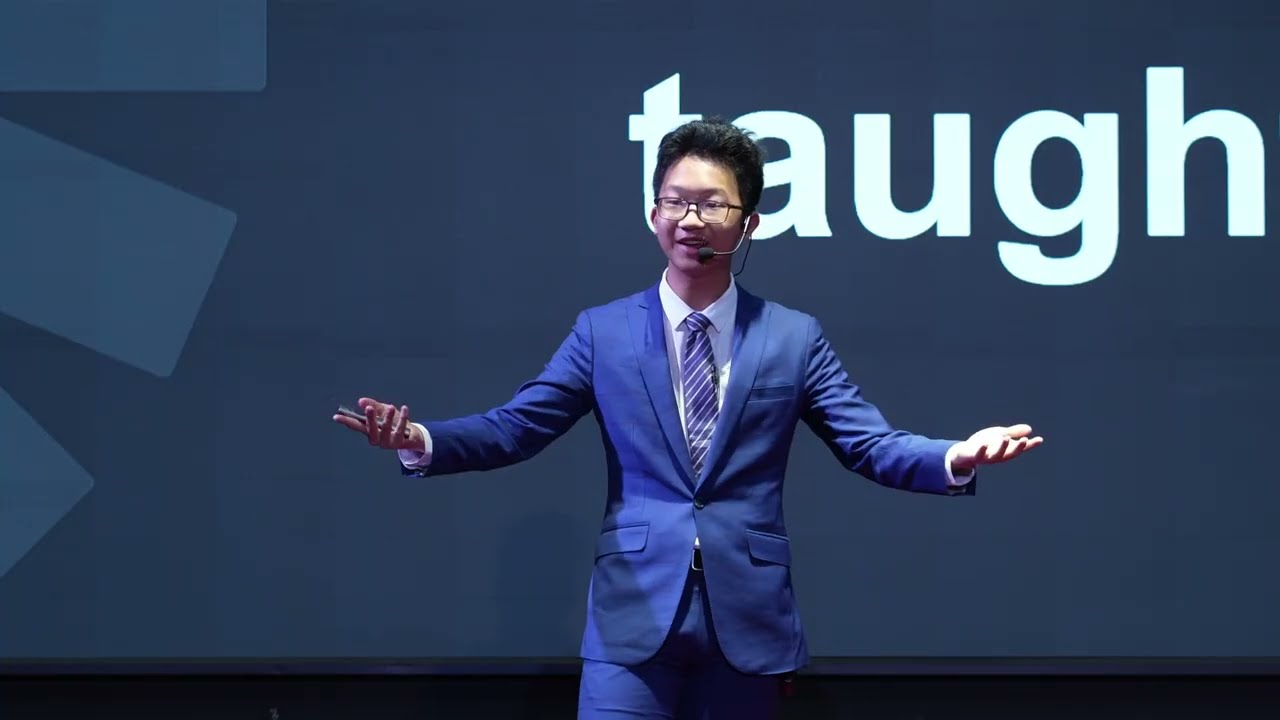
What They Never Taught Us | Aoyu William Wang | TEDxLANNA Intl School Youth
Keywords
Summary
164 words
Critical Evaluation
Value of the Information & Strength of the Argument
The talk’s value lies in its authentic personal testimony, which powerfully illustrates the human cost of a narrow curriculum. Wang’s argument is logically structured, moving from personal suffering to a critique of the educational system, then to a proposed solution. He effectively uses vivid examples and analogies, such as the two stages of ignorance (passive and willful), to strengthen his case. However, the argumentation could be bolstered by statistical evidence or expert citations; it relies heavily on anecdote. Still, the emotional resonance and clear call to action are compelling, making the talk valuable for raising awareness among educators and students.
Scientific Rigor, Source Quality, Title Accuracy
The talk is rigorous in its personal narrative but lacks scientific citations beyond references to Adichie, Dewey, and MLK. The sources are appropriately named and used, though no specific studies or data are provided to support claims about curriculum flaws. The title is well-aligned with the content, and the talk’s focus on what schools omit is consistently developed. The absence of external evidence reduces the overall scientific rigor, but the speaker’s authenticity and the clarity of his argument partially compensate. No audience comments were available for analysis.
202 words
Title / Content Match
Title accurately reflects the talk's focus on gaps in education, addressing what schools fail to teach about the world.
Quality & Reliability
6/10
Personal testimony with limited external evidence; relies on anecdote and calls for educational reform.
Key Moments
Markers derived by PSI from the transcript: the creator did not define chapters.
- Opening: admission that leaving Canada was not due to cold but to racism and bullying.
- Describes first-day insults and nickname 'Ching Chong'.
- Recounts physical attack by a student who wanted to see 'kung fu'.
- Critique of Canada's curriculum: only Canada-centric topics, with Asia and Africa reduced to negatives.
- Proposes global education and cites John Dewey; introduces two stages of ignorance.
- Concludes with MLK-inspired dream and a call to action for educators and parents.
Cited Sources
- TEDx Talks — Official TEDx page for independent TED-like events.
- Chimamanda Ngozi Adichie's 'The Danger of a Single Story' — Referenced for the concept of a single story that reduces people to stereotypes.
- John Dewey's educational philosophy — Mentioned as an advocate of education as lived experience.
- Martin Luther King Jr.'s 'I Have a Dream' — Invoked to frame the dream of an empathetic education.
Contribution & Novelties
The talk offers a personal, student-centered perspective on the systemic issue of monocultural curricula, which is relatively uncommon in educational discourse. It bridges personal trauma with a systemic critique, making the case for curriculum reform concrete and relatable. The originality lies in Wang’s dual experience as an international student and his analysis of the syllabus.
Pour aller plus loin :
- The Danger of a Single Story — Adichie’s TED talk explores the same theme of oversimplified narratives.
- John Dewey — Philosopher of education emphasizing experiential learning and democracy.
- Multicultural education — A field that advocates for curriculum reform to reflect diverse perspectives.
102 words
Radar Profile
The radar profile shows moderate scores in information quantity and quality, with a low technical level reflecting the audience-friendly nature. Fiabilité is moderate due to reliance on personal testimony. The talk is strong on emotional appeal and argumentation but weak on empirical evidence, making it a persuasive piece rather than a rigorous scientific analysis.