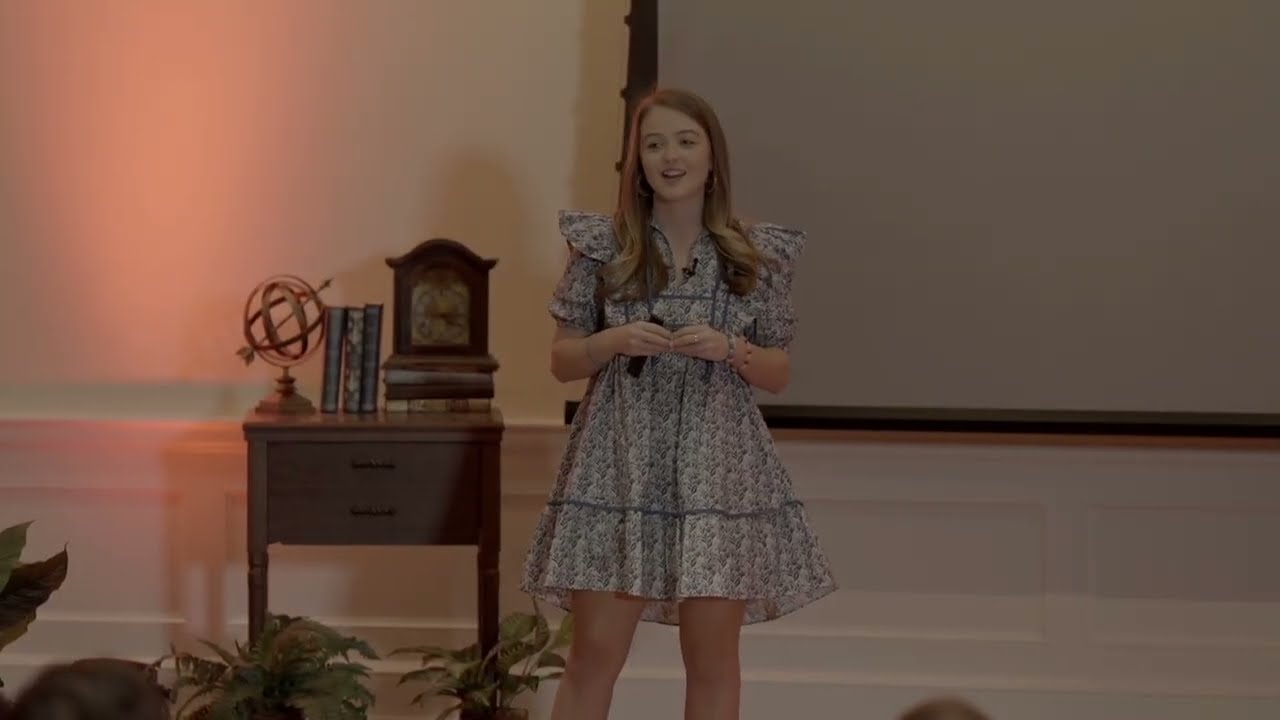
Granting Grief | Charlotte Swanson | TEDxCNU
Keywords
Summary
111 words
Critical Evaluation
Value of the Information & Strength of the Argument
The talk’s value lies in its relatable and heartfelt perspective on grief, offering a more flexible model than the traditional Kübler-Ross pyramid. The argumentation is primarily anecdotal, relying on personal stories and a vivid metaphor (glitter) rather than scientific research. The speaker effectively challenges the linear assumption, but does not provide alternative evidence-based frameworks. The emotional appeal is strong, which may influence perception more than logical rigor.
Scientific Rigor, Source Quality, Title Accuracy
The speaker correctly cites Elisabeth Kübler-Ross’s ‘On Death and Dying’ (1969) for the five-stage model. However, she does not reference any subsequent research on grief that supports her web metaphor. The title accurately reflects the content, which argues for granting grief its rightful space. The overall scientific rigor is limited, as it is a personal essay rather than a systematic review.
143 words
Title / Content Match
The title 'Granting Grief' succinctly captures the core message: allowing oneself and others to experience grief without pressure to 'move on'. The content matches this theme perfectly.
Quality & Reliability
5/10
The talk presents a personal perspective on grief, accurately referencing the Kübler-Ross model but offering no empirical evidence for the alternative views. The speaker shares a deeply personal story, making it credible from an experiential standpoint, but it lacks scientific rigor.
Key Moments
Markers derived by PSI from the transcript: the creator did not define chapters.
- Introduction: personal story of losing friend to gun violence and grandfather shortly after.
- Discussion of society's misunderstanding of grief and pressure to move on.
- Introduction of Kübler-Ross five-stage model (DABDA) and its limitations.
- Proposal of grief as a web instead of a pyramid, emphasizing non-linearity.
- Glitter metaphor: how grief lingers and resurfaces unexpectedly.
- Conclusion: treating an invitation into someone's grief as sacred and supporting them.
Cited Sources
- On Death and Dying — Mentioned as the origin of the five-stage model of grief.
- TEDx Official Page — Information about TEDx events, this talk was given at a TEDx event.
Contribution & Novelties
The talk’s original contribution is its critique of the linear Kübler-Ross model, offering a more fluid, web-like conceptualization of grief. The glitter metaphor provides a vivid and accessible way to understand how grief persists and resurfaces. The emphasis on treating grief invitations as sacred is a practical call to action.
Pour aller plus loin :
- Kübler-Ross model — Further reading on the five-stage model and its criticisms.
- Continuing bonds theory — A theory suggesting that maintaining a connection with the deceased is a normal part of grief.
- Complicated grief — A condition where grief symptoms persist and impair functioning, relevant to discussions of grieving timelines.
105 words
Radar Profile
The radar profile shows high values in quantity and quality of information relative to the low technical level, indicating a talk that is accessible and emotionally engaging but not deeply technical. Reliability is moderate, reflecting the personal nature of the content.