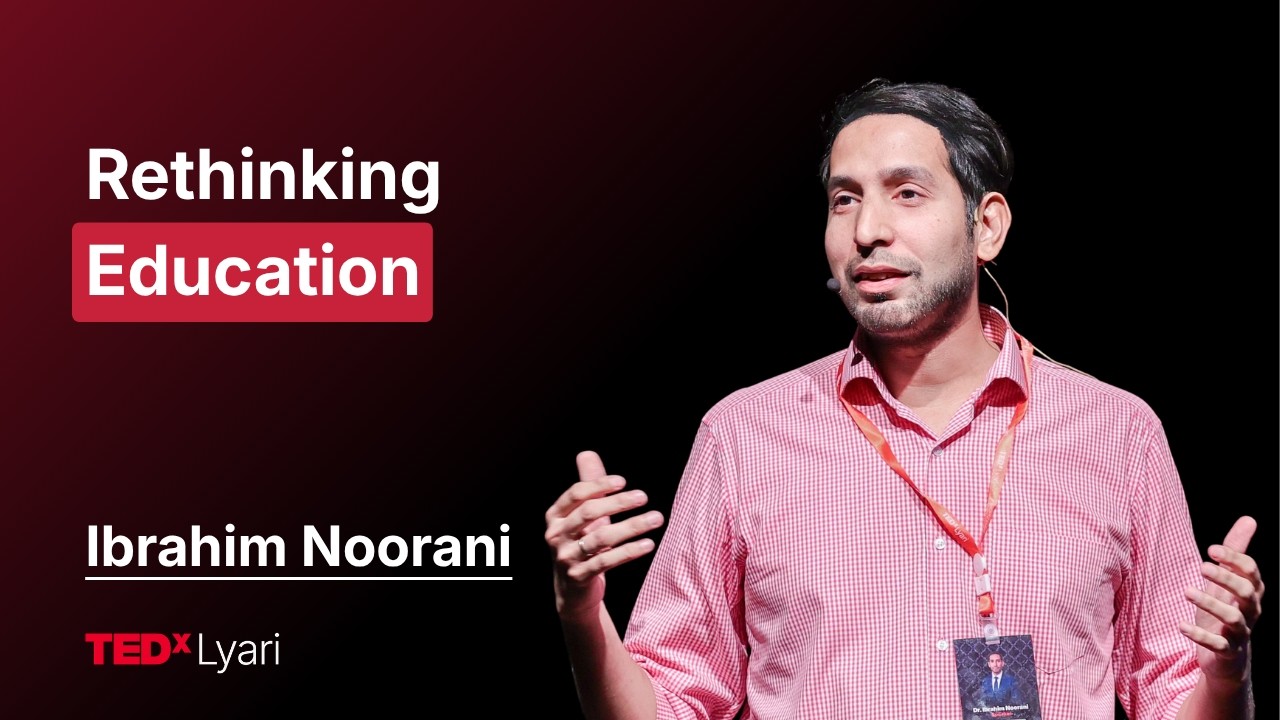
Rethinking education | Ibrahim Noorani | TEDxLyari
Keywords
Summary
179 words
Critical Evaluation
Value of the Information & Strength of the Argument
The talk offers a valuable critique of market-driven education, framing it as a loss of the original purpose of learning. The argument is structured around a clear progression: capitalism transforms society into a consumer culture, and education becomes a tool for sorting and producing workers rather than nurturing understanding. The speaker uses vivid analogies (assembly line, TikTok mentality) and personal experience to make abstract concepts relatable. However, the argumentation relies heavily on assertion and rhetorical framing; no empirical evidence or counterarguments are presented. The Islamic perspective provides a normative foundation, but it is presented as self-evident rather than critically examined. The value lies in prompting reflection on the deeper purpose of education, though the reasoning would be stronger with more concrete examples and grounding in educational research.
Scientific Rigor, Source Quality, Title Accuracy
The talk is more philosophical and opinion-based than scientifically rigorous. The speaker cites no formal research or external scholarly sources beyond references to philosophers such as Karl Marx (mentioned indirectly) and his own former professor. The only provided link is the general TEDx page, which does not support specific claims. The title accurately encapsulates the subject, but the content does not advance new empirical findings; it is a critical essay delivered orally. The speaker’s academic background lends some credibility, but the lack of citations and data limits its scientific robustness. There is no evidence of deliberate misinformation, but the absence of sources makes independent verification difficult.
248 words
Title / Content Match
The title accurately reflects the content: the talk critically examines the purpose of education, its transformation under capitalism, and proposes a spiritual redefinition.
Quality & Reliability
6/10
The speaker is an academic with a PhD, but the talk is largely opinion-driven with no empirical data or explicit scholarly sources. The argument is coherent and draws on philosophical concepts, though verification of specific claims is limited.
Key Moments
Markers derived by PSI from the transcript: the creator did not define chapters.
- Opening with Kabir's quote and introduction on human need for knowledge.
- Discusses how capitalism and modernity turned society into a market.
- Lists four mechanisms: aggressive marketing, restructuring institutions, transforming values, and altering time/space perceptions.
- Education dilemmas: from knowledge dissemination to human capital production, compartmentalization.
- Teachers' dilemmas: reluctance to continue learning and curriculum-limited mindset.
- Students' dilemmas: lack of interest, cheating, and AI-driven engagement.
- Conclusion: education should connect to spiritual growth, referencing Quranic command 'Iqra'.
Cited Sources
- TEDx program — Referenced in the video description as the general TEDx event page.
Contribution & Novelties
The talk’s original contribution is its integration of a critique of capitalist education with an Islamic philosophical perspective, arguing that modern reforms have alienated knowledge from spiritual purpose. It synthesizes familiar criticisms (human capital theory, consumer society) with a religiously grounded call to redefine ‘ilm’ as that which connects to God. This perspective adds a distinctive moral dimension to debates on educational reform, though it does not introduce new empirical data or experimental evidence.
Pour aller plus loin :
- Human capital theory — Relevant to the speaker’s claim that education now produces skills for the market rather than knowledge.
- Consumer society — Extends the discussion on how marketing and commodification shape social institutions.
- Social alienation — Connects to the speaker’s mention of compartmentalization and worker estrangement in education.
128 words
Radar Profile
The radar profile shows moderate scores across all dimensions, with information quantity and quality slightly higher than technical level and reliability. This indicates an accessible, conceptually rich talk that lacks deep technical or data-driven substantiation.