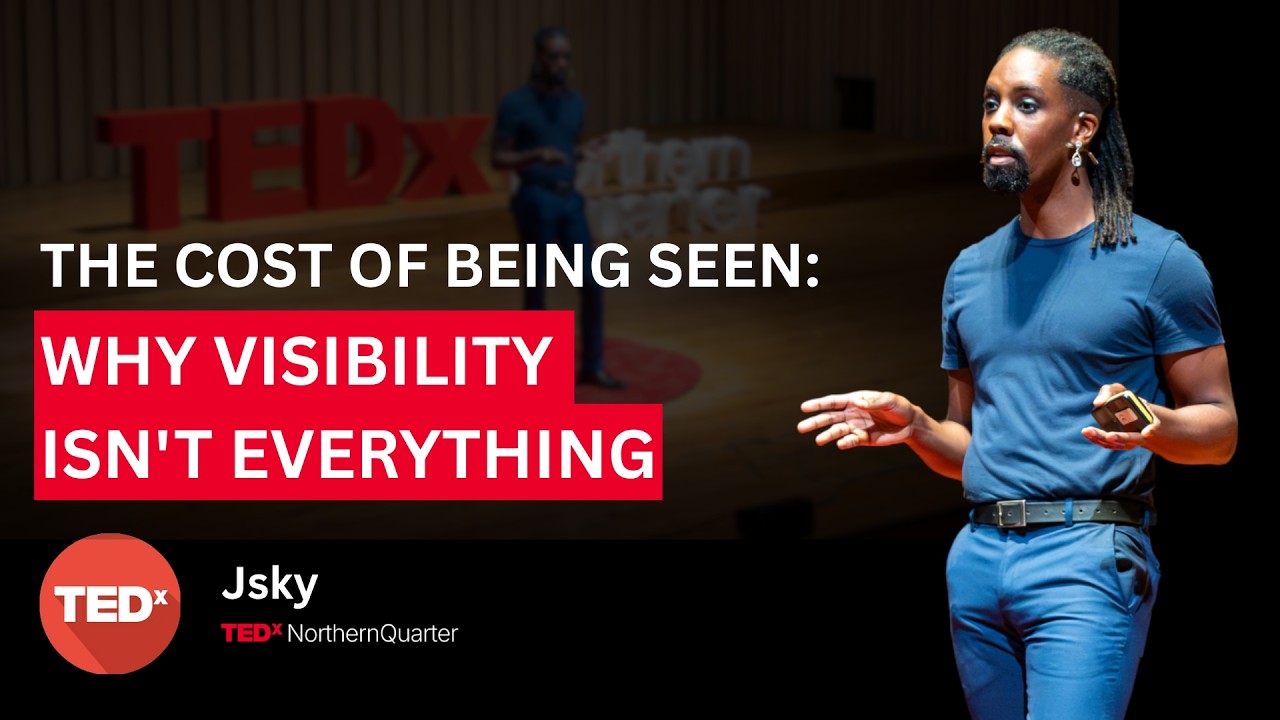
The Cost of Being Seen: Why Visibility Isn't Everything | Jsky . | TEDxNorthern Quarter
Keywords
Summary
240 words
Critical Evaluation
Value of the Information & Strength of the Argument
The talk’s value lies in its relatable and emotionally resonant framing of a widespread issue. Jsky effectively uses personal anecdotes to humanize the impact of social media on identity and self-worth, making the argument accessible. However, the argumentation relies heavily on emotional appeal and anecdotal evidence rather than empirical data. The statistics mentioned (e.g., 6 hours online, 70% harm) are given without sources, weakening the factual basis. The reasoning is coherent: the problem (algorithmic engagement) is identified, illustrated with examples, and countered with practical suggestions. Yet, the suggestions are generic and lack depth. Overall, the talk is compelling and thought-provoking, but its scientific rigor is limited.
Scientific Rigor, Source Quality, Title Accuracy
The talk is a TEDx presentation, and the only link provided in the description is the general TEDx page, which does not offer specific references. While Jsky references events like Oprah’s incident, the stats, and its own projects, none are cited with verifiable sources. The title is well-aligned with the content, clearly summarizing the central thesis. However, for a scientific analysis, the absence of citations and reliance on personal testimony reduces the overall rigor. The talk succeeds as a motivational speech but falls short as a scientifically grounded exposition.
210 words
Title / Content Match
The title 'The Cost of Being Seen: Why Visibility Isn't Everything' accurately reflects the talk's focus on the negative consequences of online visibility and the shift from external validation to internal worth.
Quality & Reliability
6/10
The talk is a persuasive personal narrative with some statistics and anecdotes, but lacks rigorous academic sourcing. The core arguments about social media's impact on self-worth are supported by general references but not detailed data. The speaker's own experience adds authenticity but not scientific robustness.
Key Moments
Markers derived by PSI from the transcript: the creator did not define chapters.
- Opening with awkward silence to illustrate fear of nothing happening.
- Oprah's story about being used by the KKK on her show and her vow.
- Introduction to the concept of likes as currency and spending self-worth.
- Personal background: growing up in Manchester, feeling unseen, and coming out.
- Experience on Channel 4's Naked Beach and the message of body positivity.
- Carrying the Queen's baton in heels, impact versus influence.
- 2025 trends: extreme content, performative altruism, and rise of micro-influencers.
- Three suggestions: digital audit, shift to active, define own metrics.
- Call to action: resist rage bait, think before engaging, demand new KPIs.
- Final vow: 'I will not be used by social media. I will command the screen and live in the room.'
Cited Sources
- TEDx Program — The talk was given at a TEDx event; the link provides general information about the TEDx format.
Concurring Sources
- TEDx Program — General TEDx resource, not directly corroborating specific claims but providing context.
Contribution & Novelties
The talk provides a personal and creative perspective on the psychological costs of social media visibility, connecting identity, self-worth, and algorithmic influence. Its novelty lies in the speaker’s unique background (body positivity activism, LGBTQ+ visibility) and his call to redefine metrics of success from external engagement to internal fulfillment.
Pour aller plus loin :
- Social comparison theory — Explains how comparing one’s life to others’ curated content can lead to negative self-appraisal, relevant to the ‘compare and despair’ mechanism.
- Algorithmic curation and filter bubbles — Discusses how recommendation algorithms shape user experience, often amplifying extreme content for engagement, as mentioned by Jsky.
- Digital well-being and design ethics — Offers a broader framework for understanding how technology impacts mental health, aligning with the speaker’s suggestions for mindful usage.
127 words
Radar Profile
The radar profile shows a talk strong on personal narrative and emotional appeal (high qualitative and quantitative information from anecdotal evidence) but weaker on technical depth and factual reliability. The speaker is persuasive but not rigorously scientific, which is reflected in moderate reliability scores.