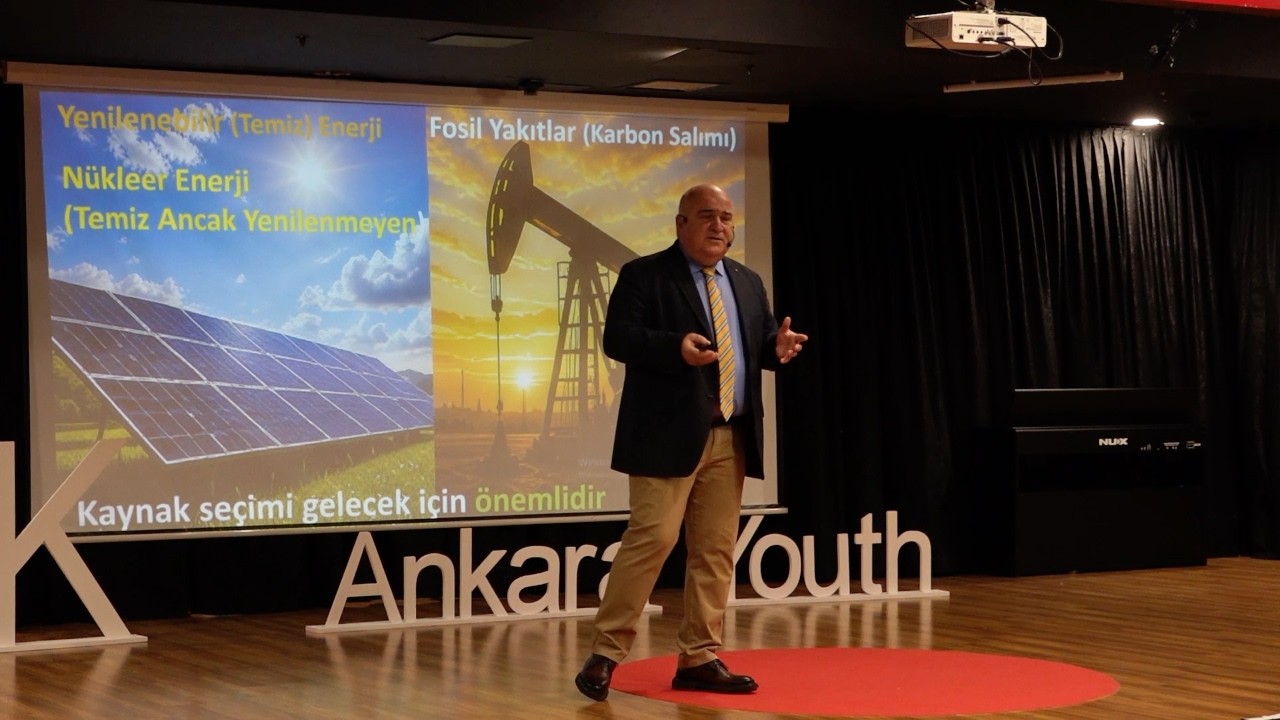
Sürdürülebilir Gelecek İçin Enerjinin Akılcı Kullanımı | Levent Çolak | TEDxBK Ankara Youth
Rational Use of Energy for a Sustainable Future | Levent Çolak | TEDxBK Ankara Youth
Keywords
Summary
194 words
Critical Evaluation
Value of the Information & Strength of the Argument
The talk provides a valuable overview of energy and sustainability concepts, particularly introducing exergy—a topic often unknown to non-engineers. The speaker argues convincingly that renewable energy alone cannot solve the problem due to intermittency, and that energy efficiency and conservation are paramount. However, the argumentation relies heavily on anecdotal examples and analogies (greenhouse effect, walnut) rather than quantitative data or references. The claim about AI using 765 billion liters of drinking water annually is striking but not sourced, and the presentation simplifies complex system dynamics. Overall, the value lies in raising awareness and providing a framework, but it lacks depth in technical details and empirical support.
Scientific Rigor, Source Quality, Title Accuracy
The scientific rigor is moderate; the speaker correctly explains fundamental physics (energy conservation, second law) and uses appropriate analogies. However, he does not cite any studies or provide references, and some statements (e.g., AI water consumption) are presented without evidence. The title appropriately matches the content, as the entire talk is about rational energy use for sustainability. No comments were provided to analyze public reception.
186 words
Title / Content Match
The title accurately reflects the content, which focuses on the rational use of energy for a sustainable future.
Quality & Reliability
7/10
The talk presents correct basic concepts of sustainability, energy sources, and exergy, but simplifies some aspects and provides no citations or references. The speaker's expertise adds credibility, yet claims about AI water consumption and others lack direct sources.
Key Moments
Markers derived by PSI from the transcript: the creator did not define chapters.
- Introduction to sustainability and definition of sustainable development
- Explanation of the three pillars of sustainability (environmental, economic, social) and role of energy
- Climate change effects: extreme weather, melting ice, droughts, acid rain
- Overview of energy sources: fossil fuels, nuclear, renewable energies and their limitations
- Introduction to exergy and the second law of thermodynamics with the walnut analogy
- Discussion on AI's energy and water consumption and the need for rational use
- Conclusion: future is a design, collective actions lead to sustainable world
Cited Sources
- TEDx Program — Official TEDx website mentioned in the description; the talk was independently organized under TEDx license.
Contribution & Novelties
The talk brings to a general audience the concept of exergy, which is often not covered outside engineering thermodynamics. It emphasizes qualitative differences in energy quality and irreversible losses, offering a fresh angle on sustainability discussions. Practical suggestions about hybrid energy use and mindful AI consumption add pragmatic value. For deeper exploration:
Pour aller plus loin :
- Exergy — Key concept presented in the talk; deepen understanding of energy quality.
- Second law of thermodynamics — Fundamental law behind exergy and irreversible losses.
- Sustainability — Broader framework and three pillars discussed in the talk.
- Renewable energy — Overview of different renewable sources and their intermittency challenges.
105 words
Radar Profile
The score profile shows balanced moderate ratings across quantity, quality, technical level, and reliability. The talk is accessible and informative but not highly technical or deeply sourced, resulting in a moderate utility for informed audiences.