Anatomie générale 4 : Ostéogenèse, arthrologie (anatomie générale des articulations)
General Anatomy 4: Osteogenesis, Arthrology (general anatomy of the joints)
Keywords
Summary
207 words
Critical Evaluation
Value of the Information & Strength of the Argument
The lecture provides high informational value for students of anatomy, systematically covering the fundamental concepts of bone formation and joint classification. The argumentation is clear and logical, building from embryological origins to adult structures, and linking structure to function. The instructor uses concrete examples (e.g., cranial sutures, clavicle, long bones) and clinical correlations (e.g., achondroplasia, microcephaly, bone age) to reinforce understanding. The explanations are detailed and accurate, reflecting standard anatomical teaching. The progression from membranous to endochondral ossification, and then to joint classification, is coherent and well-structured. The use of analogies (e.g., tectonics for cranial bone growth) aids comprehension. The lecture does not present original research but synthesizes established knowledge effectively.
Scientific Rigor, Source Quality, Title Accuracy
The scientific rigor is high, as the content aligns with standard embryology and anatomy textbooks. However, no explicit sources or references are cited in the video or description, which is typical for a lecture but limits verifiability. The title accurately reflects the content, covering both osteogenesis and arthrology. The lecture is delivered in a didactic manner, with no apparent biases or unsupported claims. The absence of a bibliography is a minor weakness, but the information is consistent with authoritative sources. No comments were provided for analysis.
212 words
Title / Content Match
The title accurately reflects the content: the video covers osteogenesis (membranous and endochondral ossification) and arthrology (classification of joints). The content matches the title well.
Quality & Reliability
8/10
The content is a university-level anatomy lecture delivered by an experienced instructor, based on established embryology and osteology. The information is accurate and consistent with standard anatomical references. However, no explicit citations or sources are provided in the description or transcript, and the lecture relies on the instructor's expertise rather than documented evidence. The absence of a bibliography or references slightly reduces the score.
Key Moments
Markers derived by PSI from the transcript: the creator did not define chapters.
- Introduction to osteogenesis: definition and two types (membranous and endochondral).
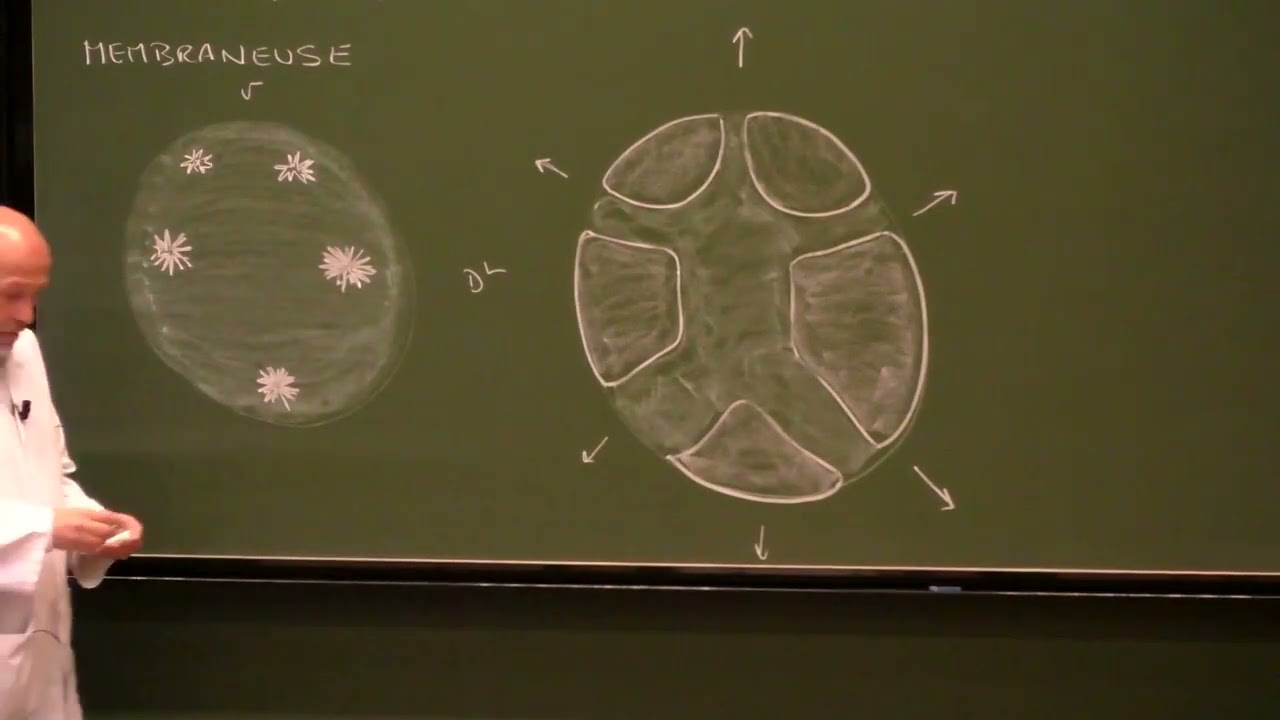
- Membranous ossification: development of cranial vault bones from a fibrous membrane, role of brain growth.
- Formation of sutures and fontanelles at birth; functional significance for childbirth.
- Closure of sutures after brain growth; clinical correlations: microcephaly and macrocephaly.
- Endochondral ossification: primary and secondary ossification centers in long bones.
- Growth plate (cartilage de conjugaison) and its role in longitudinal growth; periosteum for appositional growth.
- Bone age estimation and clinical example: achondroplasia.
- Introduction to arthrology: definition of a joint, mobility and stability.
- Classification of joints: fibrous joints (sutures, gomphosis, syndesmosis).
- Detailed examples: cranial sutures, tooth alveolus, tibiofibular syndesmosis.
Contribution & Novelties
This lecture does not present new research but offers a comprehensive and pedagogically clear synthesis of osteogenesis and arthrology for first-year health students. Its originality lies in the detailed step-by-step explanation of membranous and endochondral ossification, with clinical correlations that bridge basic science and pathology. The instructor’s use of simple analogies and blackboard drawings enhances understanding. The lecture is part of a series, providing a structured curriculum.
Pour aller plus loin :
- Ossification — Wikipedia article on bone formation, covering both intramembranous and endochondral ossification.
- Joint — Wikipedia article on joints, including classification and structure.
- Achondroplasia — Wikipedia article on the most common form of dwarfism, caused by a mutation affecting endochondral ossification.
- Bone age — Wikipedia article on bone age assessment, used in pediatrics and forensics.
127 words
Radar Profile
The radar profile shows high scores in information quantity and quality, reflecting the comprehensive and accurate content. Technical level is moderately high, suitable for first-year medical students. Reliability is strong, though slightly tempered by the absence of explicit citations. Overall, a solid educational resource.