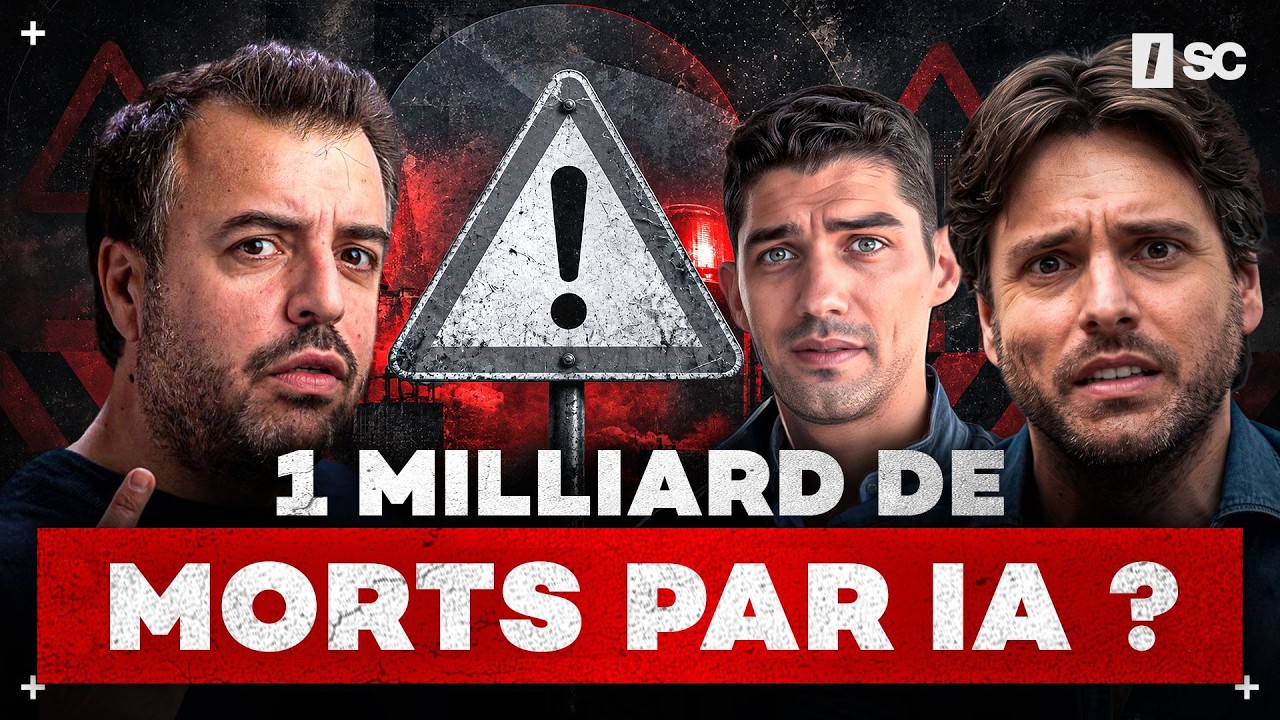
Peut-on prédire la fin du monde avec l’IA ?
Can we predict the end of the world with AI?
Keywords
Summary
160 words
Critical Evaluation
Value of the Information & Strength of the Argument
The value of the information lies in its critical examination of the p(doom) phenomenon, highlighting how subjective estimates are presented as scientific facts. The argumentation is largely based on personal opinions and anecdotes rather than concrete data. Richard Détente’s reasoning about prudence versus risk is provocative but lacks empirical support. The discussion on researcher burnout provides a humanizing perspective that is often missing in AI discourse. However, the arguments are not systematically developed and rely heavily on rhetorical flourishes, such as comparing AI to a four-year-old or dismissing concerns with analogies. The panel does not offer any alternative methodology for assessing AI risk, which weakens the overall argumentation.
Scientific Rigor, Source Quality, Title Accuracy
The scientific rigor is low; the video references several unnamed researchers and studies but provides no direct citations or links to actual papers. The guests are experts in their fields, but their claims are not substantiated with verifiable sources. The title accurately captures the theme of predicting the end of the world via AI, and the content stays on topic. The inclusion of a sponsor segment is clearly marked and does not detract from the discussion. The channel’s description provides links to guest profiles and newsletters, but these are not academic sources. Overall, the video falls short of scientific rigor due to its reliance on opinion and lack of transparent sourcing.
234 words
Title / Content Match
The title accurately reflects the content, which discusses the possibility of predicting global catastrophes with AI.
Quality & Reliability
5/10
The video presents subjective estimates and opinions from experts without rigorous scientific backing, but it does cover a relevant topic and offers contrasting perspectives.
Chapters
- Sommaire
- Alex Turner quitte Google : l'armée fait tout basculer
- Un milliard de morts avant 2050 : vraie peur ou com' ?
- [Sponsor] : Qonto, gérez votre trésorerie avec l'IA !
- P(doom) : le vrai danger vient des humains, pas des machines
- Des probabilités de l'extinction aussi fiables qu'un bluff au poker
- P(doom) : une estimation subjective élevée au rang de vérité
- L'IA peut-elle devenir consciente : une question sans définition
- QI 10000 : quand l'IA efface l'humain de l'équation
- Les prudents meurent en premier : seul le risque protège
- Catastrophistes partout, optimistes nulle part
- Jennifer Prenky : ce qu'elle a vu craquer de l'intérieur
- Spécialistes brillants mais incapables de voir les ruptures
- Labs IA : recrutés pour coder, pas formés pour tenir
- Le modèle nucléaire américain que les labs refusent d'adopter
Cited Sources
- Silicon Carne Newsletter — Channel's newsletter with detailed analyses and sources.
- Silicon Carne Substack Subscription — Subscription page for the Hacienda community.
- Silicon Carne Podcast — Podcast feed of the show.
- Anji Ismail LinkedIn — Profile of guest Anji Ismail.
- Carlos Diaz LinkedIn — Profile of host Carlos Diaz.
- Richard Détente LinkedIn — Profile of guest Richard Détente.
External References
Contribution & Novelties
The video offers a critical examination of p(doom) estimates, highlighting the subjective nature of these predictions and the potential influence of burnout and corporate pressures on AI researchers. It also introduces the concept of ‘p(utopia)’ as a counterpart to catastrophic thinking. The discussion encourages a broader perspective on AI risk, moving beyond technical aspects to human and societal factors.
Pour aller plus loin :
- AI alignment — Core concept in AI safety.
- Existential risk from artificial intelligence — Overview of the risk.
- Stochastic parrot — Critique of large language models.
90 words
Radar Profile
The radar profile shows moderate quantity of information and technical level, but lower quality and reliability, reflecting the subjective and opinion-based nature of the discussion. The low reliability score suggests that viewers should approach the claims with caution.
💬 Balanced, with notable critical remarks on the depth of the discussion and the behavior of the guests. Several positive comments appreciate the new episode format and the presence of Richard Détente.