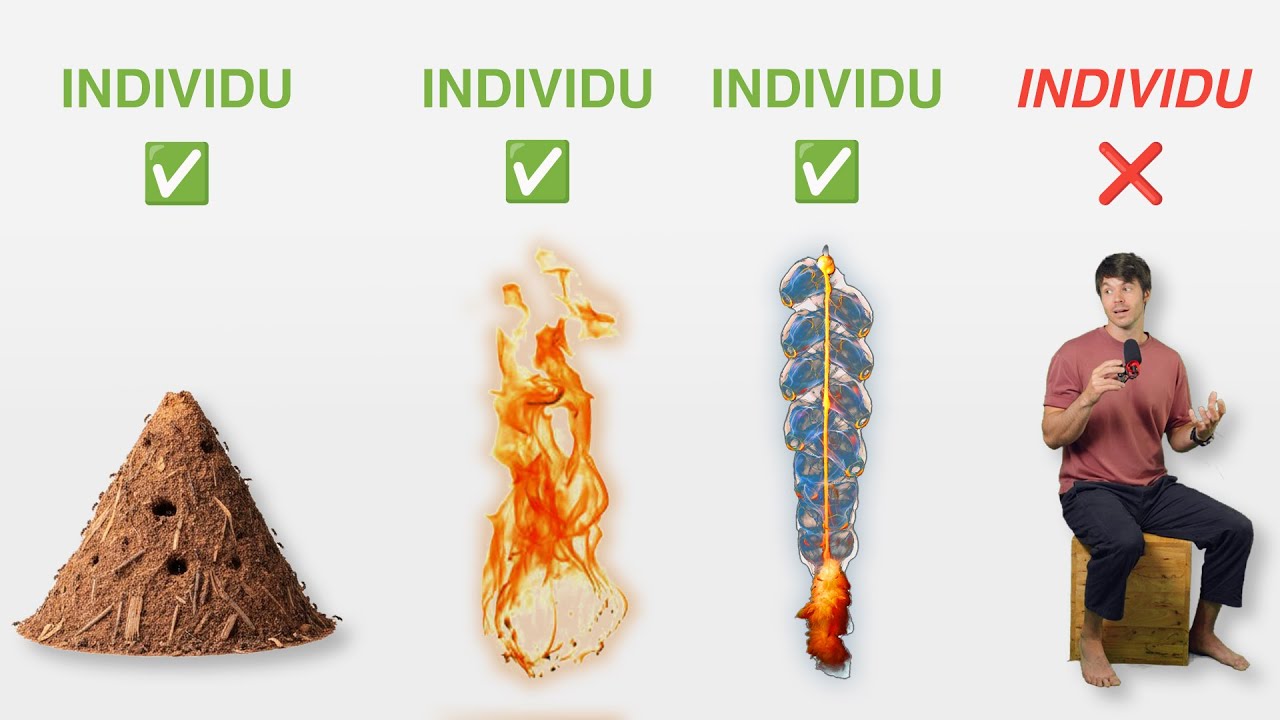
Une nouvelle théorie ƎꓕNⱯSꓤƎꓥNƎꓤ des individus
A new theory of the individuals
Title history
- Une nouvelle théorie ƎꓕNⱯSꓤƎꓥNƎꓤ des individus — observed on 20261101-0145 UTC (YouTube)
Keywords
Summary
156 words
Critical Evaluation
Value of the Information & Strength of the Argument
The video excels in presenting a compelling case for rethinking individuality. It builds its argument stepwise: starting with the intuitive definition, then introducing a series of increasingly challenging examples that each undermine a different assumption. The progression from eusocial colonies to clonal plants and symbiotic associations effectively demonstrates the inadequacy of spatial and genetic criteria. The introduction of the information-theoretic framework provides a coherent, formal answer that unifies the examples. The argument is supported by references to historical thinkers (Cuvier, Schrödinger) and a recent publication, giving it scientific grounding. The use of humor and analogies makes the complex ideas accessible without diluting their depth. However, the video could be strengthened by more explicitly addressing potential criticisms or limitations of the theory beyond its technical implementation, and by clarifying the link between information preservation and biological reproduction.
Scientific Rigor, Source Quality, Title Accuracy
The video exhibits strong scientific rigor: it cites a comprehensive source document (linked in the description), references a specific 2020 paper, and accurately explains the historical roots of the information-from-entropy idea in Schrödinger’s ‘What is Life?’. The examples are well-documented and the reasoning is logical. The inverted title is not only a creative gimmick but also semantically apt, as it visually represents the reversal of the concept of the individual. The content fully matches the title’s promise. The production quality is high, with clear visuals and engaging narration. No sponsorship or product placement appears; the video is community-funded, which enhances its perceived independence.
254 words
Title / Content Match
The deliberately inverted title mirrors the video's core message of overturning the conventional spatial and categorical view of individuals, making it a perfect match.
Quality & Reliability
8/10
The video presents a well-structured argument supported by multiple biological examples and a recent theoretical framework (2020 paper). The claims are clearly referenced via a linked document, and the reasoning is deductive and consistent. However, the theory is presented as one perspective rather than a consensus, and some examples rely on analogies that may simplify complexity.
Key Moments
Markers derived by PSI from the transcript: the creator did not define chapters.
- Introduction : la notion intuitive d'individu et sa remise en question
- Premier exemple : les crevettes eusociales (Synalpheus)
- Pyrosomes : colonies de tuniciers formant des tubes géants
- Rabdopleura : colonies fossiles vivantes du Cambrien
- Siphonophores (physalie) : zoïdes spécialisés formant un superorganisme
- Dictyostelium : amibes sociales formant une limace multicellulaire
- Fougères : cycle de vie avec gamétophyte autonome
- Lomatia tasmanica : un seul individu clonal depuis 40 000 ans
- Lichens : symbioses complexes remettant en cause l'individualité
- Présentation de la théorie de l'information de l'individualité (2020)
- Applications potentielles : paléontologie, exobiologie, IA
Cited Sources
- Sources document (Google Docs) — Document de références scientifiques mentionné dans la description de la vidéo.
Concurring Sources
- Superorganism (Wikipedia) — Rejoint la discussion sur les colonies comme méta-individus.
- Holobiont (Wikipedia) — Concept de symbiose qui appuie l'extension de l'individualité.
Contribution & Novelties
The video’s main contribution lies in making a recent and abstract scientific theory accessible to a general audience while preserving its conceptual depth. It highlights the shift from a static, spatial definition of individuals to a dynamic, temporal one based on information preservation. This reframing has implications for how we think about biological organization, evolution, and even artificial intelligence.
Pour aller plus loin :
- Information theory — Fondements mathématiques utilisés par la théorie de l’individualité.
- Mutual information — La mesure clé proposée pour quantifier l’individualité.
- Superorganism — Concept connexe pour les colonies eusociales.
- Holobiont — Notion d’organisme incluant ses symbiotes, liée à l’individualité étendue.
104 words
Radar Profile
Le profil radar montre une très forte quantité d'information et une bonne fiabilité, avec un niveau technique modéré et une qualité d'information élevée. Cela reflète une vulgarisation dense mais rigoureuse, accessible sans sacrifier la précision.
💬 très positif — Les 30 commentaires analysés sont unanimement enthousiastes, saluant la qualité pédagogique, l'originalité du propos et l'humour (ex. 'super vidéo', 'excellente vidéo'), avec plusieurs témoignages d'intérêt pour le sujet.