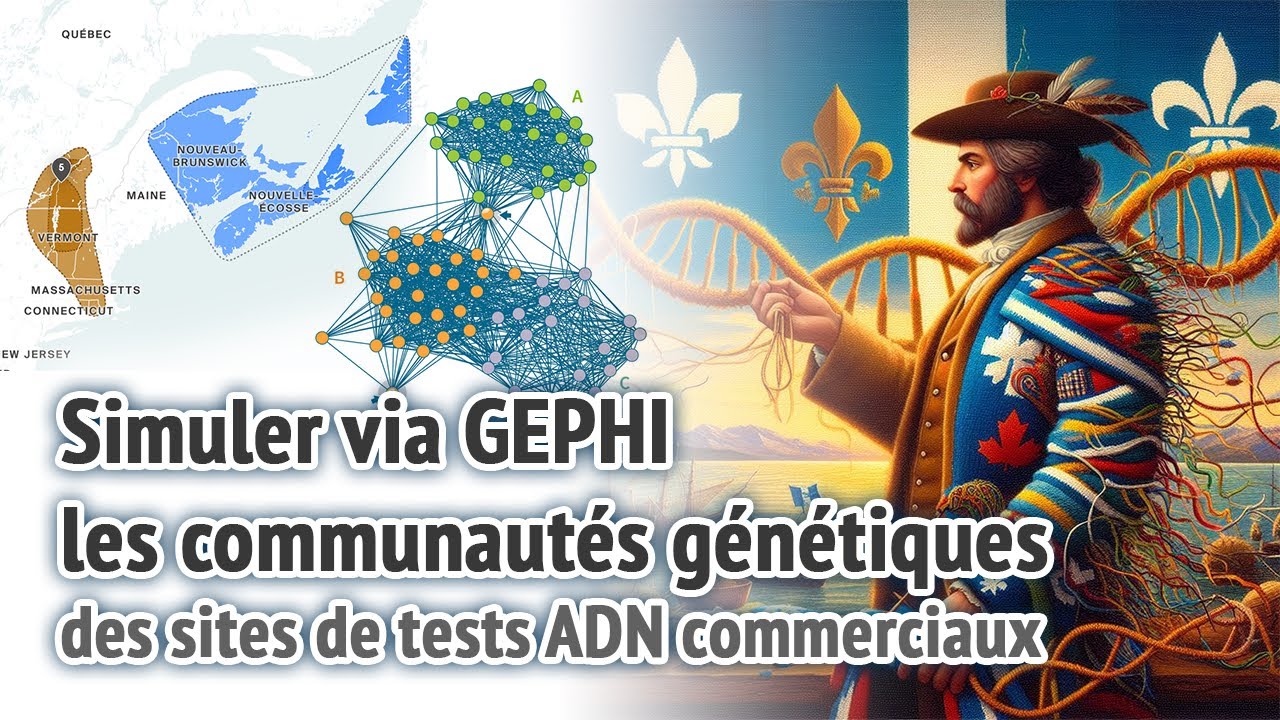
Reproduire via Gephi les communautés génétiques (test ADN)
Reproduce via Gephi the genetic communities (DNA test)
Keywords
Summary
200 words
Critical Evaluation
Value of the Information & Strength of the Argument
The video’s value lies in its practical, hands-on demonstration of a method used by commercial DNA services, making it accessible via free open-source tools. The author clearly explains the difference between broad ethnic origin estimates and more granular ‘genetic communities’, highlighting the role of genealogical trees and statistical clustering. The argumentation is logically structured: he first shows his own manually colored graph, then runs the modularity algorithm automatically, and compares the outputs, illustrating both agreements and discrepancies. The two graphs (his and his wife’s) provide contrasting examples, strengthening the explanatory power. The scientific basis is sound: he explicitly name-drops the Louvain method and references Ancestry’s white paper, tying his demonstration to documented industry practices. The main weakness is that the evidence is largely anecdotal — based on a single user’s experience and small sample sizes — but the reasoning is coherent and transparent.
Scientific Rigor, Source Quality, Title Accuracy
The creator demonstrates scientific rigor by explicitly referencing the Louvain method and Ancestry’s white paper as foundational sources for the algorithm used, and he uses a well-established open-source tool (Gephi). The methodology is reproducible, as all steps are clearly shown on screen. However, the video does not provide direct citations or links in the description to external references (e.g., the Ancestry white paper, Gephi documentation), which would have strengthened its evidenciary base. The title matches the content very well: it accurately describes the demonstration performed. No comments were provided for analysis.
249 words
Title / Content Match
The title accurately reflects the content: the video shows how to reproduce genetic community assignments (like Ancestry's) using Gephi's modularity tool.
Quality & Reliability
7/10
The author demonstrates a practical method for reproducing genetic communities using open-source software (Gephi) and a published algorithm (Louvain modularity), referencing Ancestry's white paper. The approach is transparent and reproducible, though it relies heavily on personal experience and a relatively small sample (views: 63), limiting statistical representativeness. No formal error or major inconsistency detected.
Chapters
- intro
- Gephi
- graph de 7700 individus (top 188 matchs)
- différences origines ethniques VS communautés génétiques
- méthode Louvain comme dans Gephi (Modularity)
- Quatre couleurs des grands-parents
- graph noir sans couleurs (ancêtres trouvés)
- Huit communautés par modularité statistique
- Quatre communautés par modularité automatique
- Autre graph
- deux raisons des densités de relations fortes ou faibles
- Modularité pour cet autre graph
- Huit communautés du second graph
- diminuer l'opacité des edges (relations)
- mettre l'accent sur les nodes (cercles des individus)
- conclusion
Cited Sources
- AncestryDNA white paper (implied reference to Ancestry's methodology) — The author refers to Ancestry's white paper to explain how genetic communities are assigned using the Louvain method. No specific URL is provided in the video or description.
Concurring Sources
- Gephi website (official documentation) — The software described in the video; its modularity statistic is presented as the tool to reproduce genetic communities.
Contribution & Novelties
The video provides an original and practical contribution by applying graph community detection algorithms (Louvain modularity) to genetic genealogy, a field where such tools are rarely demonstrated step-by-step for lay users. The novelty lies in the explicit comparison between automatic statistical clustering and manually verified genealogical colors, offering a critical perspective on how DNA testing companies generate community assignments.
Pour aller plus loin :
- Louvain method (Wikipedia) — The algorithm used for modularity optimization; directly relevant to the video’s core demonstration.
- Gephi (Wikipedia) — The open-source graph visualization software used throughout the video.
- Genetic genealogy (Wikipedia) — The broader context of using DNA to trace family relationships.
- Ancestry.com official site — The DNA testing service whose communities feature the video aims to replicate.
123 words
Radar Profile
The profile shows a balanced distribution with high values in information quantity and technical level, reflecting the video's detailed practical approach. Quality and reliability scores are slightly lower, due to the anecdotal nature of the evidence and lack of external citations.