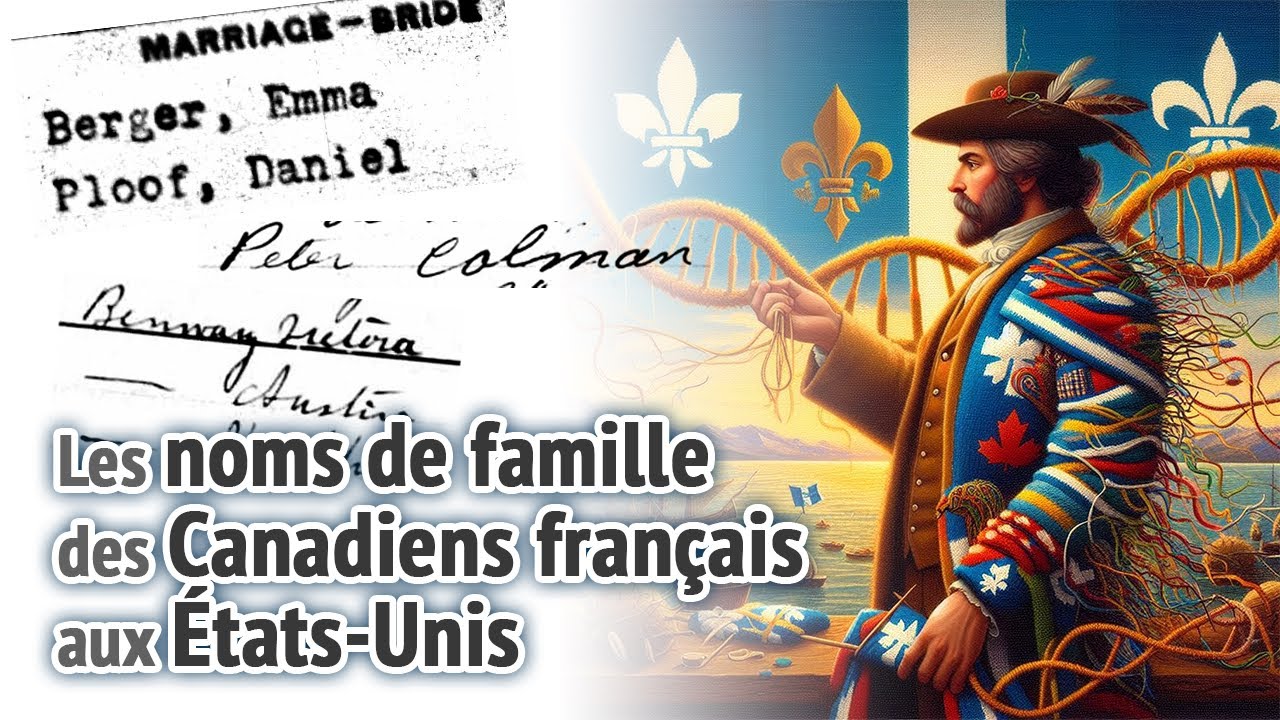
Noms de famille des Canadiens français aux États-Unis
Family names of French Canadians in the United States
Keywords
Summary
150 words
Critical Evaluation
Value of the Information & Strength of the Argument
The informational value lies in the concrete, document-based demonstration of a linguistic and historical phenomenon that is often mentioned but rarely illustrated. The host does not merely assert that names changed; he shows the actual manuscript spellings and pairs them with the presumed original French-Canadian surnames, making the transformation process tangible. The argument is built by accumulation of examples rather than by statistical or systematic sampling, which limits its evidentiary weight but does not undermine its illustrative value. The reasoning from phonetic transcription back to original pronunciation is plausible and internally coherent, particularly in the case of Benoit rendered as Benway, which the host presents as a revealing clue about the pronunciation of ‘oi’ as ‘oue’. The main weakness is that the sample is small and selected opportunistically, so no claim about frequency or representativeness can be supported. The host is transparent about this limitation, acknowledging that he may later regret not including more examples and that a second video may follow.
Scientific Rigor, Source Quality, Title Accuracy
The video is rigorous in its use of primary sources: manuscript census records, civil registers, and tombstones are shown on screen and read directly. However, no archives, repositories, or academic works are cited by name, and no URLs or references are provided in the description. The historical framing (emigration figures, Little Canadas, 1910 census proportions) is consistent with standard accounts but is presented without attribution. The title matches the content well: the video delivers exactly what it promises, namely examples of French-Canadian surnames as they appear in the United States. The scope is narrower than the title might imply, since only a limited set of examples is treated, but there is no misleading framing. The comments show a highly engaged audience, with many viewers contributing their own family examples (Greenwood for Boisvert, Sharbono for Charbonneau, Shank for Gingras, Lamprey for Longpre, Robishaw for Robichaud, Fairfield for Beauchamp, Gilman for Guilmain), which suggests the topic resonates with genealogical communities and that the video’s examples are recognized as plausible by those with direct family knowledge.
350 words
Title / Content Match
The title accurately reflects the content: the video presents concrete examples of French-Canadian surnames transformed in the United States through translation or phonetic transcription. The scope is narrower than the title might suggest (a handful of examples rather than a systematic study), but the match is honest.
Quality & Reliability
7/10
The video relies on primary genealogical documents (manuscript census records, tombstones, civil registers) and presents concrete, verifiable examples of name transformation. The historical context (1840-1900 emigration, ~325,000 net emigrants, Little Canadas) is broadly consistent with established historiography. However, no academic sources, archives, or references are cited explicitly, and the linguistic explanations remain anecdotal rather than systematically demonstrated.
Chapters
- introduction
- immigration canadienne-française 1840-1900
- villes de nouvelle-angleterre ayant des canadiens-français
- traduction ou transcription changée
- avis aux francophones hors-Québec
- Mitchel Croix Lewis Cross
- Colman Edward Coleman
- Jedediah Brough Browe Cushman
- Ploof Cushing Wemett
- Lagley Emord
- Gebo Shampo Benway
- prononciation du son oi en oué
- Burgoir Begar Berger
- conclusion
Contribution & Novelties
The video’s original contribution is to make visible, through manuscript documents and tombstones, the concrete mechanisms by which French-Canadian surnames were transformed in the United States. It goes beyond the familiar observation that names were anglicized by distinguishing translation from phonetic transcription and by using the resulting spellings to infer older pronunciations, notably the ‘oi’ as ‘oue’ shift. This phonetic reading of genealogical documents is a useful methodological angle for family historians.
Pour aller plus loin :
- French Canadians — Background on the population and its diaspora.
- Quebec diaspora — Context for the emigration to New England.
- French-Canadian Americans — Overview of the communities discussed in the video.
- Anglicisation of names — General phenomenon of which the examples are instances.
- Quebec French phonology — Linguistic basis for the ‘oi’ as ‘oue’ pronunciation discussed in the video.
136 words
Radar Profile
The profile is that of a well-documented but non-academic genealogy channel: high on reliability and information quality, moderate on quantity, and low on technical difficulty. The strength lies in the use of primary documents and the clarity of the examples; the weakness is the absence of cited references and the small, non-systematic sample.
💬 Very positive: on the 30 comments analyzed, viewers express strong appreciation for the research and contribute numerous additional family examples of surname transformation, with no critical or negative reactions.