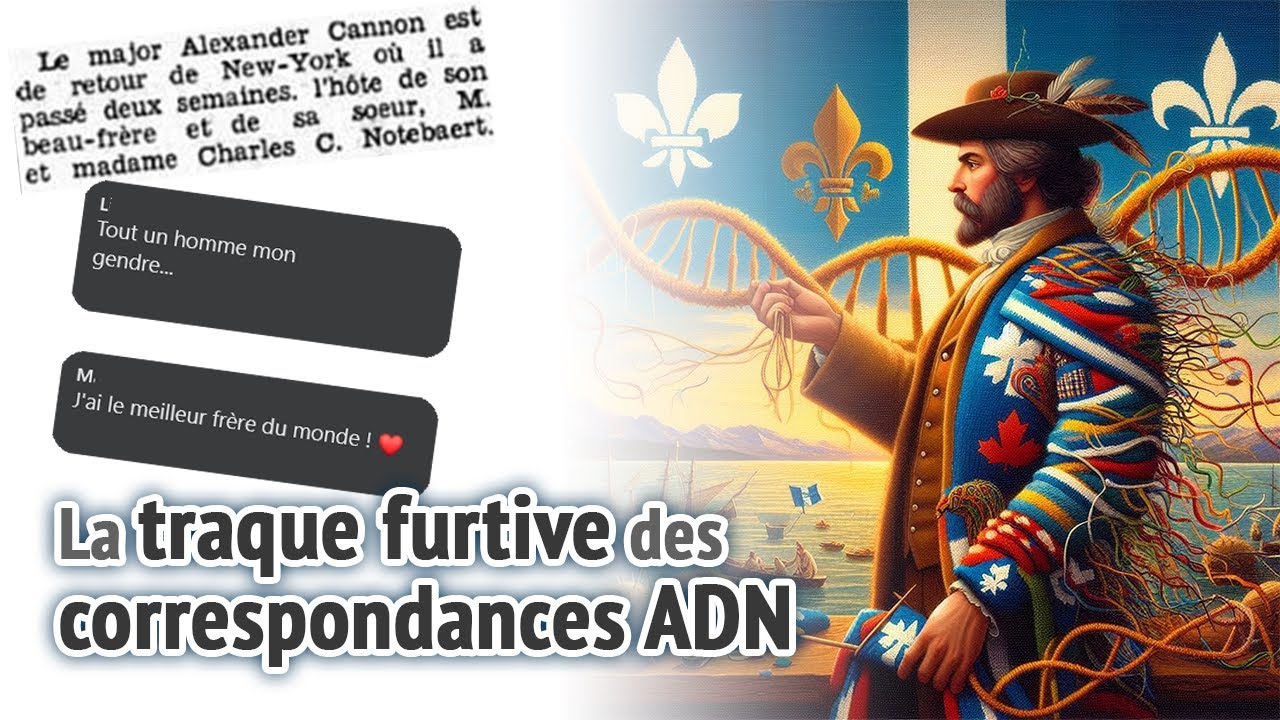
La traque furtive de correspondances ADN
The stealthy hunt for ADN matches
Keywords
Summary
194 words
Critical Evaluation
Value of the Information & Strength of the Argument
The video offers a thoughtful, experience-based perspective on a niche but growing issue in genetic genealogy. Its value lies in bridging historical practices of public information disclosure with modern digital footprints, making a compelling case that today’s ‘stalking’ concerns are not entirely new. The argument is structured around concrete examples (death notices, marriage laws, property rolls, newspaper columns) and current demographic trends (rising common-law unions in Quebec). The creator’s reasoning is coherent and nuanced, acknowledging gray areas such as the ’loop hole’ in Ancestry’s privacy settings. However, the argumentation relies heavily on personal opinion and anecdotal evidence rather than empirical data or systematic research. The ethical guidelines cited are used to support the creator’s stance, but no counterarguments or alternative viewpoints are deeply explored. The overall argument is persuasive for a general audience but lacks the rigor of a formal study.
Scientific Rigor, Source Quality, Title Accuracy
The video demonstrates moderate scientific rigor by referencing official ethical codes from genealogical organizations, which are credible sources for professional standards. However, it does not cite academic studies, primary data, or peer-reviewed literature. The creator explicitly states that some claims are based on personal observation or assumptions (e.g., property tax rolls in Europe). The title accurately reflects the content, as the video directly addresses the stealthy tracking of DNA matches and its ethical implications. The sources mentioned are relevant but not exhaustively analyzed; the creator encourages viewers to contribute their own knowledge, indicating an open but not fully verified approach. Overall, the sourcing is appropriate for an opinion piece but insufficient for a scientific review.
271 words
Title / Content Match
The title accurately reflects the content: the video discusses the practice of stealthily tracking DNA matches and the ethical boundaries involved. It is a faithful description of the topic.
Quality & Reliability
7/10
The video is a personal, experience-based reflection on the ethics of using publicly available information to build genealogical trees from DNA matches. It relies on the creator's own reasoning and on cited ethical codes from genealogical federations, but it does not present primary data, peer-reviewed studies, or a systematic methodology. The information is plausible and well contextualized, yet it remains an opinion piece rather than a rigorous scientific analysis.
Chapters
- intro
- vidéo précédente abordée
- Stalking: définition et nuance
- vos infos persos qui ne le sont pas!
- avis de décès
- rôles d'évaluation et de taxation
- journaux (carnet mondain)
- adresse complète d'un naufragé
- pourquoi le web en généalogie?
- couples vivants en union libre
- qui est à risque?
- code d'éthique des fédérations
- infos des gens vivants actuellement
- règles éthiques à suivre
- configurations d'arbres Ancestry
- respect du côté humain
- mot de la fin
- conclusion
Cited Sources
- Fédération québécoise des sociétés de généalogie - Code d'éthique — Cited for article 4.1 on respecting the confidential nature of information about citizens' private lives.
- Fédération Française de Généalogie - Droit à la vie privée — Mentioned for guidelines on not disclosing biological filiation without consent.
- Board for Certification of Genealogists - Ethical Standards — Referenced for rules on not publishing personal genealogical or genetic information without consent.
Concurring Sources
- Genetic genealogy privacy concerns — Wikipedia section discussing ethical issues in genetic genealogy, aligning with the video's focus on privacy.
- Quebec common-law unions statistics — Statistics Canada data on common-law unions, supporting the video's demographic argument.
Contribution & Novelties
The video’s original contribution is its synthesis of historical public information practices with contemporary digital genealogy, framed through the lens of ‘stealthy tracking.’ It uniquely compares 19th- and 20th-century newspaper society columns to modern social media posts, arguing that privacy concerns are not new but have intensified. It also provides practical, step-by-step advice for configuring Ancestry privacy settings and highlights a specific technical loophole regarding linked photos. The creator’s personal ethical guidelines add a reflective dimension often missing in technical tutorials.
Pour aller plus loin :
- Genetic genealogy — Overview of the field and its ethical debates.
- Stalking — Legal and psychological definitions, useful for contrasting with non-malicious tracking.
- Information privacy — Broader context on public vs. private data.
- Board for Certification of Genealogists — Official site for ethical standards in genealogy.
132 words
Radar Profile
The radar profile shows moderate information quantity and quality, with a lower technical level, reflecting the video's accessible, opinion-based nature. Reliability is fair, as it cites ethical codes but lacks primary data. The overall shape suggests a balanced but not deeply technical exploration.