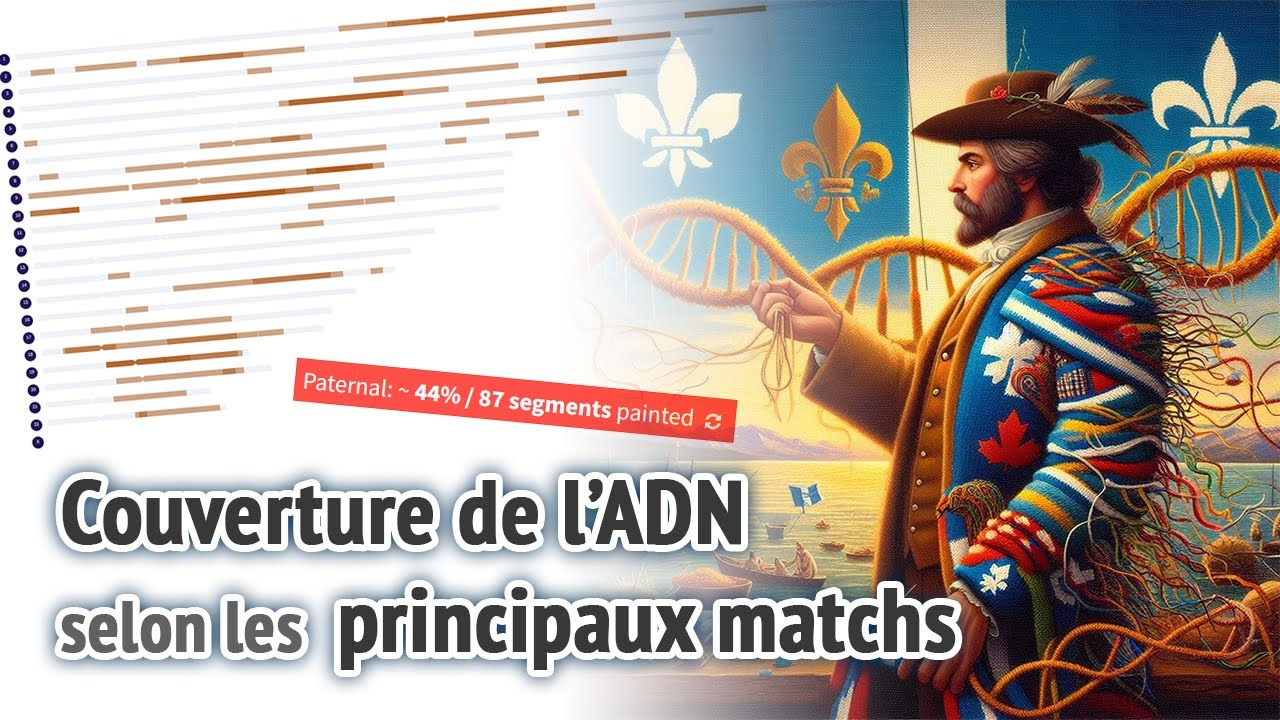
Couverture de l'ADN selon les principaux matchs
DNA coverage according to the main matches
Keywords
Summary
140 words
Critical Evaluation
Value of the Information & Strength of the Argument
The video offers a clear and honest step-by-step explanation of how to use DNA matches for chromosome mapping. The value lies in its practical demonstration, showing specific percentages and examples from two real tests. The argumentation is logical and transparent, with explicit caveats about the anecdotal nature of the data. However, since only two individuals are analyzed, the conclusions are not generalizable. The author appropriately refrains from overclaiming, but the lack of statistical context limits the scientific value.
Scientific Rigor, Source Quality, Title Accuracy
The scientific rigor is limited, as the author explicitly labels the demonstration as non-scientific. No external scientific sources are cited; the primary inputs are personal DNA tests and MyHeritage data. The title accurately represents the content. The methodology is internally consistent, but the reliance on personal examples without broader validation reduces the reliability. The absence of citations to academic literature on genetic genealogy means the video serves more as a tutorial than a research contribution.
168 words
Title / Content Match
The title accurately reflects the content, which focuses on how much of one's DNA can be covered using top matches on a genetic testing site.
Quality & Reliability
5/10
The video explicitly states that the demonstration is non-scientific and anecdotal. It uses a limited sample of two tests without statistical validation. The methodology is clearly explained, but the reliability of the conclusions for general populations is low.
Chapters
- intro
- procédure et intrants utilisés
- notion de triangulation
- exclusions
- Démonstration NON-scientifique!
- Test A: 5 matchs maternels
- Test A: 10 matchs maternels
- Test A: 20 matchs maternels
- Test A: 5 matchs paternels
- Test A: 10 matchs paternels
- Test A: 20 matchs paternels
- Top 15 mélangé du Test A
- Contexte du Test B
- Test B: 5 matchs maternels
- Test B: 10 matchs maternels
- Test B: 20 matchs maternels
- Test B: 5 matchs paternels
- Test B: 10 matchs paternels
- Test B: 20 matchs paternels
- Top 15 mélangé du Test B
- assigner aux ancêtres de plus haute génération
- comparer les arbres
- chercher les plus récents ancêtres communs
- attribution (couleurs) du segment
- autre recherche pour segment différent
- corroborer l'hypothèse avec plusieurs segments
- conclusion
Cited Sources
- MyHeritage — Used to obtain DNA segment matches and triangulation data.
- DNAPainter — Used for visual chromosome mapping and segment assignment.
Concurring Sources
- MyHeritage — Supports the possibility of obtaining segment data for genetic genealogy.
- DNAPainter — A widely used tool for visualizing and painting DNA segments by ancestor.
Contribution & Novelties
The video provides a practical, easy-to-follow example of chromosome mapping using top DNA matches. While not scientifically novel, it offers a concrete demonstration that can motivate beginners. The step-by-step coverage percentages and the explanation of triangulation and ancestor assignment are helpful. The video clearly explains the process and its limitations, making it a useful starting point for those new to genetic genealogy.
Pour aller plus loin :
- Genetic genealogy — Core concept underlying the video’s approach.
- Identical by descent — Key notion for understanding shared DNA segments.
- Genealogy — Background on family tree research used for segment assignment.
98 words
Radar Profile
The radar profile shows a balanced moderate score across dimensions, with the technical level slightly higher due to the tutorial's methodological explanations. Reliability is the weakest point, reflecting the anecdotal nature and absence of scientific validation.