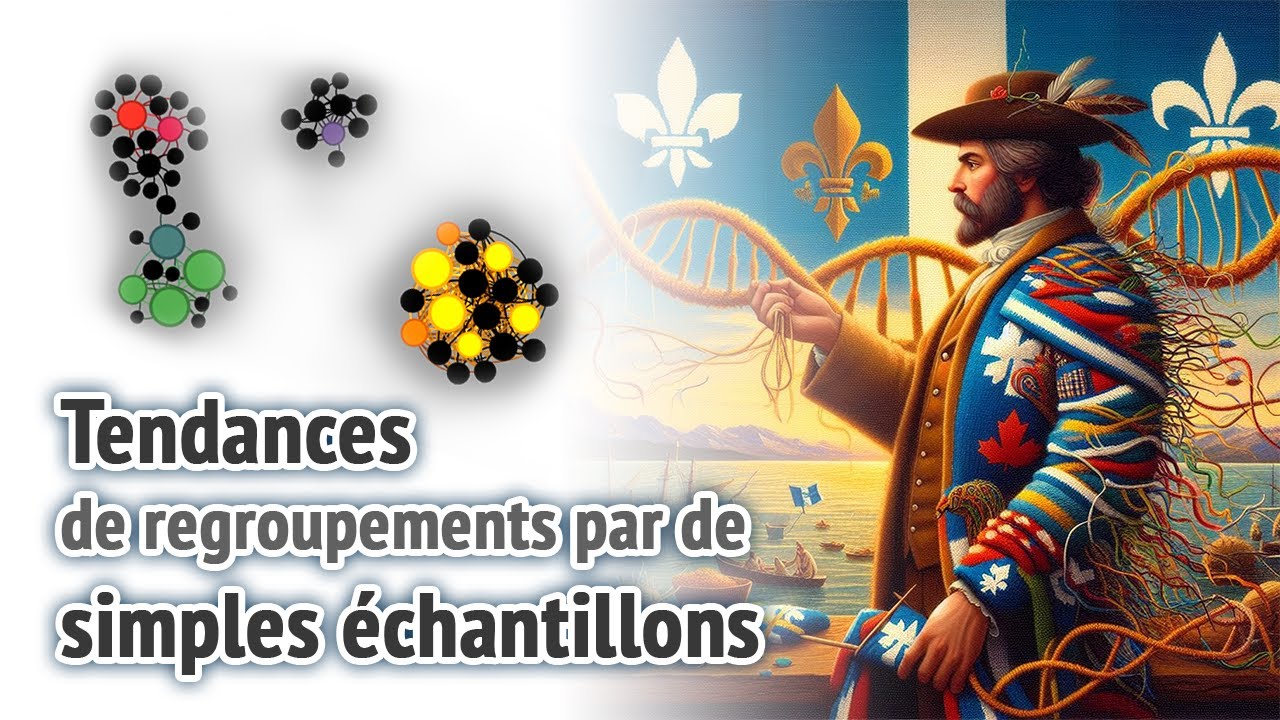
Tendances de regroupements par de simples échantillons
Grouping trends from simple samples
Keywords
Summary
147 words
Critical Evaluation
Value of the Information & Strength of the Argument
The video offers valuable practical guidance for genetic genealogy enthusiasts, showing that meaningful insights can be obtained with minimal effort. The argumentation is built on two concrete case studies (the creator and his spouse), which lends anecdotal but convincing evidence. The step-by-step progression from 10 to 100 common matches illustrates that the same clusters persist, reinforcing the reliability of the approach. However, the lack of statistical testing or comparison with a control group limits the strength of the claims. The method is heuristic and may not generalize universally, though the creator acknowledges this caveat.
Scientific Rigor, Source Quality, Title Accuracy
No external sources are cited in the video or description, which is acceptable for a tutorial-style content. The scientific rigor is moderate: the method is transparent and reproducible, but it relies on personal data and lacks peer-reviewed validation. The title is adequate and directly reflects the content, though it might benefit from specifying it is a tutorial. The use of established tools like Gephi and centimorgan thresholds adds credibility. No advertising or sponsored segments were present.
185 words
Title / Content Match
The title accurately reflects the content: the video demonstrates that clustering trends can be discerned from a small sample of matches.
Quality & Reliability
6/10
The video presents a practical method for observing genetic clustering trends with a limited number of DNA matches, based on personal examples. While the approach is plausible and clearly explained, it relies on anecdotal evidence without statistical validation or peer review.
Chapters
- intro
- choix pour fins d'illustration
- graphique Gephi de 7751 nodes
- récupération des correspondances communes
- 10 matchs communs du Top 30 principal
- données de 30 matchs communs du Top 30
- données de 100 matchs communs du Top 30
- exemples avec autre individu
- récapitulatif global (comparaisons rapides)
- conclusion
Contribution & Novelties
The video contributes a practical, time-efficient technique for preliminary genetic clustering using limited data, lowering the barrier for beginners. It demonstrates that even with a handful of matches, meaningful patterns can emerge, encouraging users to start exploring without overwhelming datasets.
Pour aller plus loin :
- Genetic genealogy — An overview of the field and its methods.
- Gephi — The open-source graph visualization software used in the video.
- Centimorgan — The unit of genetic recombination, central to interpreting DNA match strengths.
- Leeds method — A similar approach for sorting DNA matches without dedicated tools, often discussed in genealogy communities.
98 words
Radar Profile
The overall profile shows a balanced approach with moderate scores across all dimensions. Quantitative information is slightly higher than qualitative, reflecting the number of examples, while technical level and global reliability are lower, indicating a practical but not deeply scientific content.