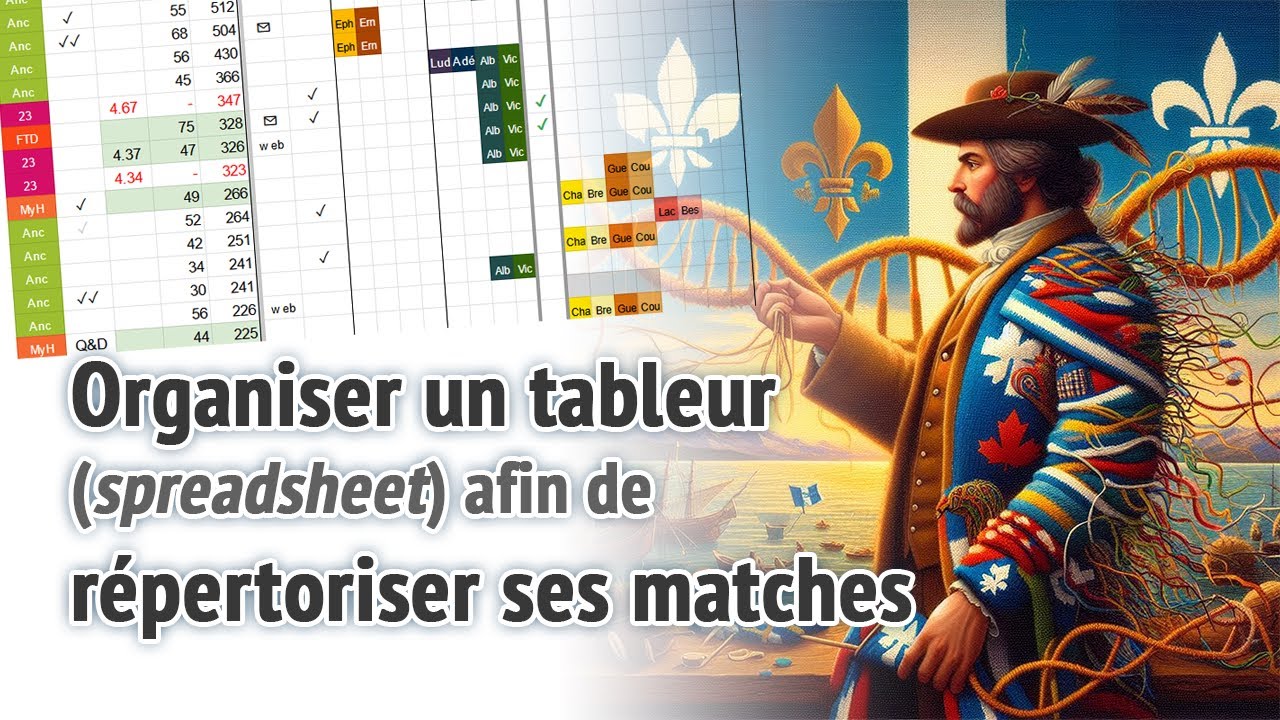
Organiser un tableur pour répertorier ses matches ADN
Organizing a spreadsheet to list one's DNA matches
Keywords
Summary
183 words
Critical Evaluation
Value of the Information & Strength of the Argument
The video offers a strong practical value for genealogists who want to consolidate DNA match data from multiple sites into a single, customizable spreadsheet. The author provides a detailed rationale for each column and explains how the information can be used to identify shared ancestors and build family trees. The argumentation is logical and based on personal experience, making the advice relatable and actionable. The inclusion of color-coding and filtering techniques enhances usability, and the tip about creating ‘quick and dirty’ trees for matches without published trees is particularly useful. However, the video is more opinion-based than evidence-based, as it relies solely on the author’s workflow without citing comparative studies or large-scale validation.
Scientific Rigor, Source Quality, Title Accuracy
The video demonstrates a methodical and systematic approach, with clear explanations and consistent logic. The main source mentioned is The Genetic Genealogist (by Blaine Bettinger) for X-chromosome inheritance images, which lends some credibility to that specific point. However, the overall content is based on personal experience rather than scientific research, and no peer-reviewed sources or data are provided. The title accurately matches the content, as the video focuses exclusively on organizing spreadsheet columns for DNA matches. No external reviews or viewer comments were provided for analysis, so the public reception cannot be assessed.
221 words
Title / Content Match
The title accurately reflects the content: the video is a step-by-step guide to organizing DNA matches in a spreadsheet.
Quality & Reliability
7/10
The video provides a methodical and clear explanation of how to structure a spreadsheet for organizing DNA matches, based on the author's personal experience. The approach is practical and well-articulated, but it lacks formal scientific validation and relies mostly on anecdotal advice.
Chapters
- intro
- 1- le nom
- 2- doublon
- ordre de saisie des matches
- 3- âge et ville
- 4- géré par (managed)
- 5- site web d'ADN
- possibilité de transférer son test
- filtrer les colonnes
- 6- arbre
- faire l'arbre du match
- correspondance = sa famille
- 7 à 9- colonnes de segments / proximité génétique
- 10- contact
- 11- avis de décès
- ancêtres proches
- ancêtres éloignées
- chromosome X
- chemin (lignée) généalogique
- double match (2 parents)
- parent proche du match
- URL de la fiche du match
Cited Sources
- The Genetic Genealogist - Blaine Bettinger — Mentioned as the source for images of X-chromosome inheritance patterns displayed in the video.
Contribution & Novelties
The video contributes a detailed, step-by-step template for organizing DNA matches in a spreadsheet, filling a gap for amateur genealogists who may not know how to effectively manage multiple data sources. The novel aspects include the use of customized color codes for ancestor groups and the ‘quick and dirty’ tree method for matches with no available trees.
For further reading:
- Chromosome Browser — A tool that visualizes matching DNA segments on chromosomes, including discussions of segment inheritance.
- Centimorgan — The unit used to measure genetic linkage, essential for interpreting match strength.
- Genetic Genealogy — The broader field that encompasses DNA testing for family history research, with context on methods and limitations.
- The Genetic Genealogist — Blog by Blaine Bettinger, a respected genetic genealogist, for further insights on X-chromosome inheritance and testing strategies.
132 words
Radar Profile
The profile shows balanced scores in information quantity and quality, with slightly lower technical depth and reliability, reflecting a practical, experience-based tutorial rather than a rigorous scientific study.