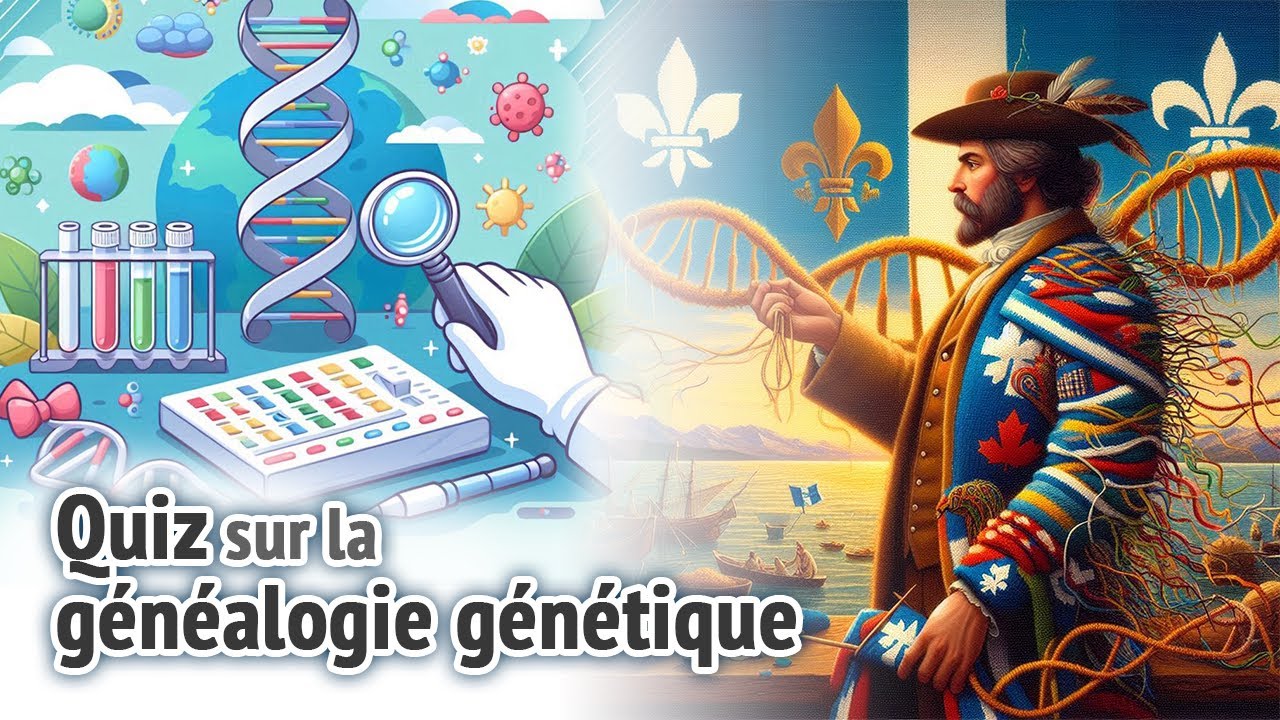
Quiz sur la généalogie génétique
Quiz on genetic genealogy
Keywords
Summary
289 words
Critical Evaluation
Value of the Information & Strength of the Argument
The informational value lies in the density of correctives to widespread misconceptions. Rather than presenting new research, the video targets intuitions that feel logical but are wrong: that a pedigree shows siblings, that 23 is the number of chromosomes, that ethnicity estimates are stable, that a child receives a variable share from each parent, that a male X chromosome cannot carry paternal-grandfather segments, that an adoptee needs a tested parent, that DNA is immutable, that siblings get identical results, and that centimorgans always track generational distance. Each correction is paired with a short mechanistic explanation, which is the main pedagogical strength: the viewer is not merely told the answer but given the reason, generally framed around recombination, chromosome pairing and the distinction between autosomes and sex chromosomes. The argumentation is didactic rather than demonstrative. It proceeds by assertion plus illustration, using pedigree diagrams, an X-inheritance chart and a real match list as visual supports. The strongest passage is the final question, where the host deliberately breaks the rule he has just stated by showing a case with 561 cM to a great-uncle and 366 cM to a first cousin once removed, where the higher centimorgan value corresponds to the more distant common ancestor. This self-imposed counterexample is a genuine mark of argumentative honesty and shows awareness that genetic-distance heuristics have exceptions. The weakest passages are those where the mechanism is compressed: the claim that DNA changes between conception and death conflates somatic mutation, clonal haematopoiesis and donor-derived DNA after transplant, and the statement about adoptee searches is asserted without describing the actual methods (triangulation, chromosome browsers, shared-match clustering) that make it possible. The overall reasoning is sound but remains at the level of rules of thumb, with the exceptions acknowledged rather than systematically characterised.
Scientific Rigor, Source Quality, Title Accuracy
No external source, study, dataset or institutional reference is cited at any point. The only authority invoked is the testing company’s own documentation, mentioned generically in relation to ethnicity-estimate updates and to the recommendation against testing after a stem-cell or bone-marrow transplant. This is a legitimate appeal to a primary operational source, but it is not named precisely enough to be checked, and no link is provided. The scientific content is nevertheless consistent with standard genetics: chromosome count and pairing, autosomal inheritance proportions, recombination-driven variance in grandparental contributions, X-chromosome transmission patterns and the non-monotonic relationship between shared centimorgans and genealogical distance are all correctly stated. The host also explicitly signals uncertainty and personal learning, noting that a year earlier he would have answered about half the questions incorrectly, which is a healthy epistemic posture. The main limitation is the absence of any quantitative anchor: no typical ranges of shared DNA per relationship, no reference to the published distributions of centimorgan values, no mention of the fact that ethnicity estimates are statistical inferences with confidence intervals. On title-content adequacy, the match is exact: the video is a quiz on genetic genealogy, the announced format is respected, and no overpromising occurs. No comments were supplied for analysis.
514 words
Title / Content Match
The title announces a quiz on genetic genealogy and the video delivers exactly that: ten beginner-to-intermediate questions with answers and short explanations. The match is faithful and without misleading framing.
Quality & Reliability
7/10
The content is produced by a specialised channel on genetic genealogy and the answers given are broadly consistent with established population-genetics principles: 46 chromosomes in 23 pairs, 50% autosomal inheritance from each parent, random recombination producing a range of shared DNA with grandparents, the distinction between pedigree/ancestral trees and full family trees, the instability of ethnicity estimates due to reference-panel and algorithm updates, and the fact that centimorgans do not map monotonically onto generational distance. No primary literature is cited, the explanations remain at a didactic level, and a few formulations are approximate (e.g. the claim that DNA 'changes' over a lifetime is presented loosely, mixing somatic mutation, chimerism and transplant effects). The absence of any external reference limits the score, but no major factual error was detected.
Chapters
- intro
- frères et sœurs affichés dans un pedigree
- combien de chromosomes
- origines ethniques toujours les mêmes
- entre 35% et 65% d'ADN par parent
- 20% d'ADN d'un grand-parent
- segment du chromosome X de ma mère
- parent doit tester pour un adopté
- même ADN à la naissance que la mort
- mon frère aura les mêmes résultats
- pourcentage d'ADN et ancêtre proche
- conclusion
Contribution & Novelties
The video does not present original research or new data. Its contribution is pedagogical: it assembles ten common misconceptions about genetic genealogy into a single quiz format and corrects each one with a short mechanistic explanation. The most valuable element is the deliberate counterexample in the final question, where the host shows his own match list and demonstrates that a 561 cM match corresponds to a more distant common ancestor than a 366 cM match, thereby illustrating that centimorgan thresholds are probabilistic heuristics rather than deterministic rules. The treatment of ethnicity estimates as a moving target, dependent on algorithm and reference-panel revisions rather than on the tester’s DNA, is also a useful corrective that is often absent from introductory material.
Pour aller plus loin :
- Centimorgan — Definition and use of the centimorgan as the unit of genetic linkage distance, directly underpinning the final question.
- Genetic recombination — The mechanism that explains why siblings receive the same proportion but not the same segments from each parent.
- Pedigree chart — Standard conventions for ancestral trees, relevant to the first question on sibling display.
- International Society of Genetic Genealogy — Reference body publishing shared-DNA statistics per relationship and guidance on adoptee searches.
- Human genome — Overview of the 46-chromosome, 23-pair organisation and the autosome/sex-chromosome distinction.
213 words
Radar Profile
The profile is balanced but modest: informational quantity and technical level sit in the middle, reflecting a short quiz format aimed at beginners, while quality and overall reliability are higher because the answers are factually sound and the misconceptions targeted are real ones. The gap between technical level and reliability indicates accurate but accessible content rather than shallow or speculative material.