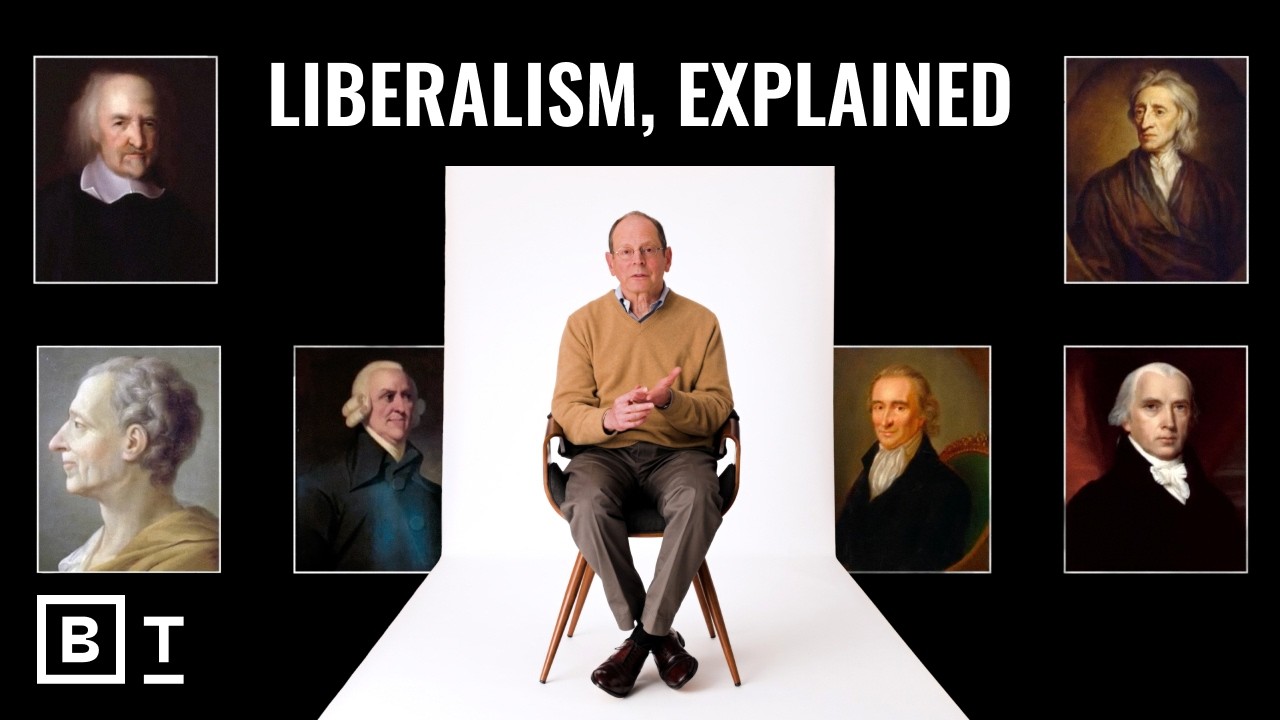
The political philosophy that changed the world | Jonathan Rauch: Full Interview
Keywords
Summary
131 words
Critical Evaluation
Value of the Information & Strength of the Argument
The value of the information is high: Rauch provides a clear, comprehensive, and intellectually stimulating framework for understanding liberalism as a practical system rather than a mere philosophy. His concept of liberalism as a social technology offers an original lens that bridges economics, politics, and epistemology. He makes a compelling case for why liberal systems are self-correcting and why their internal conflicts are features, not bugs. The argumentation is logically structured, building from definitions to historical examples (e.g., the wars of religion, his personal experience as a gay man) to contemporary threats. He anticipates counterarguments (e.g., slavery, the persistence of injustice) and addresses them, strengthening his thesis. The reasoning is persuasive, though some claims (e.g., the unique self-correcting nature of liberalism) are presented with minimal empirical evidence, relying more on theoretical discourse. Overall, the argumentation is robust and intellectually engaging, though it would benefit from more concrete data to support its broad assertions.
Scientific Rigor, Source Quality, Title Accuracy
The rigor is considerable given Rauch’s expertise and the interview format. He references key thinkers (Locke, Madison, Hayek, Smith) but does not provide precise citations within the video; the transcript and additional resources are available via the description link. His affiliation with Brookings lends institutional credibility. The title aligns well with the content, as the interview indeed covers a political philosophy with global impact. The chapter structure aids comprehension. The only minor weakness is the lack of direct textual citations, which may challenge a viewer seeking verifiable sources. Nevertheless, the speaker’s authority and the coherence of the presentation support a high level of trust.
272 words
Title / Content Match
The title accurately reflects the content: a full interview on political philosophy, specifically liberalism, which indeed has had a transformative global impact. The phrase 'changed the world' is appropriate given the historical influence of liberal ideas.
Quality & Reliability
9/10
The speaker is a senior fellow at the Brookings Institution, provides structured arguments, cites historical thinkers, and offers a coherent thesis. The interview format allows deep exploration of the topic. No significant factual errors or misleading claims were identified.
Chapters
- Chapter 1: Liberalism: Humanity’s greatest technology
- What makes liberalism unique and what it delivers
- Who decides what’s true?
- Chapter 2: The global backlash of liberalism
- Two threats: Cancel culture and “firehose of falsehood”
- The fascism question
- Chapter 3: The surprising link between liberalism and Christianity
- Jesus meets Madison
- A case for civic theology
Cited Sources
- Read the video transcript — Official transcript and supporting material for this interview from Big Think.
External References
Contribution & Novelties
Rauch’s original contribution lies in reframing liberalism as a set of interoperable social technologies (markets, democracy, science) and in introducing the ‘Constitution of Knowledge’ as a necessary complement to legal and economic frameworks. He connects epistemic norms (open criticism, falsification) to political stability, arguing that liberal systems thrive only when citizens internalize these rules. This is a fresh synthesis that draws on Popperian epistemology and public choice theory. The interview also bridges philosophy and civic theology, suggesting that religious traditions may reinforce liberal habits of mind. This is a provocative and underexplored angle in liberal theory.
Pour aller plus loin :
- Liberalism (Stanford Encyclopedia of Philosophy) — A comprehensive philosophical overview of liberalism, relevant to Rauch’s core arguments.
- The Constitution of Knowledge (Wikipedia) — Details of Rauch’s book, which elaborates on the epistemic system he discusses.
- FA Hayek and the information-processing function of markets — Hayek’s ideas on decentralized knowledge, which Rauch references as the genius of the market mechanism.
160 words
Radar Profile
The profile shows high scores across all dimensions, with particularly strong quality and reliability. The content is rich and well-argued, indicating a top-tier intellectual production. The technical level is moderately high, suitable for an informed general audience. Overall, this is an excellent piece of expert analysis.
💬 On the 30 comments analyzed, the overall sentiment is very positive, with viewers praising the clarity and depth of the explanation, while a few raised critiques about the US-centric perspective and historical accuracy, and one noted the relevance to current political shifts.