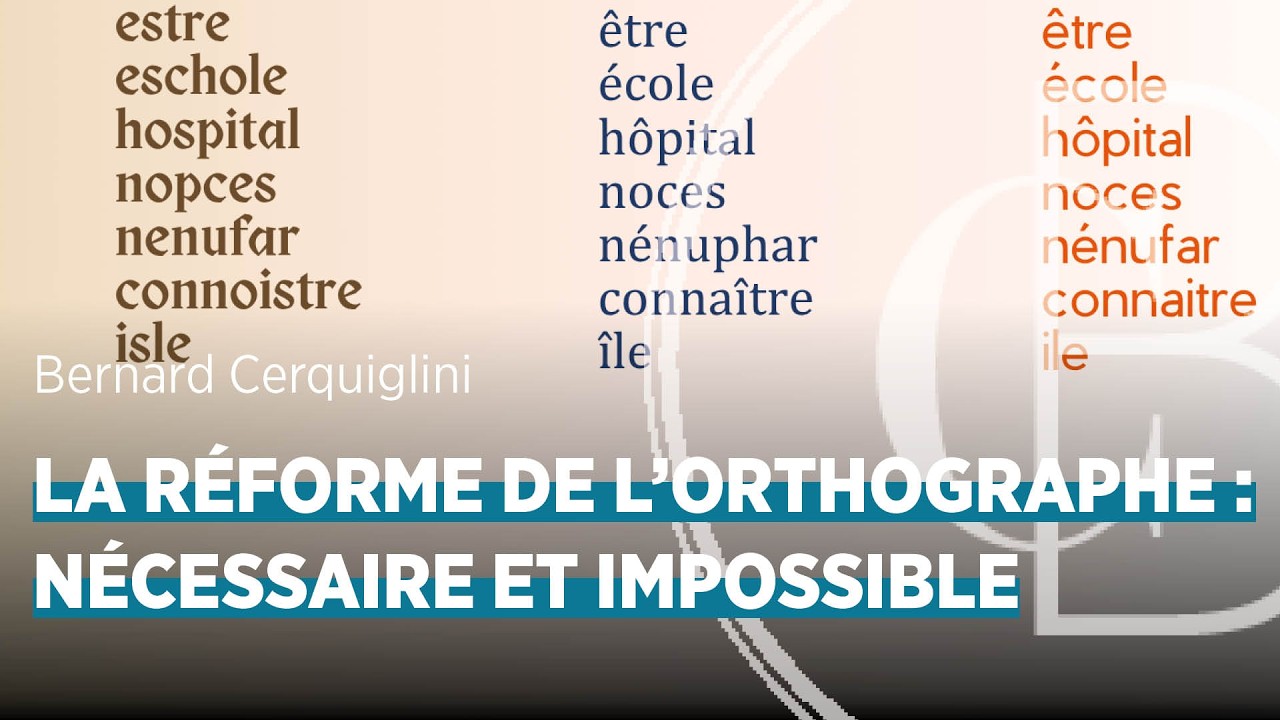
La réforme de l'orthographe : nécessaire et impossible, par Bernard Cerquiglini
The spelling reform: necessary and impossible, by Bernard Cerquiglini
Keywords
Summary
156 words
Critical Evaluation
Value of the Information & Strength of the Argument
The lecture provides a comprehensive and original framework for understanding the resistance to spelling reform. Cerquiglini’s argumentation is solid, grounded in specific historical evidence—such as the 16th-century grammarian Louis Maigret, the 1694 Dictionnaire de l’Académie, and the 1833 Guizot law—and he presents a clear thesis linking the visual distinction function of orthography to attitudes toward reform. His personal involvement in the 1990 reform adds a practical dimension, while his references to other linguists and historical documents strengthen the credibility. The analysis avoids oversimplification, acknowledging that orthography is both a technical tool and a cultural symbol, which enriches the persuasive value.
Scientific Rigor, Source Quality, Title Accuracy
Cerquiglini demonstrates scholarly rigor by citing specific sources, including quotes from Paul Valéry and René Douic, and by referencing the work of colleagues like Jean-Marie Klinkenberg. The lecture is well-structured, moving from a description of the problem to a historical investigation, and the title accurately encapsulates the central contradiction. The speaker’s academic credentials and his role in the 1990 reform lend authority. The only minor weakness is the lack of numerical data or formal citations, but the verbal references are reliable enough for a general audience. Overall, the title and content align perfectly, and the sources used are appropriate and trustworthy.
216 words
Title / Content Match
The title accurately reflects the content: the lecture explores why French spelling is complex and why reforms have failed throughout history, framing it as both necessary and impossible.
Quality & Reliability
9/10
Lecture by a renowned linguist and academic, with historical evidence and logical argumentation. The speaker draws on his own experience as a reform participant and cites specific historical documents and figures, contributing to high reliability.
Key Moments
Markers derived by PSI from the transcript: the creator did not define chapters.
- Introduction and opening remarks, including a quote from Paul Valéry criticizing spelling.
- Presentation of the main defects of French orthography: incoherence, lack of bi-univocity, and etymological complexity.
- Discussion of the first reformer Louis Maigret and his failed attempt to reform spelling in the 16th century.
- Analysis of medieval scribes and their role in adding etymological letters, which contributed to the visual distinction of homophones.
- Examination of the Académie française's choices, including its admission of having selected a conservative orthography in 1694.
- Impact of 19th-century mass education and the rise of dictation as a tool for enforcing a standardized spelling.
Cited Sources
- Collège Belgique lecture series — Official page for the Collège Belgique, hosting the lecture.
- Playlist of 2026 Collège Belgique lectures — YouTube playlist containing other recordings of the 2026 lectures.
Contribution & Novelties
The lecture offers a novel synthesis of historical, social, and linguistic factors explaining the resilience of French spelling. It highlights the overlooked role of the visual dimension of writing and the function of distinguishing homophones, and it critiques the traditional narrative that merely condemns medieval scribes. Cerquiglini’s insider perspective as a participant in the 1990 reform provides unique authenticity, while his call to rethink reform without discarding the cultural heritage of spelling is a refreshing contribution.
Pour aller plus loin :
- French orthography — Comprehensive overview of the written system and its peculiarities.
- Louis Meigret — The 16th-century grammarian and proponent of spelling reform.
- Reforms of French orthography — Historical account of various reform attempts, including the 1990 rectifications.
119 words
Radar Profile
The profile shows consistently high scores across all dimensions, indicating that the lecture is not only informative and technically sound but also highly reliable. The strongest points are the quantity and quality of information, while the technical level, though advanced, remains accessible. The high reliability reflects the speaker's expertise and the well-supported argumentation.