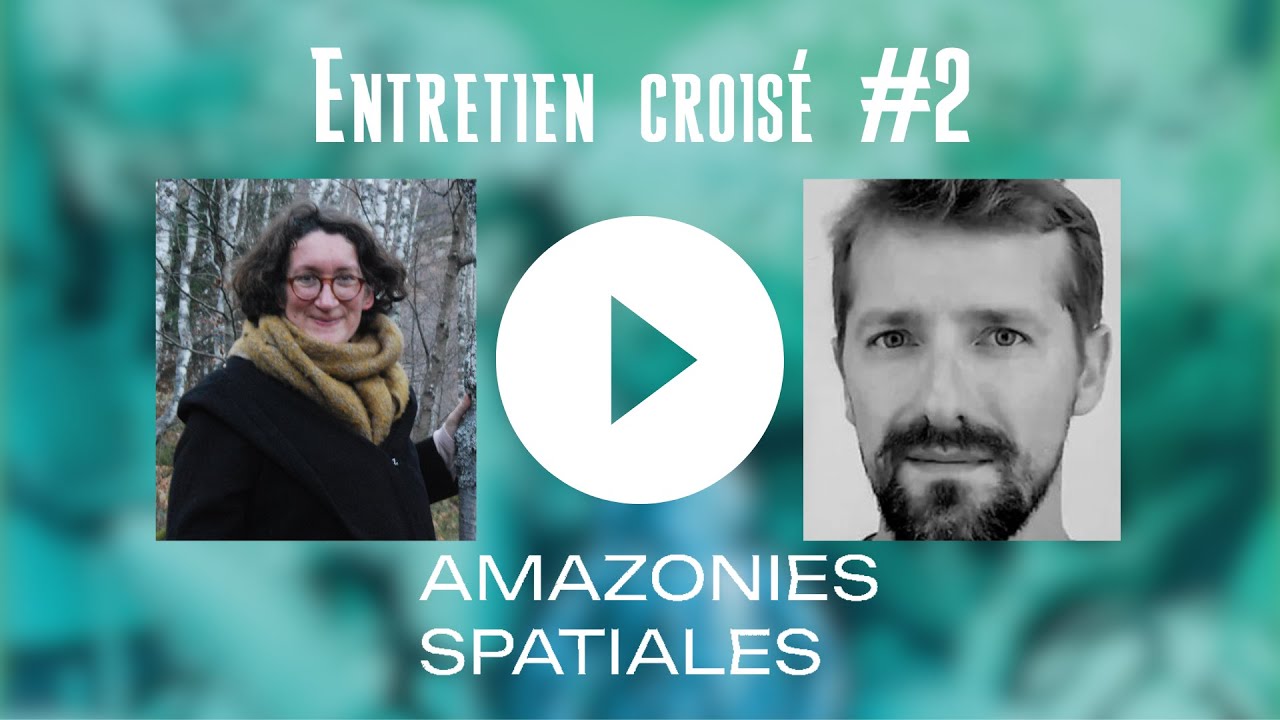
Amazonies Spatiales : Interview croisée avec Silène Edgar et Adrien Normier
Space Amazonias: Cross Interview with Silène Edgar and Adrien Normier
Keywords
Summary
251 words
Critical Evaluation
Value of the Information & Strength of the Argument
The informational value of this interview lies mainly in the concrete description of an art-science collaboration and in the articulation of a research agenda around space ethics. Normier provides specific, checkable examples of impact categories: satellite constellations, gas clouds released by interplanetary spacecraft, and impact craters on other bodies in the Solar System. The Starlink laser example is particularly instructive because it is presented explicitly as an unresolved scientific question rather than a settled fact, which is an honest way to frame it. The argument that fiction can supply imagination where expert inventories fall short is developed coherently: the research group asked authors to help enumerate impacts that specialists had not considered, and Normier reports that new ideas emerged from that exercise. The second main argument concerns the feedback loop between fiction and public understanding: because most narratives require continuity of characters and human-scale timelines, they tend to introduce faster-than-light travel, teleportation or identity-preserving devices that are physically implausible, which in turn shapes how non-specialists perceive space. The claim that this produces a ’lack of narration’ for large-scale, long-term problems is a strong interpretive thesis rather than a demonstrated result, and it is supported mainly by anecdote and personal experience. The discussion of inference-based communication, as opposed to procedural or equation-based explanation, is plausible and consistent with well-established ideas in science communication, but it is asserted rather than evidenced here. Overall the argumentation is clear, internally consistent and grounded in the speakers’ direct experience, but it remains programmatic: it identifies questions and proposes a direction rather than presenting tested conclusions.
Scientific Rigor, Source Quality, Title Accuracy
Scientific rigour is moderate. The interview does not present data, methodology or peer-reviewed results; it reports on a residency and on a research programme in progress. Normier is careful to distinguish what is known from what is not, notably in the Starlink laser example, and he explicitly notes the survivorship bias in claims that science fiction predicts real technologies. He also correctly identifies COSPAR as an existing body dealing with planetary protection and scientific research in the Solar System, while arguing that no equivalent exists for broader cosmic-impact governance. These are accurate and appropriately qualified statements. The sources provided in the description are limited to the channel’s own review of the anthology and to author pages for Silène Edgar on Babelio and Bragelonne; they document the book and the author but do not constitute scientific references for the technical and ethical claims made in the interview. No academic papers, institutional reports or datasets are cited. The title-to-content match is good: the video is indeed a cross-interview with the two named participants, conducted at the launch event, and it stays on topic throughout.
457 words
Title / Content Match
The title accurately announces a cross-interview with Silène Edgar and Adrien Normier, and the video delivers exactly that, framed around the 'Amazonies Spatiales' anthology.
Quality & Reliability
6/10
The interview features two credible participants: a published author of speculative fiction and an aerospace engineer who works on space ethics and leads a research programme. The content is largely first-hand testimony about a science-fiction/art-science residency and the resulting research questions, which lends it authenticity. However, no quantitative data, peer-reviewed results or detailed methodology are presented; several claims (e.g. Starlink laser detectability from Proxima Centauri, the absence of any governance body for cosmic impact) are stated as open questions or personal observations rather than documented findings. The discussion is therefore reliable as an account of a project and its rationale, but not as a source of verified scientific conclusions.
Key Moments
Markers derived by PSI from the transcript: the creator did not define chapters.
- Introduction of Silène Edgar and Adrien Normier, with their respective backgrounds in speculative fiction and aerospace engineering.
- Normier explains his work on space ethics and the founding of a research institute on human impact on the cosmos.
- Edgar describes how the collaboration with Normier shaped her scenarios from the beginning of the writing process.
- Normier explains how the research group used the authors' imagination to inventory human impacts in space.
- The Starlink inter-satellite laser example and the open question of detectability from nearby exoplanets.
- Discussion of the difference between scientific research and fiction writing, and the need for narrative legibility.
- The relationship between science and fiction, including the atomic bomb example and survivorship bias.
- How mainstream science fiction shapes public imaginaries with non-physical paradigms such as teleportation.
- Edgar on avoiding unrealistic habitable planets and human-like aliens in her story for the anthology.
- Normier announces the open letter calling for governance on cosmic impact and messaging to extraterrestrial intelligence.
Cited Sources
- Syfantasy review of 'Amazonies Spatiales' — The channel's own critical review of the anthology discussed in the interview.
- Silène Edgar bibliography on Babelio — Complete bibliography of the interviewed author, referenced in the description.
- Silène Edgar author page at Bragelonne — Publisher page listing the author's works, referenced in the description.
Concurring Sources
- COSPAR planetary protection policy — Supports the statement that an existing body addresses protection of scientific research in the Solar System, while leaving broader cosmic-impact governance unaddressed.
- Space debris — Wikipedia — Corroborates the existence of orbital impact categories discussed in the inventory of human effects in space.
Dissenting Sources
- Starlink — Wikipedia — The interview raises the possibility that inter-satellite laser links could produce a detectable signal from nearby exoplanets, but explicitly states that this cannot be answered scientifically at this stage. Public documentation on Starlink describes the laser links and constellation size without supporting any conclusion about detectability from other star systems, so the claim remains an open hypothesis rather than a documented effect.
Contribution & Novelties
The interview’s main contribution is to document, from the inside, how a prospective science-fiction anthology was used as a tool for a research programme on space ethics. Rather than treating fiction as mere illustration, Normier describes using fifteen authors as an imagination resource to expand an inventory of human impacts in space, and reports that this produced impact categories the researchers had not anticipated. The second original element is the explicit diagnosis of a feedback loop: because narrative requires character continuity and human-scale timelines, mainstream science fiction normalises physically impossible paradigms, which in turn constrains how the public and even decision-makers frame real space questions. The third is the announcement of an open letter calling for governance mechanisms on cosmic impact and on messaging to potential extraterrestrial intelligence, framed as a gap left by existing bodies such as COSPAR.
Pour aller plus loin :
- COSPAR — The international committee whose planetary protection mandate is discussed as insufficient for broader cosmic-impact governance.
- Space debris — Background on orbital impact categories mentioned in the inventory of human effects in space.
- Starlink — Context for the satellite constellation and inter-satellite laser example used in the interview.
- Fermi paradox — Directly relevant to the question of signalling to potential extraterrestrial intelligence.
- Science fiction prototyping — Related methodology for using narrative to explore technological and ethical futures.
222 words
Radar Profile
The profile is balanced but moderate: information quantity and quality sit at mid-range, reflecting a rich qualitative discussion without data or formal references. Technical level is moderate, since the exchange touches on physics constraints and space engineering without going into depth. Overall reliability is the strongest axis, driven by the credibility and honesty of the two speakers rather than by documentary support.