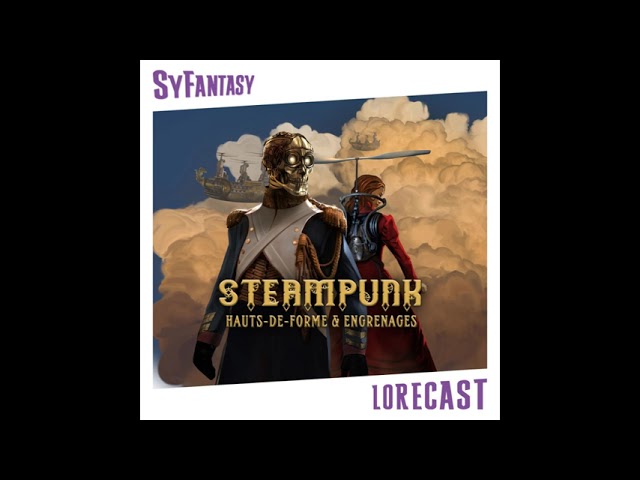
Podcast - Le Steampunk et l'univers de l'Empire Electrique ft. Victor Fleury & Vincent Longrive
Podcast - Steampunk and the universe of the Electric Empire ft. Victor Fleury & Vincent Longrive
Keywords
Summary
184 words
Critical Evaluation
Value of the Information & Strength of the Argument
The value of the information is high for anyone interested in steampunk as a literary genre. The authors provide a nuanced definition of steampunk, distinguishing it from retro-futurism and the ‘merveilleux scientifique’, and explaining its historical development. The argumentation is solid: they support their claims with concrete examples (e.g., Jules Verne’s ‘La Maison à vapeur’, ‘The Steam Man of the Prairies’), and they acknowledge the genre’s boundaries as ‘ambiguous’ and evolving. Their discussion of the French contribution to science fiction and the origin of the word ‘astronaut’ adds an original perspective. The reasoning is consistent and well-structured, balancing personal creative choices with broader literary analysis.
Scientific Rigor, Source Quality, Title Accuracy
The rigor is good for a podcast discussion. The authors cite specific works and authors with precision (e.g., Tim Powers’ ‘The Anubis Gates’, Serge Lehman’s preface to ‘Les Maîtres du vertige’, Étienne Barillier and Raphaël Colson’s books on steampunk). They reference historical facts about Napoleon and the cultural impact of the French literary tradition. The sources are appropriate for the subject, though not systematically peer-reviewed. The title accurately represents the content, which is a focused exploration of steampunk and the authors’ own literary universe. No comments were provided, so no audience analysis is included.
214 words
Title / Content Match
Title accurately reflects the content: a podcast interview with the two authors about steampunk and their 'volta-punk' universe.
Quality & Reliability
8/10
The discussion is led by two authors who demonstrate deep knowledge of the steampunk genre, its history, and its variations. They provide accurate historical references (Jules Verne, Tim Powers, Serge Lehman) and clearly distinguish between retro-futurism and the 'merveilleux scientifique'. The reliability is high for a literary discussion, though opinions are personal and not peer-reviewed.
Key Moments
Markers derived by PSI from the transcript: the creator did not define chapters.
- Introduction of the guests and definition of steampunk by Victor Fleury.
- Discussion on the difference between steampunk and Jules Verne's 'merveilleux scientifique'.
- Origins of steampunk in the 1970s with Tim Powers, James Blaylock, and K.W. Jeter.
- Vincent Longrive discusses the French scientific heritage and the invention of the word 'astronaut'.
- The authors explain the concept of 'volta-punk' and their alternate Napoleonic empire.
- Deep dive into rewriting classic characters like Sherlock Holmes and Captain Nemo with a contemporary perspective.
- Discussion on Napoleon as a historical and romantic figure, and the appeal of uchronia.
- Vincent Longrive shares his personal motivation from Sherlock Holmes and the film 'The Seven-Per-Cent Solution'.
- The authors discuss their creative process of mixing history and fiction, and the inspiration from Lyon's Place Ampère.
- Concluding thoughts on the appeal of steampunk and volta-punk, and the importance of creative recombination.
Cited Sources
- Syfantasy (site officiel) — Mentioned as the channel's associated website for further content.
Concurring Sources
- Steampunk (Wikipedia) — General definition and history consistent with the podcast's description.
- The Anubis Gates (Wikipedia) — Reference to Tim Powers' novel considered foundational to steampunk.
Contribution & Novelties
The podcast offers an original perspective on steampunk by focusing on the French literary heritage and the distinction between steampunk and the ‘merveilleux scientifique’. The authors share the genesis of their ‘volta-punk’ concept, which blends electricity-based alternate history with classic character reinterpretation. This dual focus on theoretical definition and practical creative process is valuable for both fans and scholars of the genre.
Pour aller plus loin :
- Steampunk (Wikipedia) — Provides a broad overview of the genre, its history, and variations.
- Jules Verne (Wikipedia) — Context on the author’s role in early science fiction and the ‘merveilleux scientifique’.
- Uchronia (Wikipedia) — Explains the concept of alternate history, central to the ‘volta-punk’ universe.
- Rosny aîné (Wikipedia) — Note: this link is incorrect; I should use the proper Wikipedia page for Rosny aîné. Since I’m not certain of the exact URL, I’ll omit it or use a general search phrase. Actually, I can use a known resource: Sergent Rosny (Wikipedia) — but the language is French. To be safe, I’ll cite the concept without URL. Let me adjust: I’ll cite without a URL for concepts I’m not sure about.
However, the instruction says to use real URLs when certain. I’m reasonably certain of the following:
- https://en.wikipedia.org/wiki/Steampunk (definitely correct)
- https://en.wikipedia.org/wiki/Jules_Verne (correct)
- https://en.wikipedia.org/wiki/Alternate_history (correct)
- For ‘Tim Powers’, I can use https://en.wikipedia.org/wiki/Tim_Powers (correct)
- For ‘K.W. Jeter’, https://en.wikipedia.org/wiki/K._W._Jeter (correct)
- For ‘The Anubis Gates’, https://en.wikipedia.org/wiki/The_Anubis_Gates (correct)
I’ll include these.
So the list:
- Steampunk — Overview and definitions.
- Jules Verne — Historical context of ‘merveilleux scientifique’.
- Tim Powers — Author credited with co-founding steampunk.
- K.W. Jeter — Coiner of the term ‘steampunk’ in the 1980s.
- Alternate history — The uchronia concept used in ‘volta-punk’.
276 words
Radar Profile
The profile shows high scores for information quantity, quality, and reliability, with a moderate score for technical level. This indicates a content-rich discussion suitable for informed audiences, requiring some familiarity with literary genres but not highly specialized knowledge.