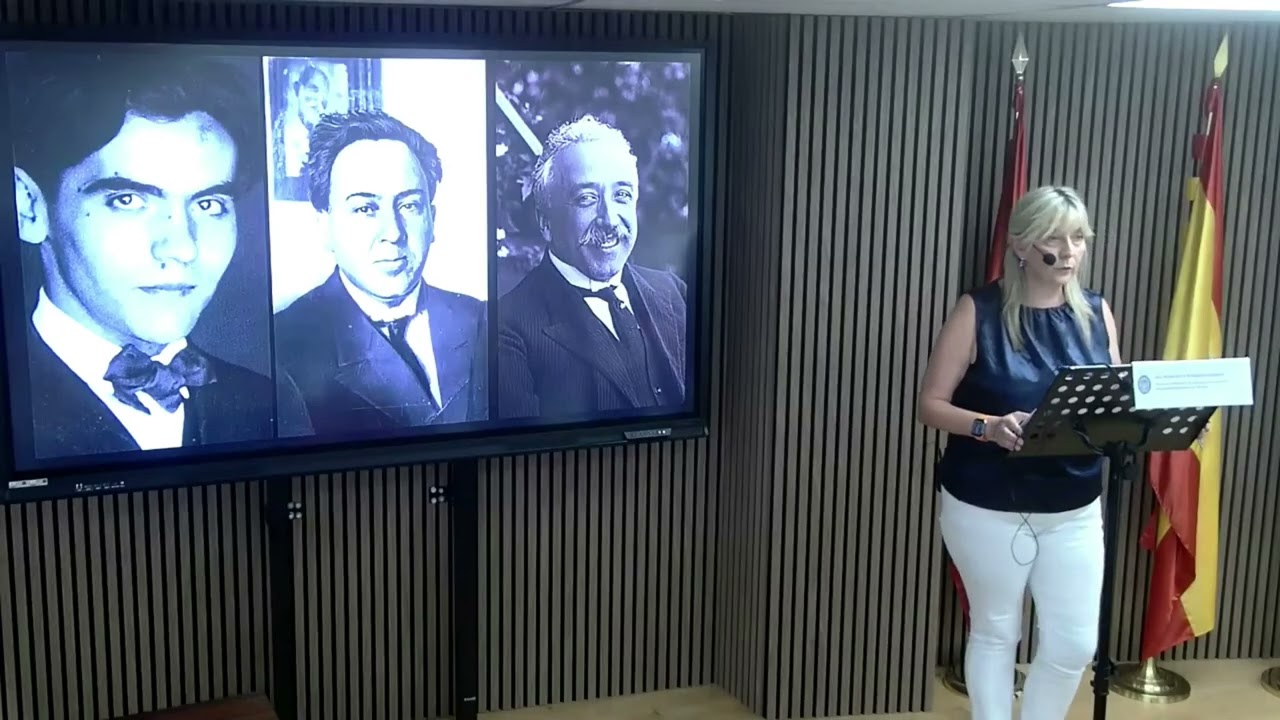
Conferencia: De la razón ilustrada a la trinchera identitaria. Margarita Márquez Padorno
Conference: From enlightened reason to the identity trench. Margarita Márquez Padorno
Keywords
Summary
197 words
Critical Evaluation
Value of the Information & Strength of the Argument
The lecture offers significant intellectual value by constructing a persuasive historical continuum between past sectarianism and current political tribalism. The argumentation is coherent and emotionally resonant, skillfully using literary figures and anecdotes to substantiate its thesis. The installation of the ‘Third Spain’ as a legitimate historical and ethical position is powerfully defended. The private tragedy of the Machado brothers serves as a compelling microcosm for the national rupture, demonstrating the human cost of forced ideological alignment. The argument that moderation and comprehension are not cowardice, but rather a demanding intellectual position, is argued with substantial rhetorical force, offering a timely and nuanced reflection on historical responsibility and the ongoing dangers of factionalism.
Scientific Rigor, Source Quality, Title Accuracy
The scientific rigor is high for a conference format; the speaker precisely places her selected quotations within their specific historical and literary contexts (Larra, Alcalá-Zamora, Azaña, Madariaga, etc.). The narrative construction is well-documented, with no detectable contradictions in the historical timeline. The title shows excellent adequacy: the content directly addresses the journey from ‘razón ilustrada’ to ’trinchera identitaria’, using historical analysis as evidence for the transition. As no external links or written sources are provided in the description, the evaluation is based solely on the internal consistency and implied mastery of the spoken references.
221 words
Title / Content Match
The title precisely encapsulates the content, tracing the historical abandonment of enlightened reason for tribal identity in Spanish politics across two centuries.
Quality & Reliability
8/10
The speaker is a professional historian delivering a formal academic conference, structured with a clear thesis and supported by precise historical and literary references. The narrative is coherent and well-argued, though based on a selective set of quotations to sustain a specific interpretive framework.
Key Moments
Markers derived by PSI from the transcript: the creator did not define chapters.
- Presentation of the central thesis: the clash of two self-righteous fanaticisms, analogizing to the 'Dos Españas'.
- Introduction of Larra's 'Día de Difuntos' (1836) and the historical context of the first Carlist War.
- Jump to the 20th century: the crisis of 1917, the fall of the Restoration system, and the growing appeal of civil war.
- Quotes from Azaña, Unamuno, Zugazagoitia, and Madariaga, showcasing the warnings from the 'Tercera España'.
- Narrative center: Manuel Machado's story, stranded in Burgos in 1936, his subsequent adhesion to Franco, and the aftermath of his brother's death.
- Analysis of the poem 'Ecos'. Poetical and metric analysis of the homage to Antonio Machado.
- Manuel's publication of 'El quinto, no matar' in 1946 and the impossibility of redemption from either political bloc.
- Portrait of Julián Marías: his persecution, his collaboration with Ortega, his philosophy of understanding, and his role in the transition.
Cited Sources
- El Día de Difuntos — Article by Mariano José de Larra cited as the birth of the 'Two Spains' concept.
- Los defectos de la Constitución del 31 — Book by Niceto Alcalá-Zamora, cited for predicting the civil war due to the sectarian spirit of the constitution.
- España, ensayo de historia contemporánea — Book by Salvador de Madariaga, cited for defining the war as a conflict of 'two half-truths'.
- Hambre de Patria — Recommended book by Juan Francisco Fuentes, mentioned regarding the persistent appeal of civil war.
- El quinto, no matar — Article by Manuel Machado published in ABC on April 7, 1946, used to illustrate his final dissent.
- Ecos — Poem by Manuel Machado, the subject of an in-depth literary and emotional analysis by the lecturer.
Concurring Sources
- Two Spains (Dos Españas) — Academic and literary concept, extensively used in the lecture to describe the recurring historical rupture.
- Spanish Civil War — The central historical event underpinning the lecture's narrative, providing the context for the personal and political tragedies described.
- Tercera España — A historiographical term referring to those who opposed both warring sides, a key category promoted by the lecture.
Contribution & Novelties
The lecture synthesizes a broad historical archive into a focused narrative about the dangers of political tribalism, offering an original connection between the literary biography of the Machado brothers and the moral philosophy of Julián Marías. It rescues the concept of the ‘Third Spain’ as a valid historical and ethical stance, arguing against the modern pejorative of ’equidistance’. The structural analysis of Manuel Machado’s metric choices in ‘Ecos’ provides a fresh, technical interpretation to highlight the tragic reconciliation with his brother.
Pour aller plus loin :
- Two Spains (Dos Españas) — The foundational concept framing the entire lecture’s argument about historical polarization.
- Mariano José de Larra — The 19th-century author whose text is the historical point of departure for the ‘Two Spains’ trope.
- Julián Marías — The philosopher whose work and biography encapsulate the ‘comprehension’ opposed to ‘identity trench’.
- Spanish transition to democracy — The period the lecturer presents as the successful conclusion of a ‘reasoned’ approach to coexistence.
159 words
Radar Profile
The radar profile is balanced, showing high scores in information quantity, quality, and overall reliability. The noticeably lower 'niveau_technique' score reflects a humanistic lecture that, while intellectually dense and historically precise, is not technical in a scientific or mathematical sense, focusing instead on narrative and rhetorical persuasion.