Séminaire - DIC-ISC-CRIA - 24 septembre 2026 par Reto Gubelmann
Keywords
Summary
158 words
Critical Evaluation
Value of the Information & Strength of the Argument
The talk provides a valuable perspective by reframing reasoning as a holistic action involving not just cognition but also affect and conation. Gubelmann builds a coherent argument using classical sources (Aristotle, Anselm) and contemporary psychology (system 1/2), illustrating with concrete examples like the HR evaluation scenario and the courage confrontation. The argument is logically structured, and the distinction between cognitive, conative, and affective failures is insightful. However, as a work-in-progress, the implications for AI reasoning are only briefly sketched, and the empirical basis for some claims (e.g., emotions affecting reasoning) is assumed rather than detailed.
Scientific Rigor, Source Quality, Title Accuracy
Gubelmann references his own papers (Gubelmann & Hongler 2026; Gubelmann 2026) which are relevant to the topic. He also draws on well-known philosophical sources without extensive citations, but the narrative is academically informed. The title ‘Grounding Reasoning’ accurately reflects the talk’s focus on making explicit the embodied and holistic nature of human reasoning. The video title ‘Séminaire - …’ correctly indicates an academic seminar format, and the content matches the announced topic. No public comments were analyzed.
187 words
Title / Content Match
The video title indicates a seminar talk and is accurate; the talk indeed presents a philosophical exploration of grounding reasoning.
Quality & Reliability
7/10
The talk by an expert in philosophy and NLP presents original ideas grounded in classical philosophy and personal research. Work in progress but well-argued.
Key Moments
Markers derived by PSI from the transcript: the creator did not define chapters.
- Introduction by host, bilingual welcome.
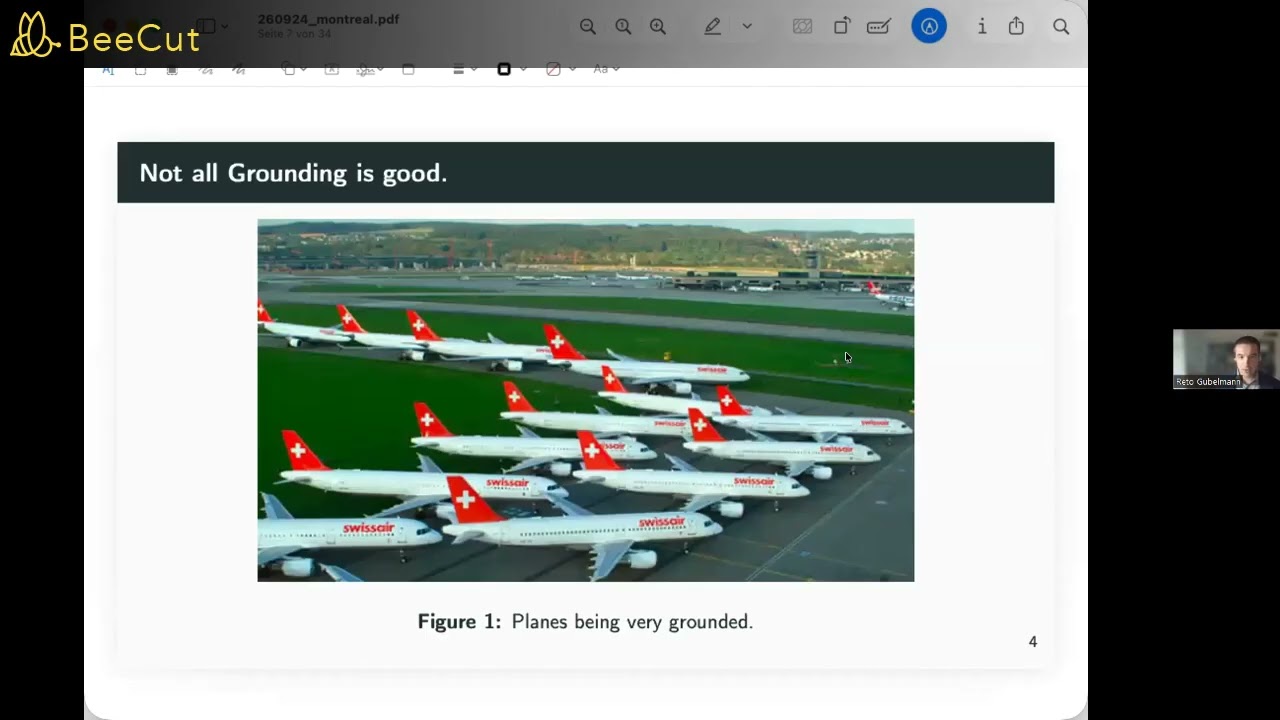
- Discussion of grounding concept using School of Athens, contrast Plato and Aristotle.
- Anselm's ontological argument and mix of emotion and logic.
- System 1 vs System 2 thinking, requirement of willpower.
- Trilogy of mind: cognition, affect, conation, and courage example.
- Practical wisdom and implications for reasoning with LLMs.
Cited Sources
- Too Fast, Too Shallow–LLMs, Including Reasoning LLMs, Are Unreliable Constitutional Reasoners — Referenced as a paper on legal AI, mentioned in the talk and description.
- Putting reasons back into reasoning: how genuine reasoning is inference-based and why neuro-symbolic NLI could achieve it — Referenced as a paper connecting philosophy and NLP, mentioned in talk and description.
Contribution & Novelties
The talk offers a novel integration of cognitive science and Aristotelian ethics to redefine reasoning, arguing that good reasoning depends on character and situation, not just logical cognition. This perspective challenges current AI approaches that treat reasoning as purely computational.
Pour aller plus loin :
- Aristotle’s Ethics (SEP) — Central to practical wisdom and the holistic view of reasoning.
- Ontological Arguments (SEP) — Provides background on Anselm’s argument discussed in the talk.
- Dual Process Theory (Wikipedia) — Explains system 1/2 distinction and its empirical basis.
85 words
Radar Profile
The radar shows high quality and moderate quantity, with technical depth and reliability balanced. The score profile indicates a conceptually rich talk with some gaps in empirical support, fitting an expert opinion format.