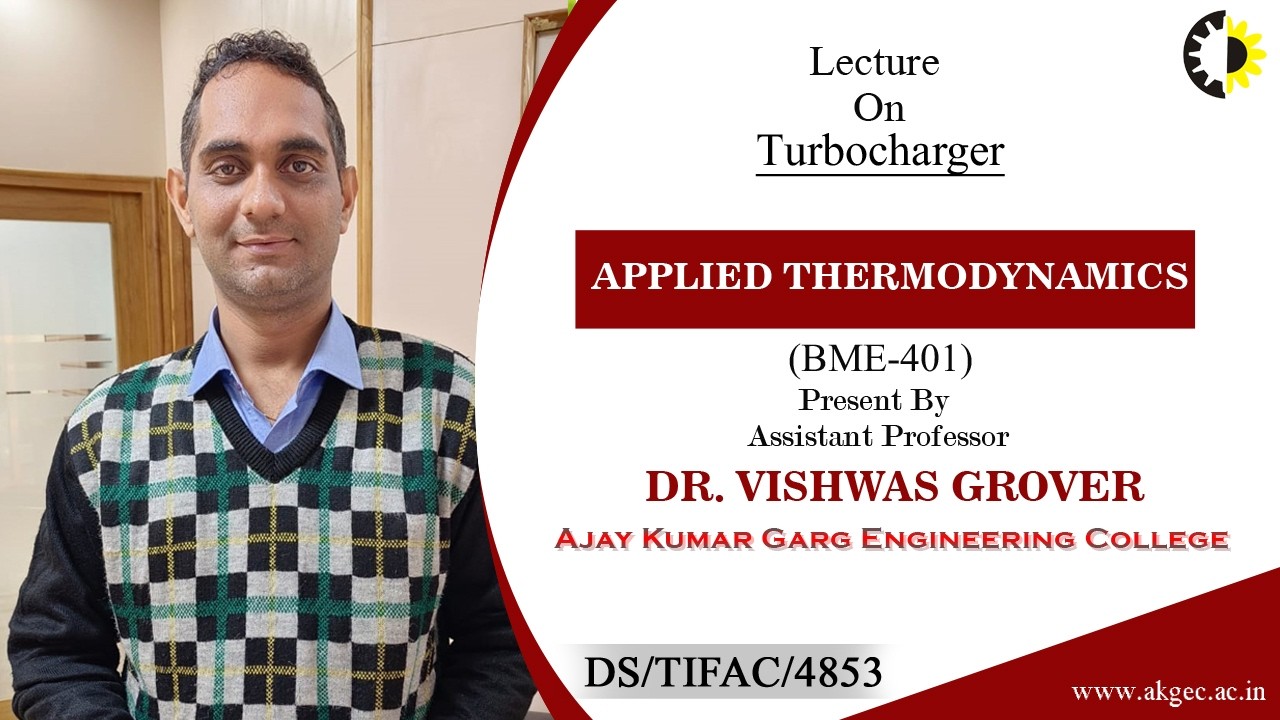
TURBOCHARGER | APPLIED THERMODYNAMICS | LECTURE 04 BY DR. VISHWAS GROVER | AKGEC
Keywords
Summary
154 words
Critical Evaluation
Value of the Information & Strength of the Argument
The lecture provides a clear and structured explanation of the working principles of turbochargers and superchargers. It uses simple demonstrations and describes the components and their functions. The argumentation is logical, explaining how exhaust gases drive the turbine and compressor to increase air intake, leading to improved power output. The lecture also covers different types of superchargers and compares them with turbochargers, touching on advantages and disadvantages. The information is valuable for engineering students as it lays a foundation for understanding forced induction systems.
Scientific Rigor, Source Quality, Title Accuracy
The scientific rigor is moderate; the lecture presents well-established concepts without citing primary sources. The title matches the content precisely. No references are given beyond the college’s website and a playlist of related lectures, so the reliability is based on the credibility of the instructor and institution. The information is accurate but not supported by external sources.
156 words
Title / Content Match
The title accurately reflects the content: a lecture on turbocharger in applied thermodynamics.
Quality & Reliability
7/10
Lecture from an engineering college providing clear explanations of turbocharger and supercharger concepts, but lacks citations or references.
Key Moments
Markers derived by PSI from the transcript: the creator did not define chapters.
- Introduction to turbocharger and its purpose
- Working principle of turbocharger: exhaust gases drive turbine
- Components of turbocharger and boost pressure details
- Introduction to supercharger and its working
- Types of superchargers: centrifugal, vane, Roots
- Advantages and limitations of turbochargers and superchargers
Cited Sources
- AKGEC Official Website — Official website of the college providing the lecture.
- Applied Thermodynamics Playlist — Playlist containing this lecture and other related lectures.
Contribution & Novelties
The lecture offers an educational overview of turbocharging, synthesizing known principles without introducing new research. Its value lies in its clarity for students. For further exploration, consult standard references on forced induction.
Pour aller plus loin :
- Turbocharger - Wikipedia — Overview of turbocharger history, operation, and applications.
- Supercharger - Wikipedia — Detailed explanation of supercharger types and mechanics.
- Internal combustion engine - Wikipedia — Context of engine operation where these devices are used.
74 words
Radar Profile
The radar profile shows moderate scores across all dimensions, indicating a balanced but not outstanding educational content. The content is informative and technically reasonable, but lacks depth and rigor in terms of sourcing.