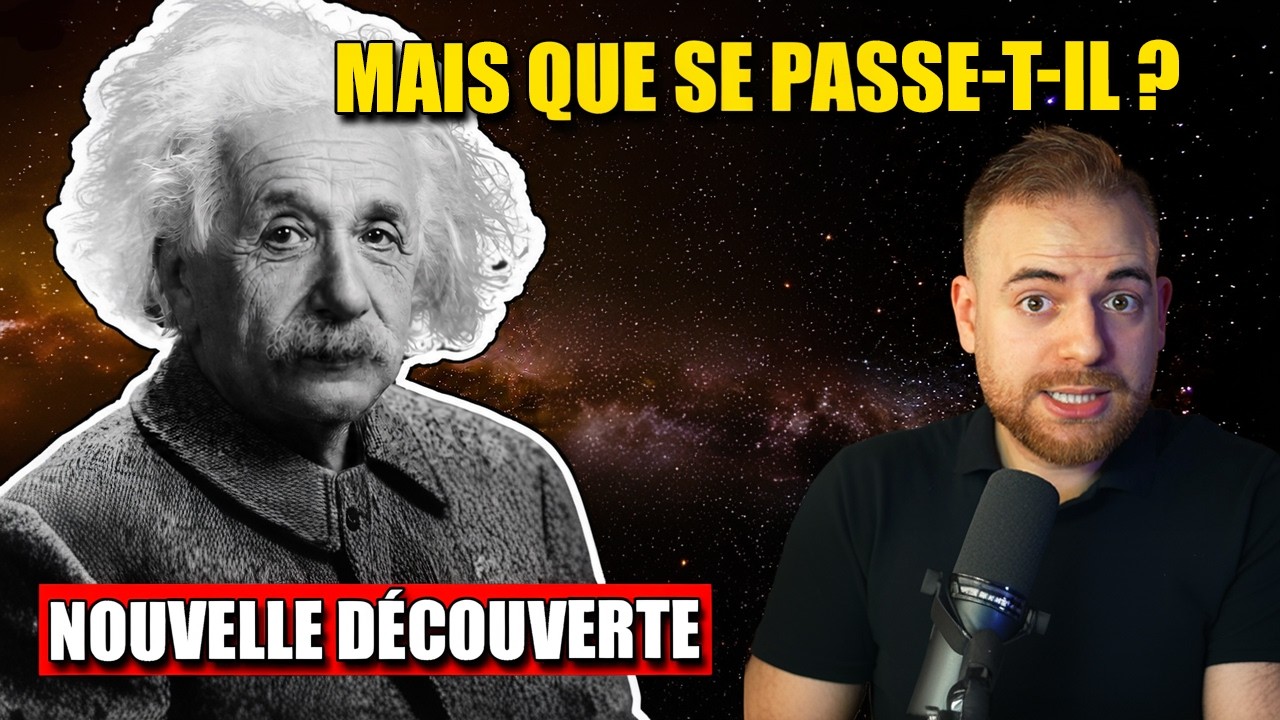
Mais que se passe-t-il avec l'univers ? (jamais vu ça)
But what is happening with the universe? (never seen that)
Keywords
Summary
173 words
Critical Evaluation
Value of the Information & Strength of the Argument
The video’s value lies in its timely and accessible synthesis of recent cosmological controversies, particularly the evidence against a constant dark energy and the novel quantum mechanical explanation. The argumentation is generally coherent: it outlines the problem, presents converging observational data, explains the theoretical proposal, and acknowledges counterarguments. The presenter uses analogies (e.g., the uncertainty principle) to make complex ideas understandable without losing nuance. The discussion of the model’s empirical tuning and the lack of a complete theoretical foundation demonstrates balanced critical thinking. However, the promotional segment at the end (about 2 minutes) is a clear sales pitch and detracts from the scientific narrative, though it is clearly separated and does not undermine the earlier content.
Scientific Rigor, Source Quality, Title Accuracy
The video references several credible sources: the DESI collaboration’s mapping of 47 million galaxies, a supernova catalog from the University of Queensland, and a paper by Savas Kyprianos in Physical Review D. It also mentions Subir Sarkar’s work from Oxford. However, no direct URLs or citations are provided in the description, limiting verifiability. The presenter accurately notes that DESI results are not yet at ‘discovery’ level and that Kyprianos’s model has weaknesses. The title is somewhat clickbait but aligns with the content’s focus on surprising observations. The promotional segment is present for approximately 2 minutes and does not influence the scientific assessment.
233 words
Title / Content Match
The title raises a provocative question and the video directly addresses it, discussing observations that suggest the universe's expansion may be slowing. It is somewhat sensationalized but accurately reflects the content.
Quality & Reliability
8/10
The video provides a clear and largely accurate overview of recent cosmology research, citing specific collaborations (DESI, supernova catalog) and peer-reviewed papers. The presenter distinguishes established findings from speculative hypotheses, acknowledges uncertainties, and notes the model's weaknesses. However, direct links to primary sources are missing, and the promotional segment at the end may slightly affect perceived objectivity.
Chapters
Cited Sources
- Vision IA Newsletter — Free newsletter offering daily updates on AI and science news, referenced at the beginning and end of the video.
- Formation IA (AI Training Program) — Paid training course on AI presented in the promotional segment, claiming to teach practical AI integration.
Contribution & Novelties
The video’s original contribution is its synthesis of recent, rapidly evolving cosmological data with a speculative quantum mechanical explanation, making cutting-edge research accessible to a broad audience. It highlights the potential of quantum uncertainty principles applied at cosmic scales, a fresh perspective rarely covered in mainstream science communication. The inclusion of AI’s role in verifying physics calculations also provides an original angle.
Pour aller plus loin :
- Dark energy — Essential background on the phenomenon driving cosmic acceleration.
- Cosmological constant — Einstein’s original concept and its modern interpretation.
- Uncertainty principle — The quantum concept extended to cosmology in the video.
- DESI (Dark Energy Spectroscopic Instrument) — The project providing key observational evidence discussed in the video.
116 words
Radar Profile
The radar profile shows high scores for information quantity, information quality, and overall reliability, balanced with a moderate technical level. This indicates the video is informative and trustworthy but not overly technical, making it suitable for general audiences. The lower technical level relative to other scores suggests it explains concepts clearly without entering deep mathematical detail.