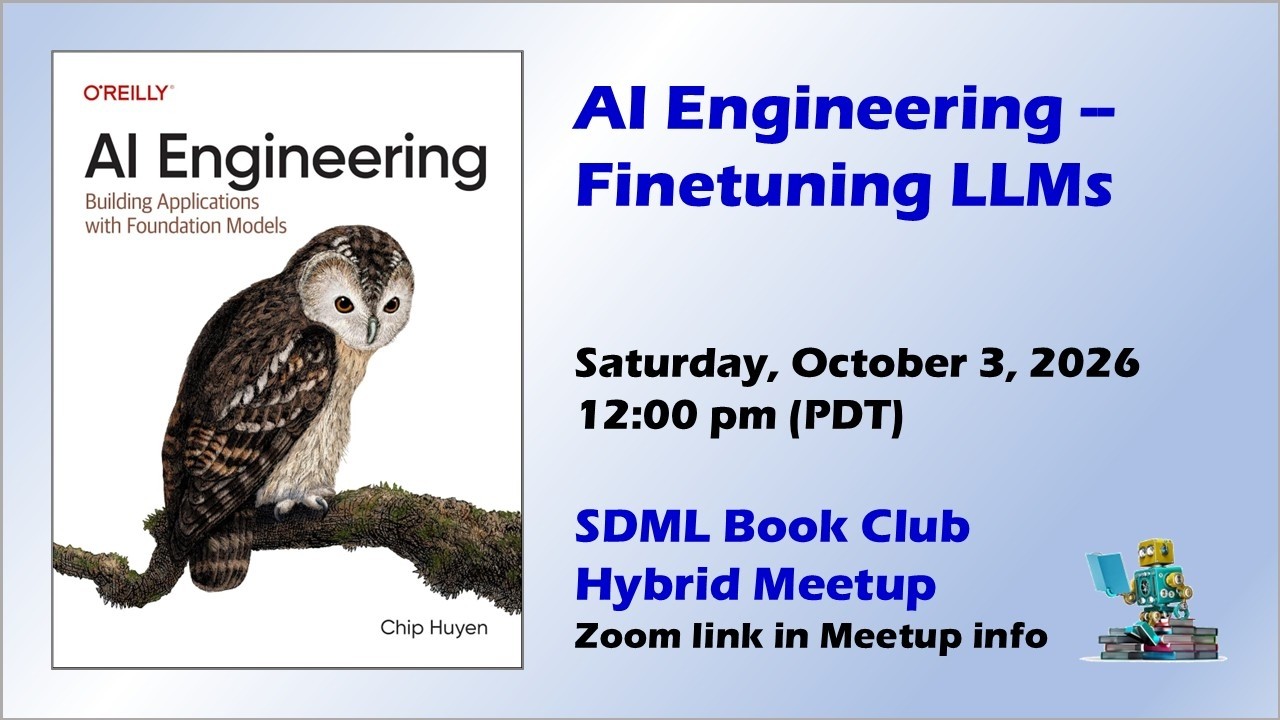
Finetuning LLMs - AI Engineering
Keywords
Summary
146 words
Critical Evaluation
Value of the Information & Strength of the Argument
The value of the information lies in its practical orientation, connecting theoretical concepts to real-world application decisions. The presenter argues that fine-tuning is not about teaching new knowledge but about specializing existing capabilities, a perspective echoed by AI companies. The argumentation is coherent, supported by examples like legal QA and the use of chat templates. The discussion also addresses common misconceptions, such as the relationship between SFT and classical supervised learning. However, the casual format means some points are simplified, and the reliance on a single source (the book) limits the depth of critical evaluation.
Scientific Rigor, Source Quality, Title Accuracy
The scientific rigor is moderate; the content is based on a reputable source (Chip Huyen’s book) and the presenter cites the O’Reilly edition and the book’s companion resources. The GitHub repo for the book club provides additional notes and slides, enhancing credibility. The title adequately matches the content, as the session is indeed about fine-tuning LLMs. No comments were provided for analysis, so audience reception cannot be assessed.
178 words
Title / Content Match
The title accurately reflects the content, as the session focuses on fine-tuning LLMs, a core topic in AI engineering.
Quality & Reliability
7/10
The presentation is based on a well-regarded book by Chip Huyen, and the presenter demonstrates a good understanding of the material. However, it is a casual discussion with some potential simplifications, and the content is not peer-reviewed.
Key Moments
Markers derived by PSI from the transcript: the creator did not define chapters.
- Start of presentation, echo issues resolved
- Definition of fine-tuning vs. prompting, introduction of transfer learning
- Supervised fine-tuning explained, chat templates, data requirements
- Discussion on self-supervised fine-tuning and raw documents
- Preference fine-tuning and RLHF overview, reward model explanation
- Memory bottleneck and techniques to reduce memory footprint
- When to fine-tune vs. RAG, practical recommendations
- Q&A session, clarifications on SFT and generalization
Cited Sources
- AI Engineering: Building Applications with Foundation Models (O'Reilly) — The book being discussed, Chapter 7 on fine-tuning LLMs.
- SDML Book Club GitHub Repository — Repository with notes and slides for the book club meetups.
Concurring Sources
- AI Engineering: Building Applications with Foundation Models (O'Reilly) — The primary reference for the session's content.
Contribution & Novelties
The video provides a structured summary of fine-tuning techniques, emphasizing practical trade-offs and the role of memory constraints. It clarifies common misconceptions, such as the ’teaching new knowledge’ myth, and offers a comparative view of SFT and self-supervised fine-tuning. The discussion also touches on RLHF and reward models, giving a high-level understanding without requiring a deep reinforcement learning background.
Pour aller plus loin :
- Reinforcement Learning from Human Feedback (RLHF) — Overview of RLHF, a key technique mentioned in the video.
- Low-Rank Adaptation (LoRA) — A memory-efficient fine-tuning method that addresses the memory bottleneck discussed.
- Chip Huyen’s AI Engineering book — The original source for a deeper dive into the chapter.
111 words
Radar Profile
The profile shows high scores in quantity of information and moderate scores in quality and technical level, indicating a comprehensive yet accessible overview. Fiabilite is decent but limited by the casual format and reliance on a single source.