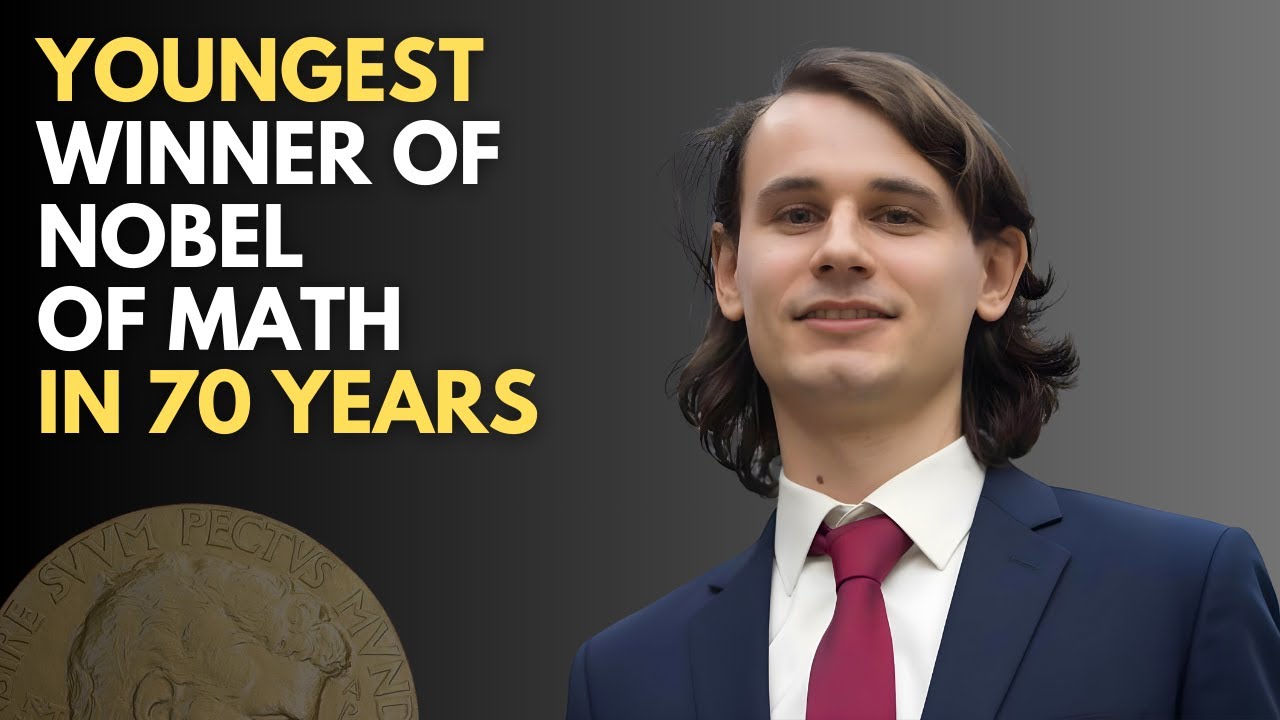
Why Peter Scholze is once in a Generation Mathematician
Title history
- Why Peter Scholze is once in a Generation Mathematician — observed on 20261101-0153 UTC (YouTube)
Keywords
Summary
151 words
Critical Evaluation
Value of the Information & Strength of the Argument
The video provides substantial value by demystifying complex mathematical concepts for a general audience using analogies and visual metaphors. It effectively argues that Scholze’s contributions are not merely solving hard problems but creating new frameworks that unify large areas of mathematics. The argumentation is solid, building a narrative from his early influences to his major works. It cites specific examples like the Harris-Taylor proof condensation and the Liquid Tensor Experiment, which add credibility. However, some claims (e.g., ‘once in a generation’) are subjective and not critically examined. The explanation of condensed mathematics could be more precise, but overall the value is high and the argumentation is coherent and persuasive.
Scientific Rigor, Source Quality, Title Accuracy
The video does not explicitly cite academic papers or interviews, but it references specific events and projects that are verifiable from public mathematical knowledge. The description provides only a link to The Turing App, not to primary sources. The title accurately matches the content. The video is well-produced with a clear narrative, but it lacks direct quotes from Scholze or his collaborators, relying instead on a narrator’s voice. The accuracy of biographical details (e.g., school name, age) appears correct. However, the claim that ‘Peter Scholze is once in a generation’ is a subjective evaluation, not a factual assertion. Overall, the scientific rigor is moderate: the content is accurate but lacks explicit source citations to primary literature.
240 words
Title / Content Match
The title accurately reflects the content: the video argues that Peter Scholze is a once-in-a-generation mathematician through his revolutionary contributions and unique intellectual approach.
Quality & Reliability
8/10
The video is a well-structured documentary blending biographical narrative with accessible explanations of advanced mathematical concepts. It features citations to real mathematical work (p-adic numbers, perfectoid spaces, condensed mathematics) and describes known events (Fields Medal, Liquid Tensor Experiment). However, some details are presented without explicit source references, and the tone is occasionally celebratory rather than critical. The content is factually reliable in its main claims, but lacks direct quotes from primary sources.
Chapters
Cited Sources
- The Turing App — The video's description provides this link as a resource for science audio shows; it is not a direct source for the mathematical content.
Concurring Sources
- Wikipedia: Peter Scholze — Confirms biographical details and major achievements mentioned in the video.
Contribution & Novelties
This video excels at translating highly abstract mathematical ideas into accessible explanations, particularly through the use of analogies like the ’tower’ for p-adic numbers and ’tilting’ as a translation. It also creatively combines biographical narrative with conceptual exposition, making Scholze’s contributions comprehensible to non-specialists. The emphasis on his ‘reverse learning’ method offers an insightful perspective on how a genius approaches knowledge.
Pour aller plus loin :
- Perfectoid space — Wikipedia overview of the concept central to Scholze’s work.
- Condensed mathematics — nLab entry providing a technical description.
- Fields Medal — Background on the award and its criteria.
- Lean proof assistant — Official page for the tool used in the Liquid Tensor Experiment.
112 words
Radar Profile
The radar profile shows high scores in information quantity and reliability, with slightly lower technical depth. This indicates a well-balanced documentary that is informative and trustworthy but may not fully satisfy experts seeking rigorous mathematical detail.
💬 Très positif — Sur les 30 commentaires analysés, la majorité exprime admiration et gratitude, avec des anecdotes personnelles sur sa rencontre avec Scholze et des discussions sur la nature du génie mathématique. Quelques commentaires mineurs signalent une erreur d'image (école) et des critiques légères sur les sous-titres.