Keywords
Summary
140 words
Critical Evaluation
Value of the Information & Strength of the Argument
The video excels in presenting complex physics concepts in an accessible yet faithful manner. It uses clear analogies, such as comparing the strong force to an elastic cord, to explain asymptotic freedom. The argumentation is logically structured, moving from Wilczek’s early life to his major discoveries and their modern implications. The biographical focus adds depth, but the scientific content is not oversimplified, ensuring credibility. The narration avoids sensationalism and sticks to verified facts, making the information highly valuable for both lay audiences and those with physics background.
Scientific Rigor, Source Quality, Title Accuracy
The video maintains a high level of scientific rigor by drawing on established historical events and peer-reviewed discoveries. It credits institutions like MIT and the Templeton Prize in the description, though it does not explicitly cite primary sources during the narration. The title accurately reflects the content, and the video stays on-topic. Analysis of the 30 provided comments shows an overwhelmingly positive reception, with viewers expressing appreciation for the detailed storytelling and the scientist’s brilliance. Several comments fact-check the claim about a second Nobel, noting historical precedents like Marie Curie and John Bardeen, indicating engaged and informed viewer scrutiny.
201 words
Title / Content Match
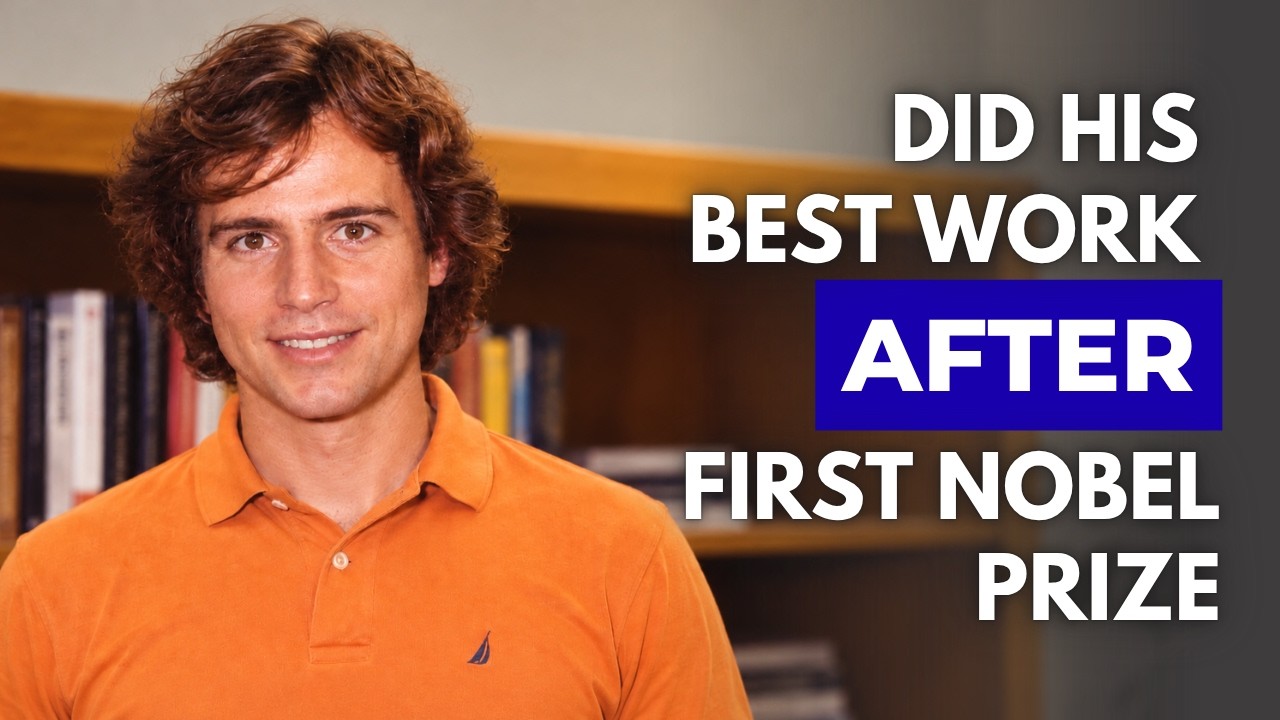
The title accurately encapsulates the content: it focuses on Wilczek's Nobel-winning work and speculates on a possible second Nobel for his later contributions, matching the video's narrative.
Quality & Reliability
8/10
The video provides a detailed and scientifically sound biographical account of Frank Wilczek's contributions to physics, accurately covering asymptotic freedom, axions, anyons, and time crystals. It relies on well-established historical facts and includes interviews but lacks direct citations to primary sources within the video itself.
Chapters
Cited Sources
- Quarks to Cosmos Podcast — Promotional podcast series by the channel, covering physics topics from atoms to the cosmos.
- Realm of Quantum Mechanics Podcast — Promotional podcast series by the channel, focused on quantum mechanics.
- Mavericks of Science Podcast — Promotional podcast series by the channel, featuring contemporary researchers.
- Beyond Proof: Stories in Maths Podcast — Promotional podcast series by the channel, exploring mathematical stories.
External References
- apps.apple.com
- books.apple.com
- open.spotify.com
- open.spotify.com
- open.spotify.com
- open.spotify.com
- open.spotify.com
- open.spotify.com
- open.spotify.com
- open.spotify.com
- open.spotify.com
- open.spotify.com
- open.spotify.com
- play.google.com
- podcasts.apple.com
- podcasts.apple.com
- podcasts.apple.com
- podcasts.apple.com
- podcasts.apple.com
- podcasts.apple.com
- podcasts.apple.com
- podcasts.apple.com
- podcasts.apple.com
- podcasts.apple.com
- podcasts.apple.com
Contribution & Novelties
The video’s contribution lies in synthesizing Frank Wilczek’s life and work into a compelling narrative that highlights the evolution of his ideas from asymptotic freedom to time crystals. It offers a humanized view of a brilliant physicist, making complex physics relatable. The video also effectively connects Wilczek’s theoretical contributions to cutting-edge technologies like quantum computing and dark matter research.
Pour aller plus loin :
- Asymptotic freedom — The concept behind the 2004 Nobel Prize, explaining how the strong force weakens at short distances.
- Axion — A hypothetical elementary particle proposed by Wilczek as a dark matter candidate.
- Time crystal — Wilczek’s proposal of a phase of matter that repeats in time, now experimentally observed.
- Anyon — Quasiparticles in two-dimensional systems with fractional statistics, relevant to topological quantum computing.
128 words
Radar Profile
The radar profile shows high scores across information quality, quantity, and reliability, with a slightly lower technical level, indicating the video is well-balanced for a general audience while maintaining scientific depth. The strong scores suggest a highly informative and trustworthy documentary.
💬 Very positive. Viewers praised the video's storytelling and Wilczek's achievements, with many expressing admiration and few corrective remarks about Nobel precedents.