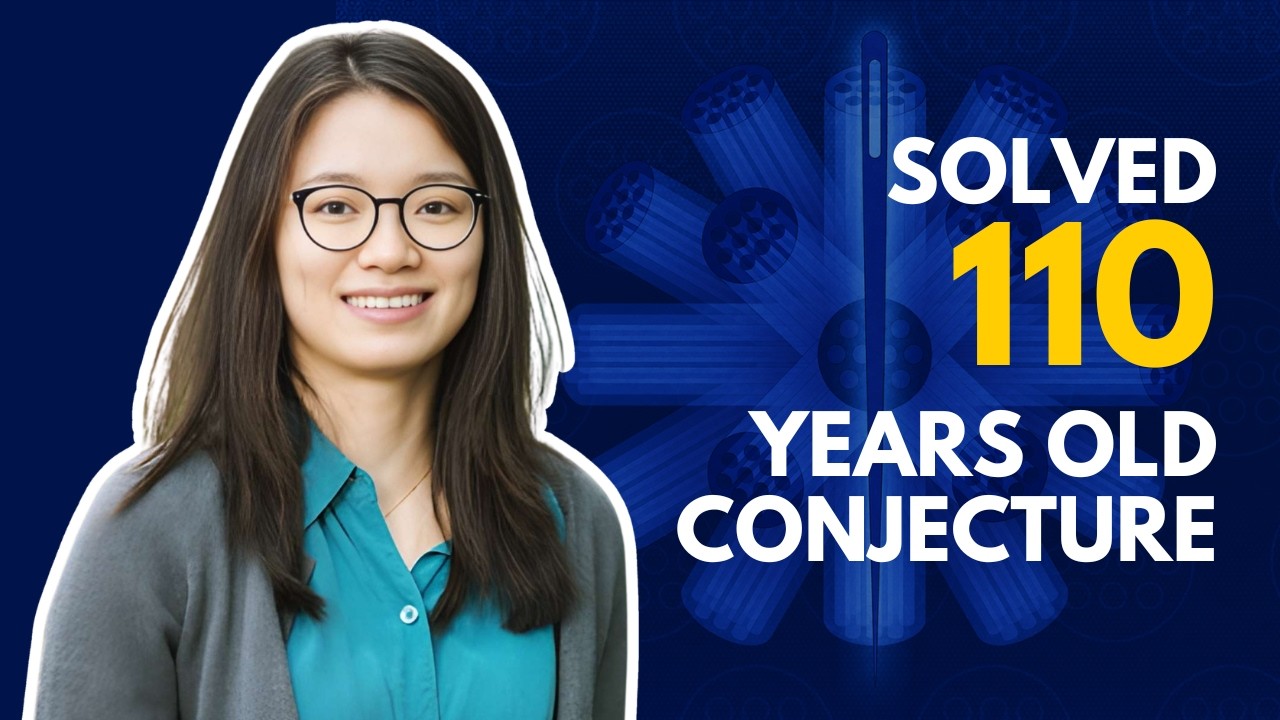
Meet Hong Wang, Winner of Fields Medal 2026, The Nobel of Math
Title history
- Meet Hong Wang, Winner of Fields Medal 2026, The Nobel of Math — observed on 20261101-0122 UTC (YouTube)
Keywords
Summary
168 words
Critical Evaluation
Value of the Information & Strength of the Argument
The video provides substantial value by breaking down a highly technical mathematical achievement into accessible analogies and historical context. It effectively explains why the Kakeya conjecture matters through the ’tower of conjectures’ and its applications to wave equations and Fourier analysis. The argumentation is solid, drawing on credible sources and direct quotes from experts. It also presents a balanced view of the Fields Medal speculation, acknowledging that there is no official shortlist. The storytelling is engaging and logically structured, though it occasionally overstates the immediate implications, such as connecting the proof to consciousness via microtubules in comments (which are not part of the video’s core argument).
Scientific Rigor, Source Quality, Title Accuracy
The video demonstrates scientific rigor by citing the actual arXiv paper, the survey by Larry Guth, and the opinions of established mathematicians. It correctly distinguishes between proven facts and speculation about the Fields Medal. The title accurately captures the content without exaggeration, though it assumes a certainty about the Fields Medal that is not official. The video uses credible sources such as MIT, NYU, and the Institute for Advanced Study, and the presented history aligns with known publications. However, it does not provide direct links to the scientific papers in the description, relying instead on app links. The inclusion of prediction market odds may be seen as less rigorous, but it is clearly presented as speculation.
237 words
Title / Content Match
The title accurately reflects the content: it highlights Wang's achievement and the Fields Medal connection.
Quality & Reliability
8/10
The video accurately describes the Kakeya conjecture and the proof by Hong Wang and Joshua Zahl, with corroborating quotes from mathematicians like Nets Katz and Eyal Lubetzky. However, it includes speculative elements about the 2026 Fields Medal and uses prediction market odds, which are not scientific facts.
Chapters
Cited Sources
- The Turing App – iOS — Description link to the channel's app
- The Turing App – Android — Description link
- The Turing App Website — Description link
- Volume estimates for unions of convex sets, and the Kakeya set conjecture in three dimensions — Paper by Wang and Zahl posted on arXiv in February 2025, mentioned in video
- A survey on the proof by Larry Guth — MIT professor wrote a 21-page survey, as mentioned in video
Contribution & Novelties
The video’s original contribution lies in synthesizing the complex story of the Kakeya conjecture’s solution for a general audience, highlighting the human elements and technical depth. It provides a clear explanation of the ‘bootstrapping’ method and the importance of the result for harmonic analysis. While it doesn’t present new research, it adds value by contextualizing the proof within a ’tower of conjectures’ and offering insight into Wang’s background and working style.
Pour aller plus loin :
- Kakeya set — Background on the problem and its variants.
- Fields Medal — Details on the award and eligibility.
- Harmonic analysis — The field where the conjecture resides.
- Bochner–Riesz conjecture — Related conjecture in the tower.
112 words
Radar Profile
The radar shows high scores in quantity of information, technical level, and quality of information, with a slightly lower but still strong reliability score due to the speculative Fields Medal discussion and lack of direct paper links.
💬 Très positif - Les 30 commentaires expriment une admiration et un respect profonds pour le travail de Wang, avec de nombreux messages de félicitations et d'inspiration, sans critique substantielle.