Aram Ebtekar and Danica Sutherland: Understanding Generalization Requires Universal Induction
Keywords
Summary
195 words
Critical Evaluation
Value of the Information & Strength of the Argument
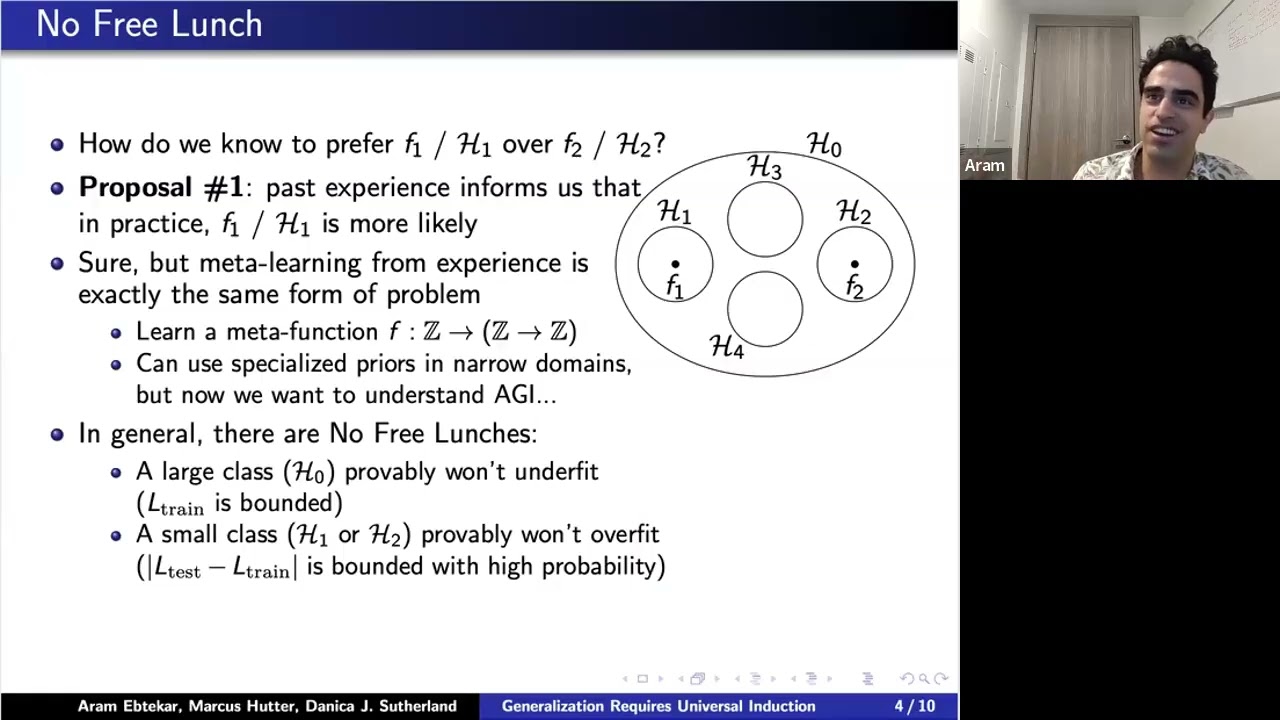
The value of the presentation lies in its rigorous conceptual analysis of a deep theoretical issue. The argumentation is solid and follows a logical progression: starting from the failure of classical learnability theory, through the No Free Lunch theorem and its extension to meta-learning, to the necessity of algorithmic information theory. The presenters effectively illustrate the problem with a concrete example involving function classes, making abstract ideas tangible. They also address potential objections, such as the arbitrary choice of programming language in Solomonoff induction, by proposing a relativization based on available information. The argument that any model must encode an inductive bias and that this bias cannot be learned from data is presented clearly, and the connection to Hume’s problem of induction gives philosophical depth. The discussion is technically dense but well-structured, and the speakers anticipate and answer audience questions, adding to the overall credibility.
Scientific Rigor, Source Quality, Title Accuracy
The talk is rigorous in its use of established concepts: it references Kolmogorov complexity, Solomonoff induction, and No Free Lunch theorems, all of which are well-founded in the literature. The main source cited is the accompanying paper (link in description), which appears to be a preprint or research paper. The title closely matches the content: the speakers explicitly discuss the need for universal induction (Solomonoff) to understand generalization. The presentation is not a news story or a simple overview; it is a technical seminar. The quality of sources is high, though the talk itself is an oral presentation and some details are simplified for a live audience. There is no obvious discrepancy between the title and the actual content.
279 words
Title / Content Match
The title accurately reflects the content: the talk argues that understanding generalization requires formalizing inductive bias via universal induction, specifically Solomonoff induction.
Quality & Reliability
8/10
The talk presents a well-argued theoretical perspective grounded in algorithmic information theory, referencing established concepts like Solomonoff induction and No Free Lunch theorems. The presenters are researchers with expertise, and the content is coherent, though it is a seminar presentation rather than a peer-reviewed publication.
Key Moments
Markers derived by PSI from the transcript: the creator did not define chapters.
- Introduction to the problem of induction and generalization in machine learning.
- Example with target function and hypothesis classes, illustrating the difficulty of choosing the right class.
- Discussion of No Free Lunch theorems and the symmetric trade-off between training error and generalization error.
- Meta-learning and the regression to higher levels of induction; application of NFL to meta-learning.
- Introduction to Solomonoff induction, its Bayesian formulation, and the prior over programs.
- Role of algorithmic information theory and the importance of program length.
- Relativizing Solomonoff induction to an information vantage point, based on the available information.
- Discussion of practical implications and the notion that AI systems approximate this optimum.
- Q&A session: audience questions on generalization components and practical aspects.
- Summary and concluding remarks on the theoretical foundations.
Cited Sources
- Understanding Generalization Requires Universal Induction (paper) — This is the paper accompanying the talk, referenced in the video description. It formalizes the arguments about No Free Lunch and Solomonoff induction.
Concurring Sources
- Understanding Generalization Requires Universal Induction (paper) — The paper is the primary source that supports the talk's claims, providing formal proofs and details.
Dissenting Sources
- No discordant sources identified — The talk did not mention any sources that directly contradict its claims. It builds upon and extends existing literature.
Contribution & Novelties
The talk offers a novel synthesis of existing ideas: it connects No Free Lunch theorems with Solomonoff induction and relativizes the latter to an information vantage point. The contribution is a reframing of inductive bias as ‘accessibility’ rather than absolute simplicity, and the argument that no algorithm can outpredict the relativized Solomonoff induction unless it contains additional information. This provides a theoretical upper bound on generalization for general-purpose AI systems.
Pour aller plus loin :
- Solomonoff’s theory of inductive inference — Overview of the foundational framework that the talk builds upon.
- No Free Lunch theorem — The theorem that constrains any learner’s performance across all problems, central to the talk’s argument.
- Algorithmic information theory — The field that encompasses Kolmogorov complexity and Solomonoff induction, essential for understanding the proposed approach.
130 words
Radar Profile
The radar profile shows very high scores in quality and technical level, indicating a deeply technical and rigorous presentation. The quantity of information is also high, but the reliability is slightly lower due to the lack of peer-reviewed publication at the time of the talk. The overall balance suggests a highly informative seminar for a specialized audience.