Soutenance de Thèse - Pauline Teysseyre
Keywords
Summary
128 words
Critical Evaluation
Value of the Information & Strength of the Argument
The primary value lies in the systematic modeling of the D region, offering a compromise between simplified and computationally expensive chemical models. The argumentation is well-structured, progressing from background to model development, validation, and application. The presenter clearly explains the physics, uses compared to existing models to support credibility, and provides concrete examples of detection performance. The reasoning is coherent, with data-driven results and acknowledged limitations, making the case compelling.
Scientific Rigor, Source Quality, Title Accuracy
The scientific rigor is demonstrated through the use of established models (e.g., MSIS, GOES data) and a systematic comparison with prior work (e.g., Virgo, Lion8). However, the transcript does not provide explicit citations or links, so the verifiability of sources is limited to those mentioned verbally. The title is adequate but under-informative, as it does not hint at the specific research topic. The presentation is well-organized and follows a logical development, though some technical details are not fully expounded, such as the validation of the HF absorption module.
173 words
Title / Content Match
The title is generic, indicating a thesis defense but not the specific subject. It is adequate but not informative about the content.
Quality & Reliability
8/10
The presentation is based on original PhD research, with detailed methodology and comparisons to existing models. However, some parts were not fully validated (e.g., HF absorption implementation) and external references are not provided in the transcript.
Key Moments
Markers derived by PSI from the transcript: the creator did not define chapters.
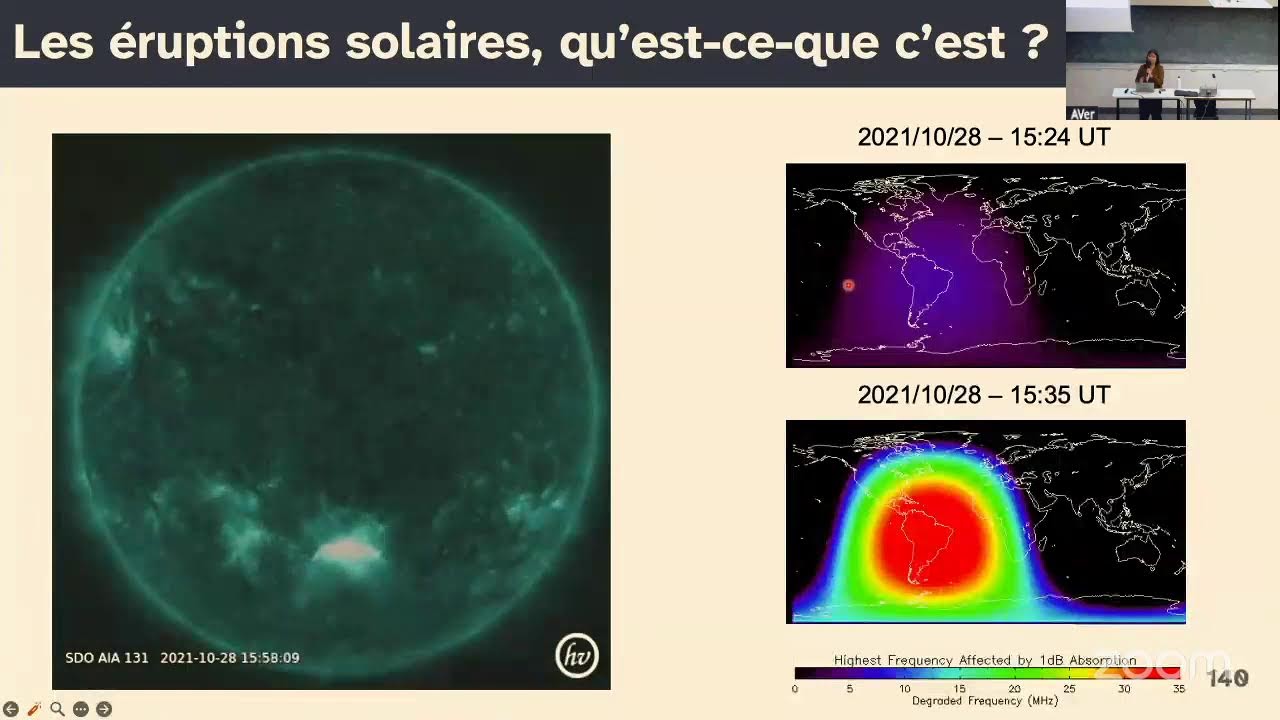
- Introduction to space weather and solar flares, explaining the scope of the PhD.
- Description of the ionosphere and D region, with focus on its ionization sources and chemistry.
- Presentation of the Lam model, including initialization, ionization calculations, and chemistry scheme.
- Results on delta t and recovery times, showing altitude dependence and the role of hard X-rays.
- VLF monitoring technique, explaining how to retrieve electron density from VLF phase and amplitude data.
- Real-time detection algorithm performance, with validation on one year of data and detection statistics.
Cited Sources
- GOES satellite soft and hard X-ray flux data — Used as reference for solar flare classification and input to the model.
- MSIS atmospheric model — Provides neutral atmosphere background for the ionospheric model.
- Virgo model — A data-based model compared to Lam for validation.
- Lion8 model — A recently published model used for comparison.
- Wait model — Simplified exponential electron density profile used in VLF inversion.
- Long Wave Propagation Model (LWPM) — Used to simulate VLF propagation and generate lookup tables.
- Kalman incremental algorithm — Referenced for real-time breakpoint detection in VLF signals.
Contribution & Novelties
The original contribution is the development of a comprehensive D-region model (Lam) that bridges the gap between simplified and full chemistry models, and the integration of VLF monitoring with real-time flare detection, achieving early warning of solar events. The work quantifies the influence of solar zenith angle and nitric oxide on the D region response, providing quantitative metrics for HF absorption prediction.
Pour aller plus loin :
- Ionosphere — Justification: Provides background on the Earth’s ionized atmospheric layers, essential for understanding the D region context.
- Solar flare — Justification: Explains the physical phenomenon driving the perturbations studied in the video.
- Very low frequency — Justification: The VLF propagation technique used for D region monitoring is based on this frequency band.
120 words
Radar Profile
The profile is high across all dimensions, with particularly strong technical level and information quantity, indicating a dense and expert-level presentation. The reliability is slightly lower, possibly due to lack of external citations, but overall the content is well-supported.