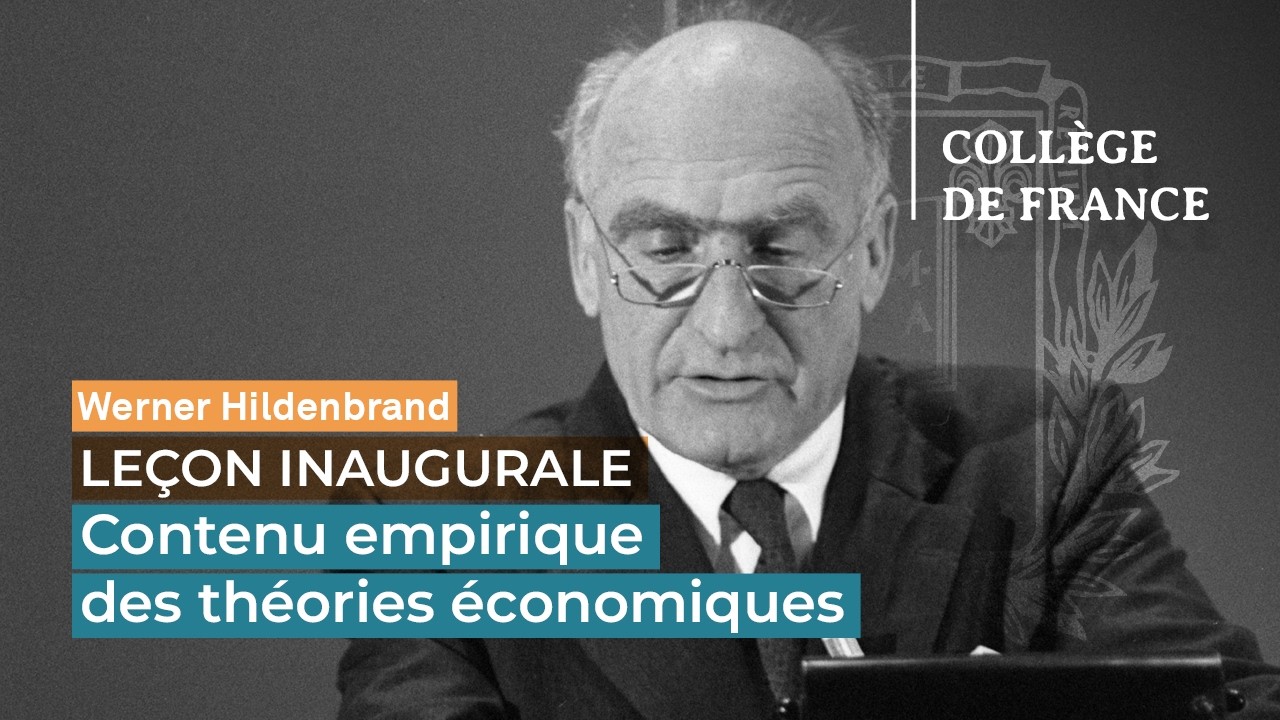
Contenu empirique des théories économiques - Werner Hildenbrand (1993)
Empirical content of economic theories - Werner Hildenbrand (1993)
Keywords
Summary
184 words
Critical Evaluation
Value of the Information & Strength of the Argument
VALUE: The lecture provides a rigorous critical analysis of the foundations of economic theory. It clearly articulates the problems of non-falsifiability and non-specificity in traditional models. The proposal to exploit heterogeneity as a source of deductive power is original and well-motivated. The use of empirical data from household surveys to support the theoretical argument strengthens the value of the information. ARGUMENTATION: Hildenbrand constructs his argument by first establishing the general crisis of confidence in economic theory, then narrowing down to the law of demand. He critically examines existing justifications (introspection, utility maximization) and demonstrates their inadequacy. He then introduces a novel approach based on heterogeneity, supported by illustrative empirical evidence. The reasoning is clear, logical, and persuasive, though it remains at a high level of abstraction.
Scientific Rigor, Source Quality, Title Accuracy
RIGOR: The lecture is methodical, referencing classical works (Robbins, Malinvaud, Koopmans) and engaging with methodological debates. Hildenbrand’s own research program is grounded in a solid understanding of economic theory and empirical data. He does not overclaim, noting limitations and open questions. SOURCES: He cites well-known economists and their works, and refers to institutional data (INSEE, budget surveys). However, the lecture does not provide a systematic review of literature, and the empirical illustrations are suggestive rather than formal tests. ADEQUATION: The title fits the content perfectly, as the lecture is exactly about the empirical basis of economic theory. No comments were provided.
242 words
Title / Content Match
The title accurately reflects the content: the lecture critically discusses the empirical basis (or lack thereof) of economic theories, particularly the law of demand, and proposes an alternative approach based on observed heterogeneity.
Quality & Reliability
8/10
The lecture is a scholarly presentation by a distinguished economist, focusing on the empirical foundations of economic theory. It critically examines the traditional assumptions and advocates for a more data-driven approach. While the content is persuasive and well-structured, it represents one expert's viewpoint rather than a systematic literature review, and the sources cited are primarily classical works and the author's own research.
Key Moments
Markers derived by PSI from the transcript: the creator did not define chapters.
- Lecture introduction and administrative welcome
- Discussion of economists' dilemma: to answer or abstain
- Critique of axiomatic foundations and lack of empirical content
- Presentation of the law of demand and its two interpretations
- Negative results on aggregation from individual maximization
- Proposal to exploit heterogeneity to obtain the law of demand
- Empirical illustration using French household budget surveys
- Conclusion on the need for dialogue between modelling and data
Cited Sources
- Werner Hildenbrand - Chaire Européenne (Collège de France) — Official page of the professor's chair, containing details about his teaching and research.
- Collège de France — General institutional site with course videos and resources.
External References
Contribution & Novelties
The lecture offers a critical perspective on the empirical content of economic theories, challenging the reliance on introspection and demonstrating the inadequacy of standard assumptions. Its novelty lies in proposing that heterogeneity across agents can generate properties like the law of demand through aggregation, giving a constructive role to diversity. It also advocates for a closer dialogue between theoretical modelling and empirical data, a still relevant theme.
Pour aller plus loin :
- Law of demand — Classical economic principle discussed in the lecture.
- Aggregation problem — Core issue of deriving macro laws from micro behavior.
- General equilibrium theory — Theoretical framework underlying the discussion of equilibria and uniqueness.
- Werner Hildenbrand (Wikipedia) — Page on the economist, though may not be fully reliable.
122 words
Radar Profile
The radar profile shows high scores (around 8-9) across all dimensions, indicating a lecture that is rich in information, technically advanced, and methodologically rigorous, though it remains within an expert opinion type rather than presenting systematic experimental evidence.