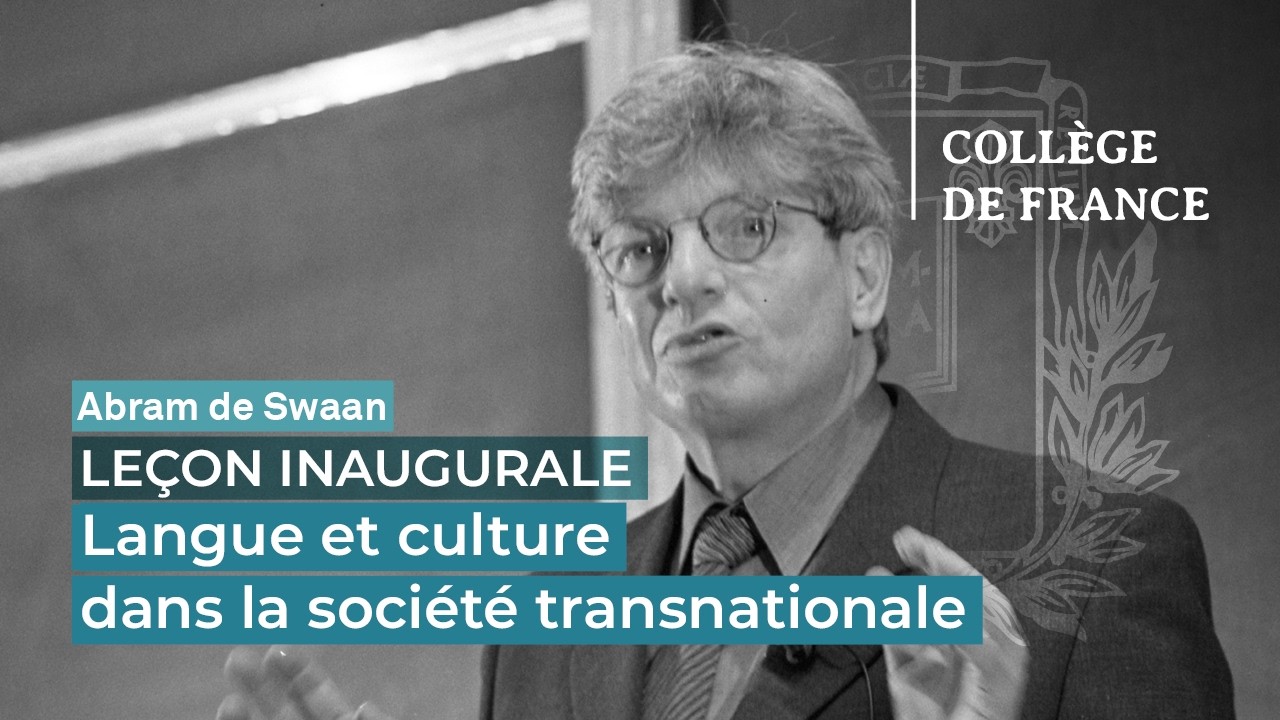
Langue et culture dans la société transnationale - Abram de Swaan (1997)
Language and culture in transnational society - Abram de Swaan (1997)
Keywords
Summary
162 words
Critical Evaluation
Value of the Information & Strength of the Argument
The lecture offers a compelling and original theoretical contribution by systematically linking sociolinguistics with world-systems analysis. De Swaan argues persuasively that linguistic hierarchies mirror economic and political structures but also possess their own dynamic, shaped by accumulated investments and expectations. He uses clear metaphors (peripheral, central, supercentral, hypercentral) and concrete examples (e.g., Frisian, Dutch, French, English) to illustrate the model. The argument is logically consistent and integrates insights from economics, sociology, and linguistics. While some assertions are presented as self-evident, the overall framework is innovative and provides a useful heuristic for understanding linguistic globalization. The lecture does not present original empirical data but synthesizes existing knowledge into a new conceptual lens, which is valuable for further research.
Scientific Rigor, Source Quality, Title Accuracy
The rigor is high, as the lecture is delivered at the Collège de France by a respected sociologist. De Swaan explicitly acknowledges influences (Bourdieu, Deutsch, Wallerstein, McLuhan) and situates his work within existing scholarship. He refers to the pragmatic work of ‘macrosociolinguistics’ and planning, but does not provide specific citations within the talk. The title accurately represents the content, and the lecture stays on topic. The sources cited in the YouTube description (Collège de France links) are institutional and not directly referenced in the talk, but they provide context for the lecture’s origin. Overall, the presentation is methodical and academically solid, with minor limitations due to the lack of specific source references and empirical validation in the oral format.
251 words
Title / Content Match
The title accurately reflects the content: the lecture discusses language and culture within a transnational society framework, focusing on the hierarchical constellation of languages.
Quality & Reliability
9/10
The lecture is delivered by a renowned sociologist Abram de Swaan at the Collège de France, presenting a coherent theoretical framework. The argument is well-structured and draws on established theories (Wallerstein, McLuhan, etc.). However, the content is based on his personal synthesis and does not include empirical verification in this talk.
Key Moments
Markers derived by PSI from the transcript: the creator did not define chapters.
- Introduction and welcome by the College de France administrator, presentation of the chair and speaker.
- De Swaan introduces the concept of the world language constellation with four levels (peripheral, central, supercentral, hypercentral).
- Discussion of the transnational society and the role of language in global connections, referencing Wallerstein's world-systems theory.
- Analysis of historical factors in language spread: demography, conquest, religion, commerce, and mass schooling.
- Conclusion on the autonomous dynamics of the language constellation and the importance of individual expectations and choices.
Cited Sources
- Collège de France - Chaire Européenne (Abram de Swaan) — Official chair page for Abram de Swaan's lecture series at the Collège de France.
- Collège de France main website — Institutional website providing access to recordings and resources of lectures.
- Collège de France on Bluesky — Official Bluesky account of the Collège de France.
- Collège de France on LinkedIn — Official LinkedIn page of the Collège de France.
- Foundation of the Collège de France - Donations — Page for supporting the Collège de France.
- Collège de France on Threads — Official Threads account of the Collège de France.
Concurring Sources
- Collège de France - Chaire Européenne (Abram de Swaan) — The institutional page confirms the lecture series and the context of the inaugural lecture.
Contribution & Novelties
The lecture introduces a comprehensive theoretical model of the world language system, which is a novel integration of sociolinguistics and world-systems theory. De Swaan proposes a hierarchical constellation of languages with clear levels and a pivotal hypercentral language (English), offering a macro-level view that accounts for both global and local linguistic dynamics. He also introduces the concept of ’transnational society’ as a framework for understanding how language interconnects with power, economy, and culture. This contributes to the field by shifting focus from national language policies to a global perspective.
Pour aller plus loin :
- World language on Wikipedia — Relevant to the notion of hypercentral languages and their global role.
- World-systems theory on Wikipedia — De Swaan explicitly uses Wallerstein’s framework; this page provides background.
- Abram de Swaan on Wikipedia — Biography and main publications of the author himself.
- Sociolinguistics on Wikipedia — Broad overview of the field in which this work is situated.
154 words
Radar Profile
The radar profile suggests a very high level of information quality and reliability, with quantitative information balanced by the lecture's concise format. The technical level is moderately high but accessible to an educated audience. Overall, the lecture excels in theoretical innovation and clarity, although it lacks empirical data in this presentation.