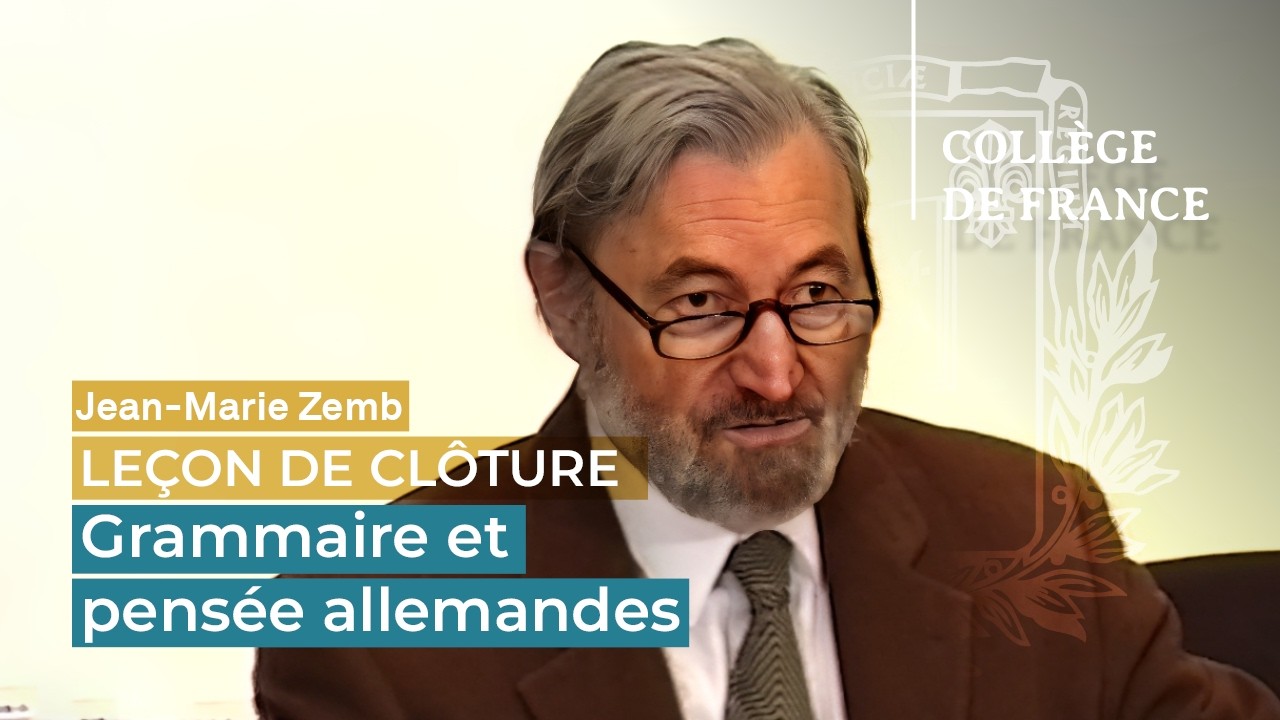
Grammaire et pensée allemandes - Jean-Marie Zemb (1997)
German grammar and thought - Jean-Marie Zemb (1997)
Keywords
Summary
167 words
Critical Evaluation
Value of the Information & Strength of the Argument
The value of this lecture lies in Zemb’s original perspective on German grammar, challenging the Francocentric bias that has dominated linguistic descriptions. He argues convincingly that German syntax is not irrational but simply different, and that the traditional use of the ‘copula’ concept obscures the actual functioning of judgment. His argumentation is supported by references to Plato and classical grammar, as well as practical examples. He also underscores the importance of not imposing one language’s structure onto another. The lecture is rich in insights, although it demands a certain level of familiarity with linguistic concepts.
Scientific Rigor, Source Quality, Title Accuracy
Zemb is a recognized authority in linguistics, and his arguments are grounded in his academic work. He references Plato’s Cratylus and concepts like ‘rhema’ and ‘onoma’ to support his claims. The title accurately captures the lecture’s topic. The sources mentioned are primarily his own work and classical texts, but the lecture is more of an intellectual autobiography than a systematic review of literature. This limits its scientific rigor, but as a professional retrospective, it is solid. The digital recording quality is suboptimal, but the content is clear.
197 words
Title / Content Match
The title accurately reflects the lecture's focus on the relationship between German grammar and thought, as Zemb discusses his life's work on this topic.
Quality & Reliability
8/10
Jean-Marie Zemb, professor at Collège de France, delivers a highly structured and reflective lecture based on decades of research. The content is dense, erudite, and interspersed with personal anecdotes, but remains scientifically grounded. The historical perspective adds value, though some references are dated.
Key Moments
Markers derived by PSI from the transcript: the creator did not define chapters.
- Introduction and reflections on career and age, referencing Plato.
- Discussion of his initial program and the 'copule' (copula) concept.
- Critique of the traditional description of German grammar as irrational.
- Explanation of the 'économie' point and examples with 'weil'.
- Discussion of the German orthography reform and his involvement.
- Conclusion and final remarks, plans for future research.
Cited Sources
- Page de la chaire de Jean-Marie Zemb au Collège de France — Description officielle de la chaire et des enseignements de Jean-Marie Zemb.
- Site du Collège de France — Institution qui a publié la vidéo et fournit les ressources.
External References
Contribution & Novelties
This lecture provides a unique retrospective insight into Zemb’s linguistic theory, particularly his redefinition of the copula and his critique of the separation between language and thought. It offers a historical account of linguistic debates in the late 20th century and a personal perspective on the evolution of grammatical analysis. The content is valuable for those interested in the philosophy of language, German linguistics, and the history of linguistic thought.
Pour aller plus loin :
- Linguistic relativity — Directly related to the idea that language shapes thought.
- Copula (linguistics) — Background on the traditional concept that Zemb critiques.
- German grammar — Context for his arguments about German syntax.
108 words
Radar Profile
The scores are high across all dimensions, indicating a well-balanced and authoritative lecture. The high quality and technical levels reflect the depth of Zemb's expertise, while the quantity of information is slightly lower due to its personal nature.