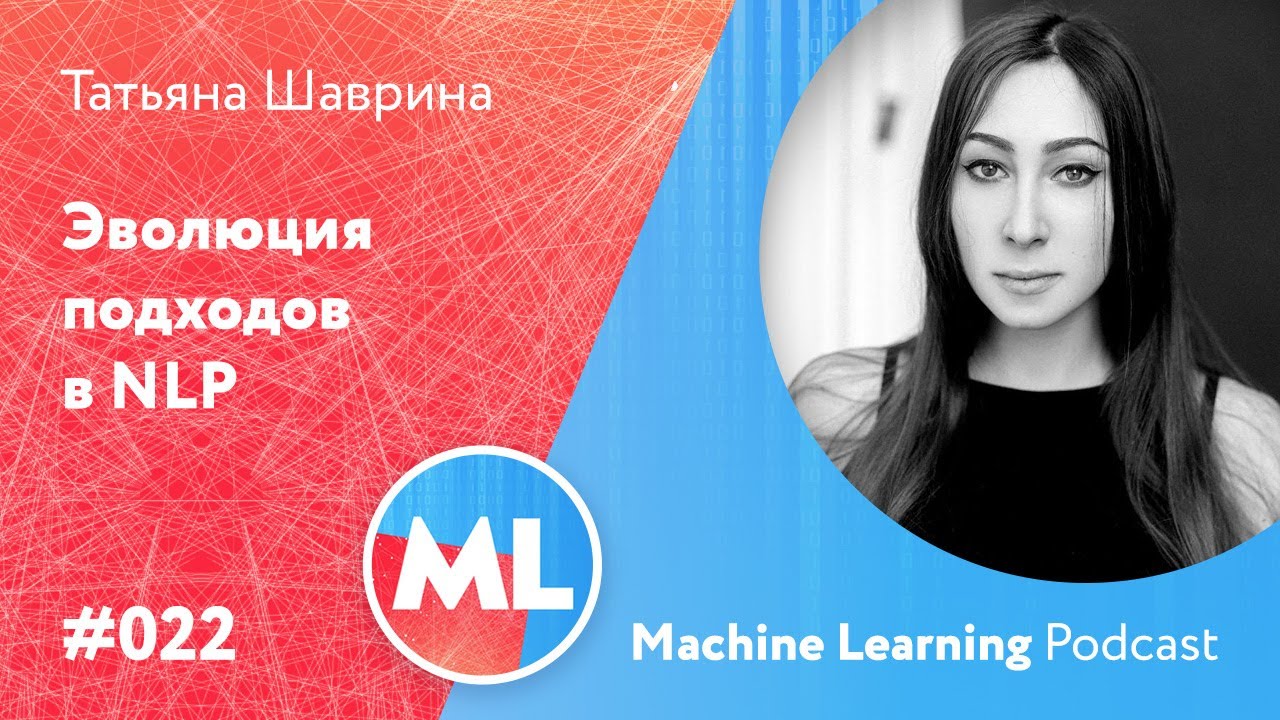
#022 ML Татьяна Шаврина. Эволюция подходов к обработке естественного языка (NLP)
#022 ML Tatyana Shavrina. Evolution of approaches to natural language processing (NLP)
Keywords
Summary
174 words
Critical Evaluation
Value of the Information & Strength of the Argument
The episode provides valuable insights into the evolution of NLP from the perspective of a practitioner with a strong linguistic background. Shavrina articulates technical concepts clearly, explaining the rationale behind each paradigm shift, from sparse co-occurrence matrices to distributed embeddings and transformer-based architectures. She effectively argues that language understanding is key to achieving stronger AI, grounding her argument in linguistic theory. The discussion is well-structured, progressing chronologically and connecting technical milestones to practical applications. The argumentation is solid, relying on historical events and widely known models, though it lacks explicit references to specific papers beyond general mentions. The value lies in the expert synthesis of how statistical and neural approaches have transformed the field, offering both historical context and current state-of-the-art directions.
Scientific Rigor, Source Quality, Title Accuracy
The discussion demonstrates scientific rigor, with Shavrina accurately describing the technical details of word2vec, transformers, and pretrained models. She correctly identifies key limitations and strengths of various approaches. The sources cited in the description (RussianSuperGLUE, MIT course, Cambridge course, and a textbook) are reputable and directly relevant to the topics discussed. The title accurately reflects the content: an examination of how approaches to NLP have evolved over time. The podcast format allows for a conversational yet informative review, with no apparent sensationalism or unsubstantiated claims. The adéquation between title and content is precise, and the episode stays on topic throughout.
237 words
Title / Content Match
The title accurately reflects the content: an in-depth conversation about the evolution of NLP approaches, from early statistical methods to modern transformers.
Quality & Reliability
8/10
The conversation features a recognized expert (team lead at SberDevices, PhD student at HSE) discussing well-documented NLP milestones. Claims align with established history of the field, though no direct citations to papers are given in the audio. The description provides relevant resources (RussianSuperGLUE, courses, book). Overall reliable for a general overview.
Key Moments
Markers derived by PSI from the transcript: the creator did not define chapters.
- Introduction: Tatyana Shavrina's background in linguistics and transition to ML.
- Anecdote about firing linguists to improve translation quality; shift from rule-based to statistical methods.
- Early tasks: spell correction, OCR, and the first Brown Corpus for statistical language modeling.
- Discussion of large corpora construction for various languages, Russian lagging behind.
- Word2vec as the first revolution: compressing sparse vectors into dense vectors; technical details and challenges with Russian morphology.
- Limitations of word2vec (antonyms, context) and the move to recurrent networks and attention.
- Transformer architecture (2017) as the second revolution; attention mechanism and its advantages.
- Pretrained models like BERT and GPT; growth in parameters and current trend of sparse attention.
- Discussion on the role of linguistics in modern NLP and the path towards general AI.
Cited Sources
- RussianSuperGLUE — Mentioned as a methodology for testing models, similar to SuperGLUE for Russian.
- Introduction to Information Retrieval (book) — Recommended as a foundational book on information retrieval.
- MIT Course 6.864 Advanced Natural Language Processing — Reference for an advanced NLP course.
- Cambridge NLP course — Reference for an academic NLP course.
- Podcast episode on Anchor — Link to the podcast episode on Anchor.
- Podcast on Apple Podcasts — Link to the podcast on Apple Podcasts.
- Podcast on Google Podcasts — Link to the podcast on Google Podcasts.
- Podcast on Yandex Music — Link to the podcast on Yandex Music.
- Podcast VK group — Link to the podcast's VK page.
- Telegram channel 'Become a machine learning specialist' — Mentioned as a resource for ML education.
Concurring Sources
- Word2vec (Wikipedia) — General information matches the description of word2vec in the podcast.
- Attention Is All You Need (arXiv) — The transformer architecture described aligns with the paper.
External References
Contribution & Novelties
The episode contributes a coherent narrative of NLP evolution framed by a linguist-turned-ML specialist, highlighting the interplay between linguistic knowledge and computational methods. It offers a clear explanation of why word2vec was revolutionary and how transformers addressed previous limitations, with practical insights into Russian language issues (high morphological complexity, large vocabulary). The discussion on the role of linguistics in modern ML is a distinctive perspective often missing in mainstream tech podcasts.
Pour aller plus loin :
- Word2vec (Wikipedia) — Overview of the model and its training algorithms.
- Attention Is All You Need (arXiv) — Original transformer paper.
- BERT (Wikipedia) — Overview of the BERT model.
- RussianSuperGLUE — Benchmark for Russian language understanding.
112 words
Radar Profile
The profile shows high scores across quantity, quality, and reliability, with a slightly lower technical level due to the conversational format that avoids deep mathematical detail. The balance indicates a well-informed discussion suitable for an intermediate audience.