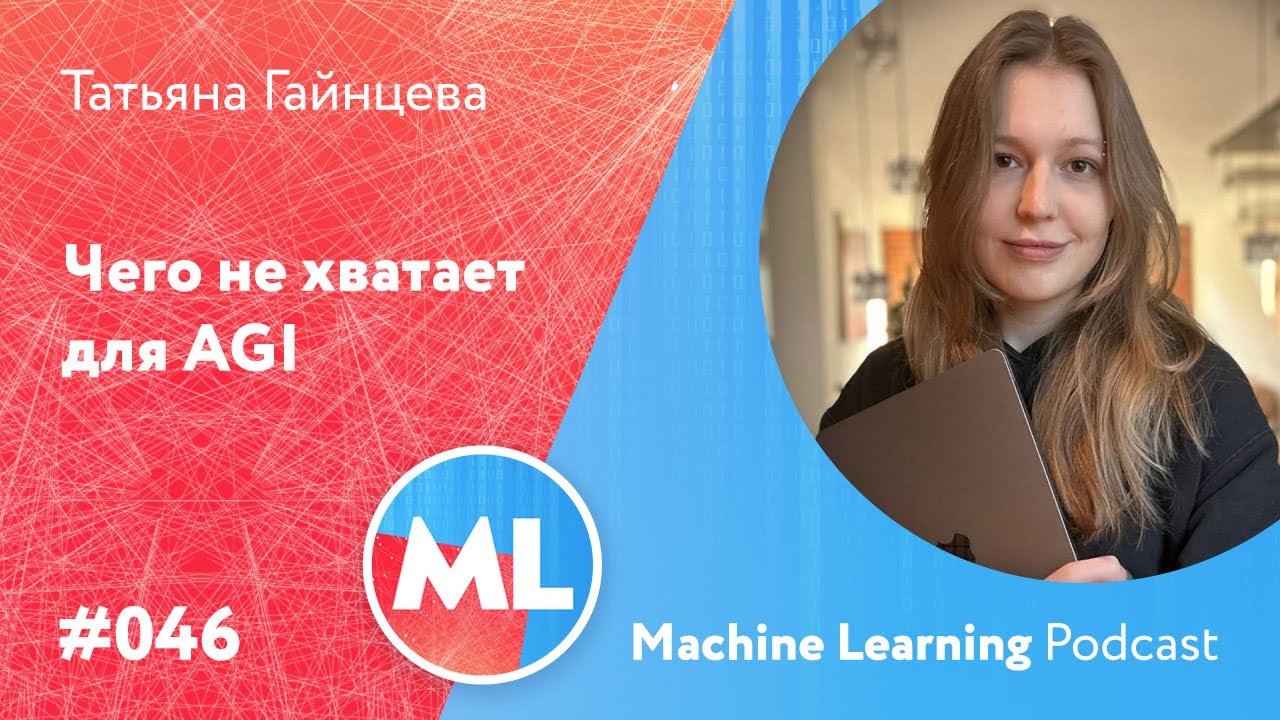
#046 ML Татьяна Гайнцева. Чего не хватает для AGI и как учиться в Физтехе, чтобы доучиться
#046 ML Tatyana Gaintseva. What is missing for AGI and how to study at Phystech in order to finish your studies
Keywords
Summary
178 words
Critical Evaluation
Value of the Information & Strength of the Argument
The primary value of this discussion lies in the personal narrative of a researcher-educator, offering insights into academic and industrial ML career paths. Tatyana’s argumentation is coherent and grounded in her direct experience, though it remains anecdotal rather than systematic. She provides practical advice on surviving rigorous programs like Phystech, but no empirical evidence is presented. Her opinions on AGI are speculative, yet she transparently distinguishes between her own beliefs and known expert positions. The strength of the argumentation is moderate; she justifies her choices logically, but the lack of concrete data or citations limits its scientific weight.
Scientific Rigor, Source Quality, Title Accuracy
The video does not rely on external scientific sources; information is primarily from the guest’s experience. The description includes several links to related resources (CVPR diffusion tutorial, a Habr article, Telegram channels), but these are supplementary and not directly cited during the talk. The title accurately reflects the content, addressing both AGI and Phystech education. The production quality is decent for a podcast, but the lack of structured chapters or clear citations reduces its scientific rigor. No comments were provided for analysis, so public reception could not be assessed.
202 words
Title / Content Match
The title accurately reflects the core topics: the guest's perspective on AGI and her advice on surviving the Phystech curriculum. The content matches both promises.
Quality & Reliability
7/10
The guest is a PhD student with industry experience in ML and teaching at reputable institutions. The discussion is subjective but grounded in personal academic and professional experience. No external validation or rigorous scientific references are provided within the talk.
Key Moments
Markers derived by PSI from the transcript: the creator did not define chapters.
Cited Sources
- CVPR 2022 Tutorial on Diffusion Models — Referenced in the description as a resource for learning diffusion models.
- Tatyana's Habr article on Inductive Bias — Linked in description, likely related to the discussion on inductive biases in AI.
- Telegram channel DLStories — Tatyana's channel where she shares content about neural networks and AI.
- Podcast episode on mave — This episode on the podcast's platform.
- Deep Learning School (DLS) — Telegram channel related to ML education, possibly connected to DLS.
Concurring Sources
- CVPR 2022 Diffusion Tutorial — Provides technical material on diffusion models, aligning with current AI research trends mentioned.
External References
Contribution & Novelties
The episode provides a unique first-hand account of combining research and teaching in ML, offering practical guidance for prospective students. While not introducing new research, it shares personal strategies for navigating academic pressure and for effectively building a career in applied mathematics. The discussion on AGI adds speculative but thoughtful reflections, contextualized with remarks from leading AI figures.
Pour aller plus loin :
- Artificial General Intelligence — Wikipedia overview of AGI concepts, useful for understanding the key discussed topic.
- Deep Learning — Background on the field that the guest specializes in.
- Moscow Institute of Physics and Technology (MIPT) — The university discussed in the context of rigorous education.
- Yann LeCun’s publications — One of the experts mentioned regarding AGI perspectives.
- Jeffrey Hinton’s Wikipedia page — Another AI pioneer referenced in the episode.
132 words
Radar Profile
The radar chart shows a moderate profile with scores around 6-7, indicating a balanced but not highly technical or deeply sourced discussion. The information quantity is decent, but quality and technical depth are average, reflecting the conversational and opinion-based nature of the episode.