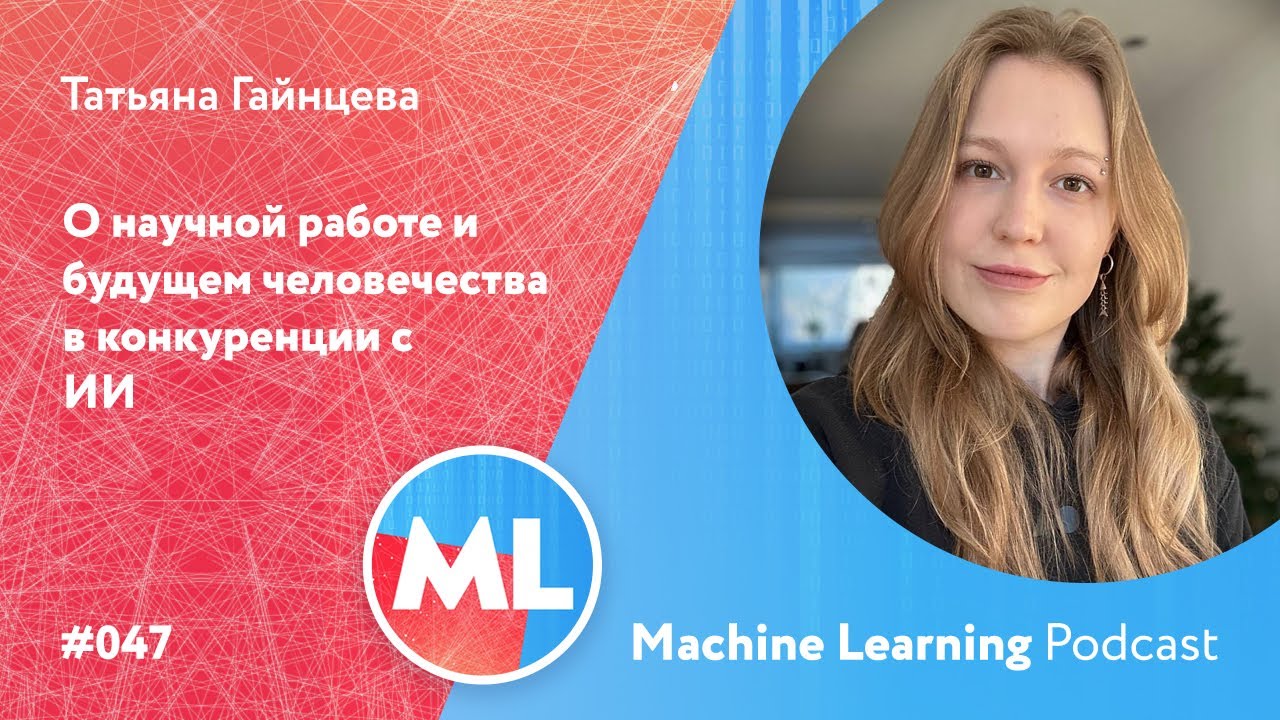
#047 ML Татьяна Гайнцева. О научной работе и будущем человечества в конкуренции с ИИ
#047 ML Tatyana Gayntseva. About scientific work and the future of humanity in competition with AI
Keywords
Summary
145 words
Critical Evaluation
Value of the Information & Strength of the Argument
The value of the information lies in the unique perspective of a PhD student actively navigating the shifting landscape of AI research. Tatyana provides concrete examples of how diffusion models encode semantic knowledge via cross-attention, and she offers a reasoned argument for why generative models might serve as better foundation models than purely discriminative ones. Her argumentation is coherent, drawing on recent developments such as SAM, DINO, and her own research direction. However, some claims are speculative, such as her assertion that generative models understand more about the world than perception models, which lacks strong empirical backing. The discussion is insightful but rooted in personal experience rather than systematic analysis.
Scientific Rigor, Source Quality, Title Accuracy
The episode is a conversational podcast with no formal citations, but the speaker references several key works and models, including Stable Diffusion, Imagen, SAM, and CLIP. The description provides links to her Telegram channel, her own podcast, and other ML resources, but no direct scientific papers are cited. The title is somewhat misleading as it promises a discussion on ’the future of humanity in competition with AI’, which is only briefly touched upon. The content does not adhere to rigorous academic sourcing, but it reflects the current state of the field from an insider’s perspective. The adequacy between title and content is moderate: the core discussion on scientific work is present, but the ‘future of humanity’ angle is largely absent.
245 words
Title / Content Match
The title is slightly broad as it mentions 'the future of humanity in competition with AI', but the main content focuses on the researcher's PhD work and foundation models, with only a brief mention of the broader implications. Overall, the title is somewhat misleading but not severely.
Quality & Reliability
7/10
The video presents an informed expert discussion on AI research, but it is based on personal opinions and experiences rather than peer-reviewed evidence. The speaker is a PhD student in the field, lending credibility, but the content is conversational and may contain subjective views.
Key Moments
Markers derived by PSI from the transcript: the creator did not define chapters.
- Introduction and setup of the second episode with Tatyana Gayntseva.
- Tatyana explains her initial PhD topic on control of semantic information in diffusion models and why she changed it.
- Discussion on cross-attention maps and how they reveal where objects are generated in diffusion models.
- Exploration of foundation models in vision, referencing SAM and DINO, and their potential as general-purpose models.
- Comparison of generative vs. discriminative models as foundation models, with arguments for why generation leads to deeper understanding.
- Discussion on the data collection and training of SAM, including automated annotation pipelines.
Cited Sources
- Machine Learning Podcast website — Main podcast page with all episodes.
- Episode page on Mave — Specific episode page for this recording.
- Tatyana's Telegram channel DLStories — Channel where she shares neural network content.
- Tatyana's podcast 'Deep Learning Stories' on Yandex Music — Her own podcast on Yandex Music.
- Machine Learning Podcast on Apple Podcasts — Apple Podcasts link for the podcast.
- Machine Learning Podcast on Google Podcasts — Google Podcasts feed.
Concurring Sources
- Stable Diffusion and its capabilities — Mentioned as an example of diffusion models with image editing capabilities.
- CLIP model — Referenced as a model that connects text and images, used in SAM's data generation.
External References
Contribution & Novelties
The video offers an insider view on the rapid evolution of diffusion models and the shift toward interpretability. It contributes to the ongoing discourse on whether generative models can serve as foundation models, a topic that gained traction with the release of SAM. The speaker’s personal experience adds a unique perspective, though the ideas are not yet published. The discussion on cross-attention as a tool for understanding diffusion models is particularly insightful.
Pour aller plus loin:
- Diffusion Models — Foundational concept behind many recent generative models.
- Segment Anything Model (SAM) — Meta’s vision foundation model discussed in the video.
- Cross-attention — The mechanism used to visualize how text tokens relate to image regions.
- Foundation Models — A broader concept covering large pre-trained models like GPT-3 and SAM.
127 words
Radar Profile
The radar profile shows high scores in information quantity, quality, and technical level, but slightly lower reliability due to the reliance on personal opinion and lack of formal citations. This indicates a technically rich but informal discussion.